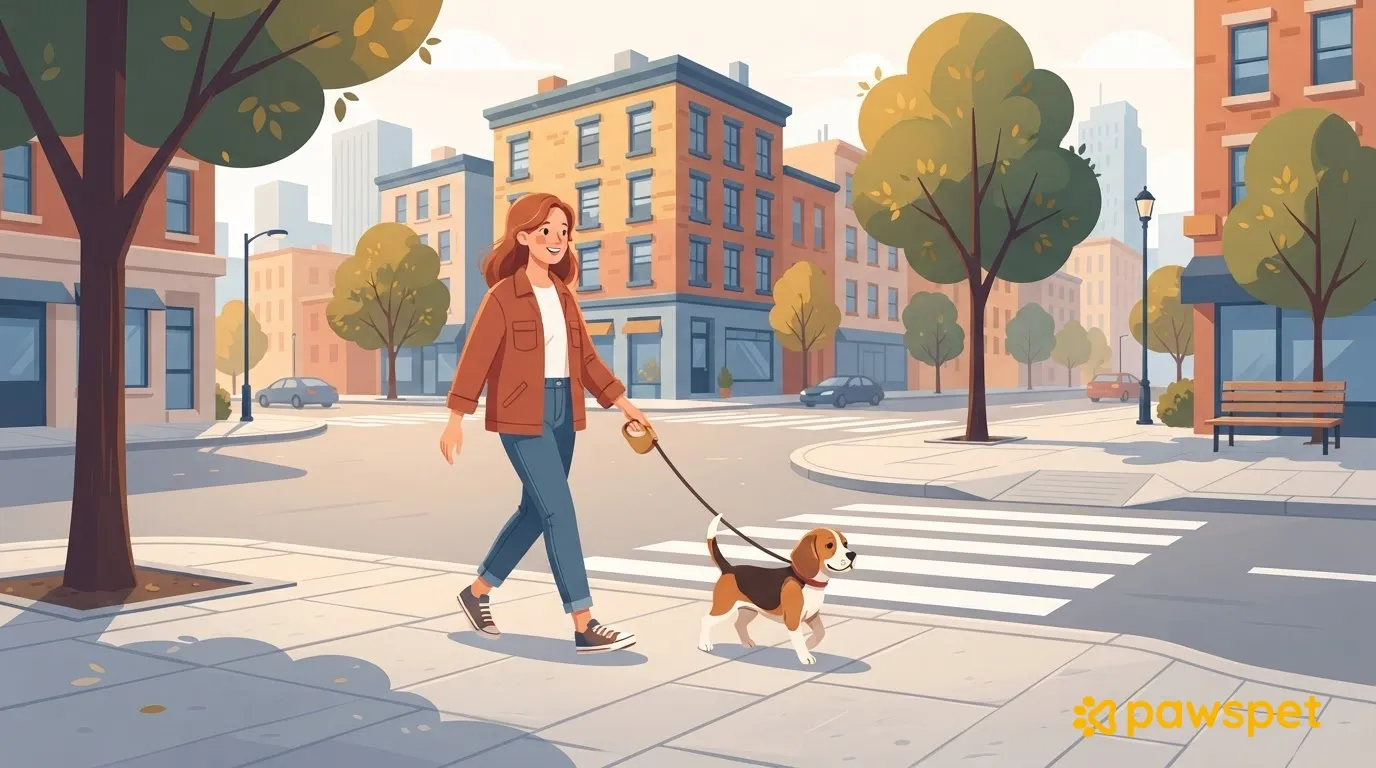
There’s no such thing as a perfect route in a busy neighborhood. It helps to use a simple checklist to assess streets a few minutes from home, at the times you actually go out, and stick with the route where your dog stays most relaxed—not the one you repeat out of habit. Two tools can help: scouting routes without your dog and having a backup route.
Start with the times you actually go out
List the real walks in a typical day: before work, during your lunch break, and in the evening. For each one, distinguish a short potty break from the longer main walk. For example, in the morning, take a short loop with a suitable potty spot away from entrances and shop windows; in the evening, detour to a side street or green space.
The same route can be different at different times of day. Look out for busy periods in your neighborhood: school drop-off and pickup, people coming home from work, trash collection, market days, and weekends. These are examples to check for yourself, not data.
How to assess a street: the checklist
For each possible street, at the time you would use it, check these eight points and note which warning signs appear.
| Criterion | What to look for | A sign that the route may not suit your dog |
|---|---|---|
| Sidewalk | Width; parked cars or trees as a buffer; outdoor seating and obstacles | You have to walk right next to the road or between continuous obstacles |
| Driveways and garages | Vehicles crossing the sidewalk | Cars pull out without warning |
| Crossings | Traffic lights, visible crosswalks, bends with limited visibility | You have to hurry across or can’t see approaching traffic |
| Noise and sudden spikes | Bus stops, construction sites, loading and unloading | Your dog tenses up or refuses to move forward |
| Trash and food on the ground | Bins, takeout places | Overflowing bins or scraps your dog tries to eat |
| Places to stop | Flower beds, trees, wider areas where your dog can sniff without getting in the way | Nowhere to stop without blocking the path |
| Escape routes | Side streets you can use to move away if your dog gets agitated | Long stretches without side streets |
| Surface and lighting | Broken glass, potholes, salt on icy days, lighting on dark winter walks | A surface your dog avoids; too little light to see where you’re walking |
The same street may suit a calm dog but not one that is sensitive to noise: the assessment applies only to your dog.
Scout the route without your dog
Choose two or three possible routes and walk them without your dog, checklist in hand, at the same time you would take the walk. Note problem spots, such as construction, a crowded bus stop, a difficult intersection, or overflowing bins, as well as helpful features: a flower bed, a quiet side street, or a place to take a break. The advantage is that you can see potential hazards without also having to manage the leash: you can stop and take a careful look.
Read your dog, not just the street
Watch how your dog behaves along the route: these signs are clues, not diagnoses.
- Signs of discomfort: tail held low, ears back, freezing, pulling toward home, panting when it isn’t hot, stopping to sniff, darting toward vehicles.
- Signs of ease: sniffing, a relaxed gait, showing curiosity.
Repeated behavior at the same spot or time matters more than a single episode. If your dog’s fear is severe or getting worse, talk to your veterinarian to rule out pain, and to a qualified dog trainer or behavior consultant.
Try two routes and compare them
For a week or two, alternate between route A and route B at the same time of day. After each walk, note where your dog stops, where they sniff happily, and which crossings are difficult. Then choose based on your dog’s behavior, not the distance: the shortest route isn’t necessarily the calmest. The runner-up can become your backup route.
To compare routes without relying only on memory, you can record your walk in the PawsPet app using your phone’s GPS and later see where your pace slows down. In the “Activity” tab, tap the red “Start recording” button, select the pet and the “Walk” type (under “General sports” in “Sports”), and start recording; when you’re done, tap “Finish” and confirm.
When you open the recorded activity, the “Route taken” section shows a map, distance, duration, and speed, with the route color-coded by pace: “Slow,” “Normal,” or “Fast.” Repeated slow sections may indicate stops, but the color doesn’t explain why: your notes can tell a pleasant sniff break from a pause in front of a construction site. The feature records the route taken with your phone and does not track your dog’s location; you need at least one pet in your profile and location permission.
If there’s no quiet route near home
It can happen that every nearby street has a drawback. In that case, the goal is to reduce the difficult parts, not eliminate them:
- For short walks, use the least challenging section and keep the loop compact.
- Take the main walk at the calmest time your schedule allows.
- When you can, go to a quieter area, even if only occasionally.
- If the best times don’t fit your schedule, ask a family member or consider hiring a dog walker.
Your plan: three routes
In the end, you need three routes:
- Short, for quick walks: the shortest loop, with a suitable potty spot.
- Long, for the main walk, at the calmest time.
- Backup, for construction, rain, or market days.
This week, one step is enough: scout two alternatives and fill in the checklist.