Teach your dog to stop at the curb gradually, starting at home and on quiet streets. It’s a safety habit, not a guarantee: your dog can’t assess traffic, so you must always decide when to cross, and a short, fixed-length leash remains your brake. Never train this off leash near the road.
Where a stop is needed and what to ask your dog to do
In a busy neighborhood, the critical points are predictable, and they’re where your dog needs to learn to stop:
- the building entrance, where you move suddenly from indoors to the street;
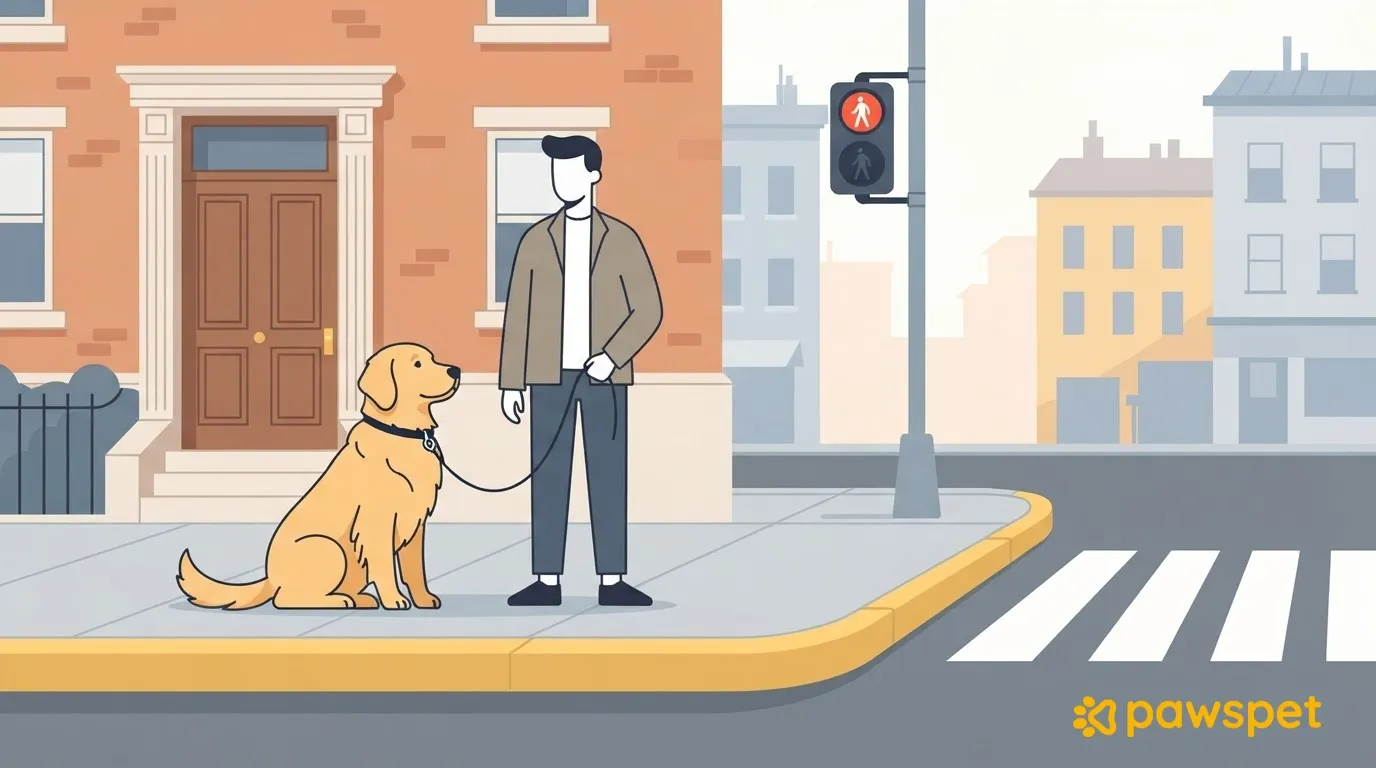
- the curb before the crosswalk;
- driveways and garage exits, where a vehicle may emerge;
- gaps between parked cars, where your dog must not squeeze through.
Ask for just one behavior: stop one step before the curb or the entrance threshold, and stay there until you give the release cue.
Standing still is perfectly fine, especially since sitting on wet, cold or salty asphalt can be unpleasant: stability matters, not position.
Before you start: leash, side and cues
Sort out these details before you get near traffic:
- Use a fixed-length leash near the road. An extendable leash makes it hard to control the distance from the curb: your dog can reach it before you do.
- Keep your dog on the side away from the road, with you between them and the cars.
- Shorten the leash calmly before the curb, without jerking it or wrapping it around your fingers.
- Use two different cues: one to stop, such as “wait,” and one to move on, such as “let’s go.” Don’t use “good dog” as the release cue: it’s praise, not the go-ahead.
- Use small, high-value treats, giving one as soon as your dog stops.
Assumption: your dog already walks beside you without pulling hard. If not, work on that first, away from roads.
The training in five stages
Keep sessions short, with just a few repetitions. There’s no one-size-fits-all schedule: move to the next stage only when the current one is easy for your dog.
At home, in front of a threshold
With your dog on leash, approach a doorway or a line on the floor and stop one step before it. As soon as your dog stops too, reward them and release them with “let’s go.” Add the cue “wait” only once stopping is already reliable, saying it as your dog stops.
The building entrance
Open the entrance door only when your dog is still, and reward them for stopping. If they move before the release cue, close the door and start again. Step outside first, with the leash short, and check both sides of the sidewalk: bikes and scooters may pass right there. Only then release your dog with “let’s go.”
Quiet sidewalks
Choose a side street with little traffic. At every curb, stop one step back, say “wait” and reward your dog when they stop. You check the road: release with “let’s go” and cross only when it’s clear. Practice the stop even when no one is coming: repetition is what makes it a habit.
Longer waits
On a quiet street, simulate a red light: stop one step before the curb and gradually extend the waiting time by a few seconds, rewarding calm behavior. If your dog gets restless, go back to a shorter wait.
Busier streets
Move on to this stage only when the stop is reliable in the previous stages. First observe traffic from a distance where your dog stays calm and reward that calm; then move closer to the curb a little at a time. If your dog struggles, go back one stage.
At traffic lights and crosswalks
Once the stop is reliable, use it this way when crossing:
- Wait one step back from the curb, with your dog on the side opposite any turning vehicles, and say “wait.”
- Check for bikes and scooters even when the light is green: they may not stop.
- Release your dog with “let’s go” only after you’ve checked that it’s safe to cross.
- Cross at a steady pace, without stopping or sniffing on the crosswalk, with the leash short.
At crossings without traffic lights, wait until vehicles have actually stopped, not just slowed down.
Mistakes that make the stop unreliable
- Starting on a busy road: noise and movement make it hard to learn.
- Jerking the leash or scolding: stopping may become an unpleasant experience.
- Changing cues: switching between “wait,” “stay” and “stop” confuses your dog.
- Using “good dog” as the release cue: your dog may set off whenever you praise them.
- Letting your dog decide when to move on: you always give the go-ahead.
- Expecting a stop in the first few minutes of a walk, when your dog is more excited: first let them sniff in a safe area.
- Relying on the cue without a leash: a word isn’t enough to stop a dog that bolts.
When to ask for help
Ask a dog trainer or behavior consultant for help if your dog lunges at cars, buses or scooters, panics at noises, freezes or tries to run away, or if you can’t hold them safely—for example, because they’re very strong or because you have limited mobility. A professional can observe the two of you in person and suggest a suitable plan; in the meantime, choose less busy streets.
If the change is sudden—for example, a dog who used to wait calmly now stiffens up or bolts at the curb—see your veterinarian first to rule out pain.
To see which trainers or consultants are available in your area, search in the “Services” tab of the PawsPet app and filter by service type, such as “Training” or “Behavior consultation,” and by search area.
Where to start this week
Choose two cues, one to stop and one to move on, and always use the same ones. Practice at your home threshold and building entrance; once stopping is easy, try it on a quiet street before using it on main roads. Stopping helps, but it doesn’t replace your attention: you decide when to cross, with the short leash in your hand.