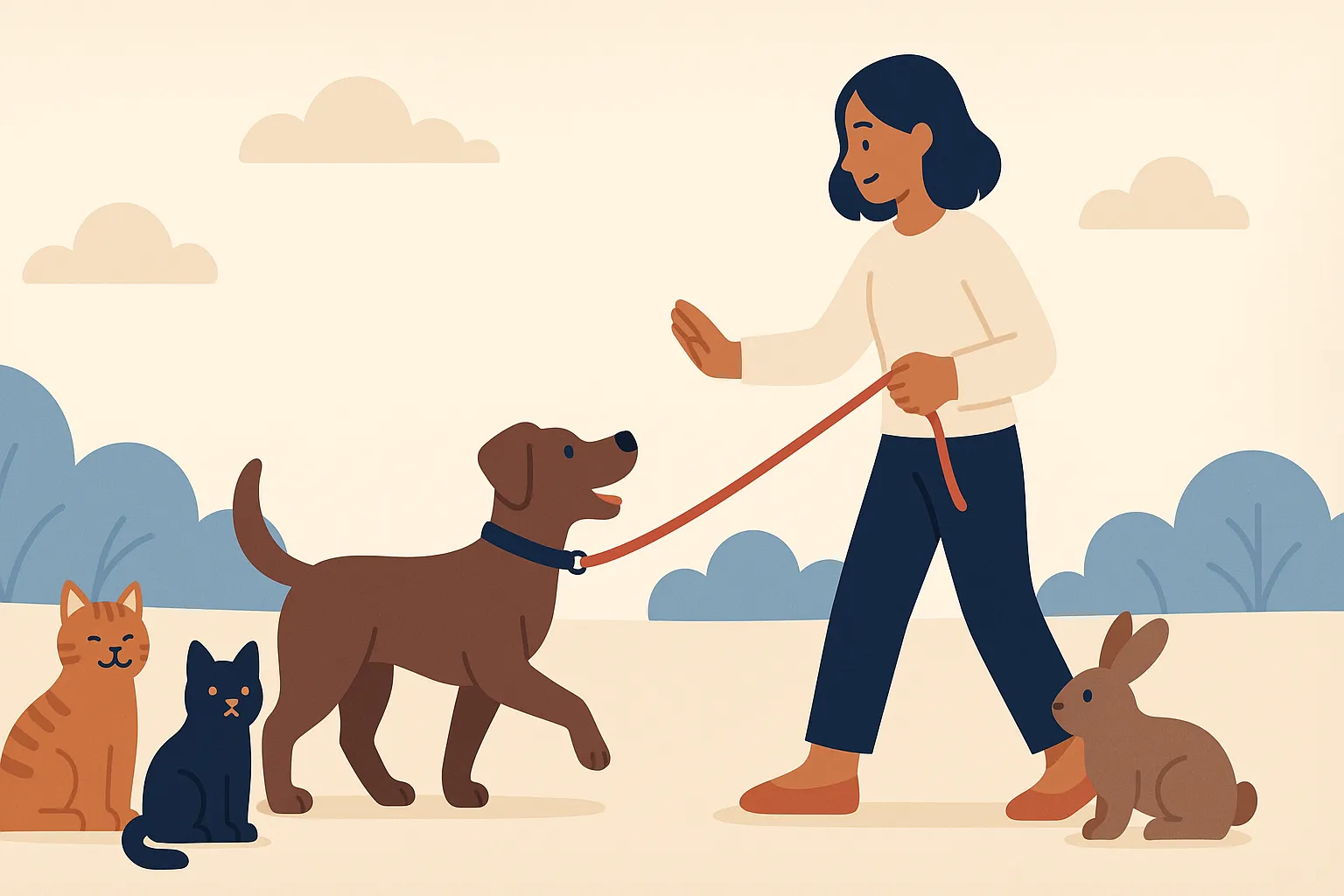
Taking your dog out should be a moment of relaxation and bonding. But if your dog pulls on the leash, every walk can turn into a struggle: a sore arm, frustration, embarrassment when you meet other people or dogs.
If you’re wondering “how do I get my dog used to the leash without pulling?” or looking for practical exercises to teach loose-leash walking, this article is for you.
We’ll cover:
- why dogs pull on the leash;
- how to choose the right gear;
- step-by-step exercises for puppies and adult dogs;
- mistakes to avoid and strategies for difficult situations.
With practical tips and a respectful approach, to make walks with your dog safer and more enjoyable for both of you.
Why does a dog pull on the leash?
Understanding the reason is the first step to solving the problem of the dog that pulls on the leash.
The most common causes
-
Excitement and excess energy
- The dog is happy to go out and wants to explore everything.
- It hasn’t yet learned self-control during walks.
- This is often typical of puppies and young dogs.
-
Lack of specific training
- No one has ever taught it how to walk on a leash.
- It has “learned” that pulling works: it pulls → it moves forward → it gets what it wants.
-
Anxiety, stress, or insecurity
- It wants to get away from something that scares it.
- It tries to reach home or its owner more quickly.
- This may come with other signs (panting, repeated yawning, tail held low).
-
An environment that is too stimulating
- Smells, noises, other dogs, people, bicycles...
- Difficulty focusing on the handler.
-
Physical problems
- Joint or muscle pain can change the way the dog walks.
- A collar or harness that doesn’t fit properly can be uncomfortable or painful.
If you suspect a physical issue or significant discomfort, always consult your vet and, if needed, a dog trainer.
The most common mistakes when a dog pulls
Before seeing how to get your dog used to the leash, it helps to recognize the behaviors that make the situation worse.
What not to do
-
Yanking the leash back hard
- The dog may feel pain and pull even more.
- Risk of neck damage, especially with a fixed collar.
-
Jerking and scolding
- It associates the walk with something negative.
- Stress and confusion increase, and it doesn’t learn what to do.
-
Using choke chains or prong collars without professional guidance
- They can cause pain, injury, and fear.
- The dog stops pulling because of discomfort, not because it has learned.
-
Letting it pull “just sometimes”
- No consistency = a lot of confusion for the dog.
- If pulling occasionally gets it what it wants, it will keep trying.
-
Doing only “technical” walks
- If the whole walk is just “don’t pull, don’t pull,” there’s no room for exploration and sniffing.
- The dog gets frustrated and finds it hard to cooperate.
Gear: how to choose leash, harness, and collar
To get your dog used to the leash without pulling, the right tools help a lot. They don’t “train” for you, but they make the work easier and safer.
Leash: which one should you choose?
To teach good loose-leash walking, avoid:
- retractable leashes;
- leashes that are too short (less than 5 feet / 1.5 m).
Prefer:
-
Length of 6–10 feet / 2–3 meters
- Gives the dog room to sniff without having to pull.
- Lets you guide it without being “stuck” to its shoulder.
-
Fixed leash, not retractable
- Clearer communication through tension.
- Fewer sudden jerks and less risk of hand burns.
-
Soft but durable material
- Nylon, biothane, or good-quality leather.
- Comfortable handle, especially if your dog is strong.
Harness or collar?
In general, for most dogs:
-
H-style or Y-style harness (properly fitted)
- Distributes pressure across the chest and shoulders.
- Reduces the risk of damage to the neck and trachea.
- Comfortable for most everyday activities.
-
Fixed collar (simple, not choke)
- Only if the dog has no breathing or neck issues.
- Useful as support for identification (tag), not as the only point of tension for dogs that pull a lot.
“Anti-pull” devices (front-clip harnesses, etc.):
- Can be useful when used together with a leash training program.
- They do not replace exercises and should not be used to “force” the dog.
Before you start: the ideal conditions for good work
For dog walking exercises to work, set the right conditions.
1. Appropriate energy level
A dog that is overloaded will find it much harder not to pull.
- Do a short play session or mental enrichment activity (sniffing games, search games) before working on leash walking.
- Avoid starting exercises when the dog is already out of control from excitement.
2. Low-stimulation environment
At the beginning, it’s better to use:
- a quiet apartment courtyard;
- an empty parking lot;
- a little-used street;
- a park during low-traffic hours.
Once your dog gets better, you can gradually move to more stimulating environments.
3. Treats and motivation
Prepare:
- soft, very tasty treats, very small (pea-sized pieces, little bits of sausage, or dog-specific snacks);
- possibly a favorite toy, for more play-oriented dogs.
The goal is to help your dog understand that staying close to you and not pulling is a choice that pays off.
Basic exercises to get your dog used to the leash without pulling
Let’s start with the fundamental exercises, suitable for puppies and adult dogs.
Exercise 1: “Loose leash”
Goal: the dog learns that only a loose leash lets the walk continue.
Steps:
- Start in a quiet place, with the dog already attached to the leash.
- Begin walking normally.
- As soon as the dog pulls and the leash tightens:
- stop immediately.
- stand still like a “post,” without jerking or shouting.
- Wait until:
- the dog takes a step back,
- or turns to look at you,
- or the leash becomes loose again, even for half a second.
- As soon as the leash loosens:
- praise the dog with a “good” and a treat near your leg,
- resume walking.
What the dog learns:
- If it pulls → everything stops.
- If it keeps the leash loose → the walk continues.
Exercise 2: “Reward the position next to me”
Goal: make staying near your leg attractive for the dog (left or right, whichever you prefer).
Steps:
-
Choose a side (by convention, the left is often used).
-
Hold the treats in the hand on that side.
-
Walk slowly.
-
Every time the dog:
- walks with its shoulder roughly aligned with your leg,
- or looks at you while walking,
give a treat near your leg.
-
If the dog moves ahead and starts to pull:
- stop,
- wait for it to come slightly back,
- start moving again and reward when it is close.
Tip: keep the hand with the food close to your knee, not in front of the dog’s muzzle, so it doesn’t “follow” your hand.
Exercise 3: “Change direction”
Goal: teach your dog to follow your movements and pay attention.
Steps:
- Walk in a straight line.
- As soon as the dog passes you and starts to tighten the leash:
- without jerking, turn 180° and walk in the opposite direction.
- When the dog reaches you again:
- reward it near your leg.
- Repeat several times, calmly and consistently.
What the dog learns:
- If it “decides” the direction and pulls, it ends up on the other side.
- If it stays attentive and follows you, it can keep going and gets rewarded.
Training plan: how to structure the sessions
To really teach leash manners, you need a bit of organization.
Session length
- 5–10 minutes of focused exercises are more effective than 40 minutes of frustration.
- Better 2–3 mini-sessions a day than one very long one.
Example daily routine
Days 1–3 (quiet environment):
- 5 min: “loose leash” (stop when it pulls).
- 5 min: “reward close to me.”
Days 4–7 (still a quiet environment, but with a bit more stimulation):
- 5 min: “change direction” + “loose leash.”
- 5 min: relaxed walk with rewards for staying near you (without asking for perfect position).
From the second week onward:
- Introduce slightly more stimulating areas (near a park, a less noisy street).
- Always keep in pauses and opportunities to sniff.
Puppy or adult dog: what changes?
How to get a puppy used to the leash
A puppy often:
- has no experience with a collar or harness yet;
- may sit down, dig in, or “chew” the leash;
- gets distracted extremely easily.
Practical tips:
- Start indoors or in the yard:
- put on the harness,
- clip on the leash and let it drag under supervision (with no risk of getting tangled),
- reward the puppy when it moves with you on a loose leash.
- Keep sessions very short (2–3 minutes).
- Play a little between mini-sessions to keep the experience positive.
Teaching leash manners to an adult dog
An adult dog may have:
- established habits (it has always pulled);
- negative associations with the leash/walks;
- greater physical strength, which makes handling harder.
Practical tips:
- Don’t expect results in two days: give the dog time to understand the new rules.
- Check with your vet if there are signs of pain or stiffness.
- Consider help from a dog trainer if:
- the dog is very strong;
- it becomes unmanageable around other dogs or people;
- it pulls so hard that your safety is at risk.
How to manage the real walk (not just the exercises)
Exercises help, but the full dog walk should also be a time for well-being, exploration, and relaxation.
Include “freedom zones” during the walk
Alternate between:
-
Work moments:
- you walk at a steady pace;
- you explicitly ask for “close” (or another cue you prefer);
- you reward often when it respects the loose-leash criterion.
-
Exploration moments:
- you say a “freedom” word (e.g. “go”);
- you let the dog sniff and choose the direction, as long as the leash stays loose;
- you don’t ask for precise position by your leg.
This balance reduces frustration and makes it easier for the dog to focus when it’s time to work.
What to do if your dog starts pulling during the walk
-
Use the “loose leash” rule:
- stop,
- wait for it to calm down and loosen the leash,
- start again only when it stops pulling.
-
If the situation is too stimulating (e.g. school dismissal with lots of kids):
- move a few meters away;
- work at a distance where your dog can still think clearly (look at you, take treats);
- gradually get closer on later outings.
Managing difficult cases: other dogs, bikes, people, city life
Many dogs pull especially:
- toward other dogs to play or out of fear;
- toward bicycles or scooters;
- in chaotic urban settings.
Meeting other dogs
- Keep the leash loose and not constantly under tension.
- If your dog speeds up and pulls:
- stop before it reaches full tension;
- ask for a look at you (reward it if it looks at you);
- decide whether it’s better to approach or to make a wide arc and pass by.
- Avoid “dragging” dogs face to face: curved approaches with room to move away are better.
Bikes, scooters, runners
- Work at a distance:
- choose a park with a bike path or a low-traffic street.
- stop at a safe distance, reward your dog when it:
- notices the movement,
- but keeps the leash loose and its attention on you.
- Gradually reduce the distance over the weeks.
If your dog shows intense reactivity (barking, lunging, trying to chase), consult a professional.
Daily management mistakes that sabotage training
Even the best dog leash training plan can fail if:
-
One person in the house follows the rules and another doesn’t.
- Everyone in the family must:
- use the same cues;
- stop when the dog pulls;
- reward when the leash is loose.
- Everyone in the family must:
-
Rushed outings ignore the rules.
- If in the morning, because you’re short on time, you let the dog pull all the way to the dog park, you confirm that “pulling works.”
- Better to leave two minutes earlier and stay consistent.
-
The dog only goes out to “do its business” under stress.
- Same routine every time, tight schedules, no sniffing.
- This increases walk-related anxiety and the urge to rush to “finish quickly.”
How technology can help you manage walks
Digital tools like the PawsPet app can make it easier to organize leash training within your daily routine.
Practical examples:
-
Calendar and reminders
- Schedule short daily leash exercises.
- Get reminders so you don’t “skip” days during busier periods.
-
Walk journal
- Record duration, route, and notes (how much it pulled, in which situations).
- Over time, you’ll have a useful history to share with your dog trainer.
-
Health records
- Keep track of vet visits and any treatments for joint or respiratory issues that could affect walks.
- Having all health info at hand is useful if you notice sudden changes in the way your dog walks or pulls.
Combining technology with good daily habits helps you monitor your dog’s progress and adjust training more consciously.
Action checklist: what to do starting tomorrow
Before going out:
- I chose a fixed, non-retractable leash of at least 6 feet / 2 meters.
- I have a properly fitted harness or collar.
- I have tasty, easy-to-handle treats with me.
- I have 5–10 minutes set aside for specific exercises.
During the walk:
- I stop every time the dog puts tension on the leash.
- I start moving again only when the leash becomes loose.
- I reward my dog when it naturally walks near me.
- I include “go” moments so it can explore.
Over the course of the week:
- I’ll vary the routes a little, while still staying in manageable environments.
- I’ll mentally note (or log in the app) the most difficult situations so I can work on them more specifically.
- I’ll consider bringing in a trainer if I don’t see improvement after a few weeks.
Conclusions: calmer walks are possible
A dog that pulls on the leash is not “stubborn” or “bad”: in most cases, it has never really learned a different way to walk, or it is too excited or insecure to cooperate.
In short, the key points are:
- Choose the right gear (fixed leash, comfortable harness).
- Start in quiet environments, with short but consistent sessions.
- Use simple exercises: loose leash, reward near you, direction changes.
- Alternate work moments with freedom and sniffing breaks.
- Keep everyone in the family consistent.
- Ask a dog trainer for support if the problem is severe or linked to fear-aggression.
With patience and a methodical approach, walks can truly become a pleasure, not a tug-of-war.
If you want to better organize your dog’s routine, track progress, and always keep health and activity under control, you can try the PawsPet app: it helps you structure outings, training reminders, and keep a practical diary of your four-legged companion’s daily life.
FAQ: dog that pulls on the leash
1. How long does it take to teach a dog not to pull on the leash?
It depends on:
- the dog’s age;
- previous habits (how long it has been pulling);
- training consistency.
With daily exercises, many dogs show improvement within 1–2 weeks, but stable behavior may take several weeks or a few months. The key is consistency: always stop when it pulls and reward correct behavior often.
2. Is a harness or collar better for a dog that pulls?
For most dogs that pull, a properly fitted H-style or Y-style harness is safer and more comfortable than a collar, because it spreads pressure over a larger area and reduces the risk of trauma to the neck and trachea. A simple collar can still be used for the ID tag. If in doubt, ask your vet or a trainer for advice.
3. What should I do if my dog only pulls when it sees other dogs?
In this case, the issue is not just the leash but the emotion linked to other dogs (excitement, frustration, or fear). Work at a distance: watch other dogs from far away, at a distance where your dog can still eat treats and hear your cues. Reward it when it looks at you and keeps the leash loose. Gradually reduce the distance over time. If it reacts very intensely (lunges, barks furiously), professional help from an experienced trainer or behavior specialist is recommended.
4. Can I use a retractable leash (flexi) to teach my dog not to pull?
A retractable leash is not ideal for teaching leash manners, because it works by giving in to tension: the dog learns that by putting pressure on it, the leash extends. That goes against the idea of a “loose leash.” It’s better to use a fixed 6–10 foot / 2–3 meter leash for training; if you later want to use a flexi in specific situations, do so only once your dog already understands the basic walking rules.