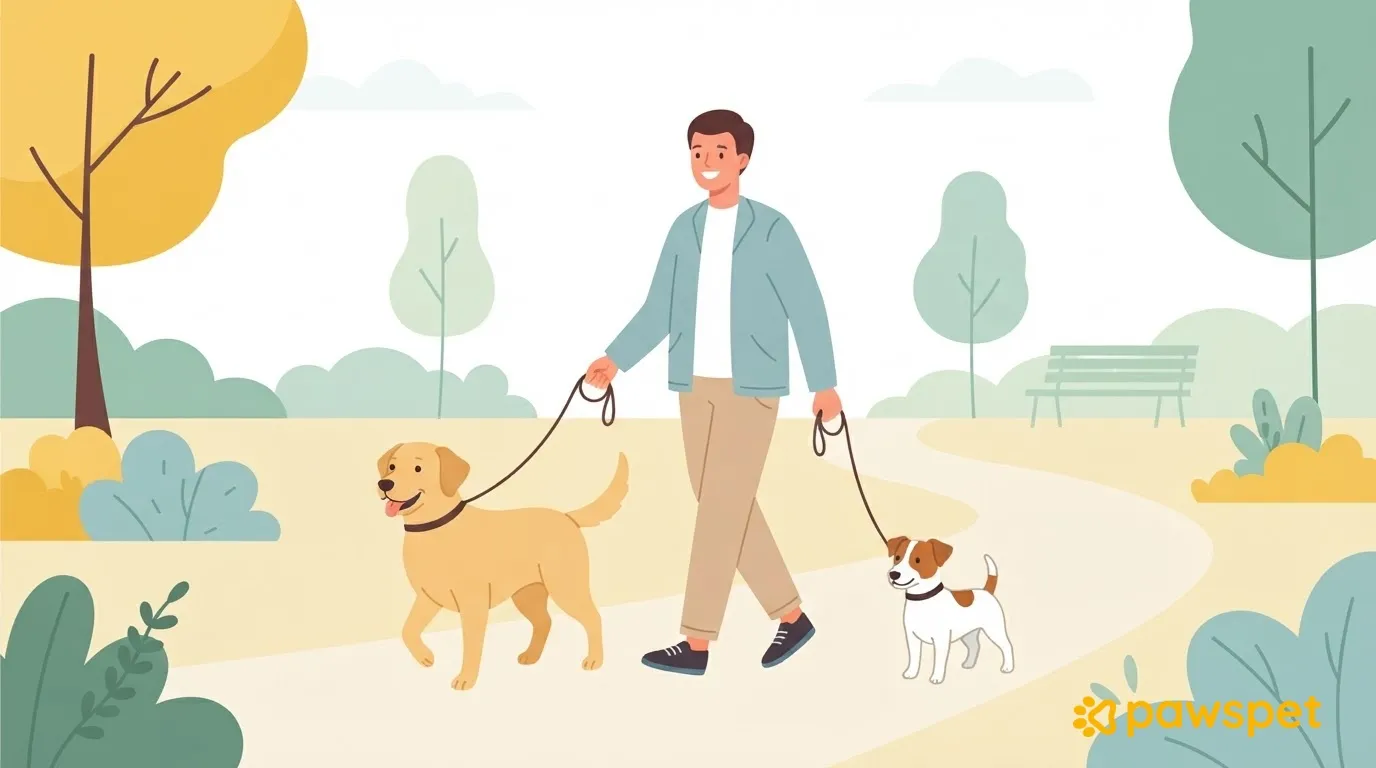
Walking two dogs together makes sense when each dog can walk calmly on leash alone, their exercise needs are compatible, and you can stop both if something happens. If even one of these conditions is missing, split the walk, entirely or in part. Walking as a pair is not the starting point: it is a skill you build by working with each dog individually first.
Three questions to ask before walking two dogs together
- Can each dog walk calmly on leash alone? If a dog pulls, freezes, or gets agitated even when they are the only one on the leash, the problems will add up when you walk both.
- Are their needs compatible? Consider energy, age, physical condition, and time to sniff. A young dog who wants to run and an older dog who prefers to walk slowly, stopping at every scent, do not have the same kind of walk: keeping them at the same pace leaves the first with excess energy and forces the second to walk at a pace that is not right for them.
- Can you handle an unexpected situation? Another dog approaching, a cat, a bike, a narrow sidewalk: you need to be able to stop both dogs without having to choose which one to hold back.
One “no” is enough to skip the full walk together. That does not mean giving up; it means changing the plan.
Signs it is better to split the walk
If you notice any of these signs, split the walk, at least for now:
- the leashes keep getting tangled;
- one dog pulls the other along;
- their reactions add up: one barks and the other joins in;
- one dog falls behind, stops often, or pants more than usual;
- you cannot reward either dog at the right moment.
If either dog shows marked tiredness, limps, or is unusually short of breath, shorten the walk and talk to your veterinarian instead of trying to guess the cause.
How to hold two leashes safely
Use one leash per dog, with a fixed and similar length, and follow three rules:
- One side per dog. If the same dog always walks on the same side, the leashes cross less and each dog learns their place.
- An adjustable grip. You should be able to shorten or let one leash slide without letting go of the other.
- Never wrap a leash around your hand or wrist. If a dog lunges, you may not be able to free yourself in time.
Retractable leashes make walking two dogs harder to manage: their length keeps changing, they tangle more easily, and it is difficult to keep the dogs at the distance you want. A double leash, meaning a single leash that splits into two, links the dogs’ movements: if one pulls or gets scared, the other is affected. That is why it is not suitable during training or for dogs that have tension between them.
The first walks together
When walking two dogs on leash, choose quiet places and short stretches. At first, have a second adult ready to take one dog. Extend the walk only if both dogs stay calm; otherwise, go back to the previous step. At the same time, keep training each dog on their own: that is where walking as a pair begins.
Splitting walks without shortchanging either dog
Separate walks are not a fallback: they tailor the outing to each dog. Here are a few options:
- A shared stretch plus an individual walk. Walk together briefly for bathroom breaks, then take the dog with more energy on a walk alone.
- Taking turns. Alternate which dog gets the longer walk so neither is always left with the shorter one.
- Walks tailored to each dog. A slow route with lots of smells for the older dog, play or training for the younger one.
- Another person. Ask another family member or a dog walker to take one dog out.
One-on-one time has value in itself: it is easier to train one dog at a time, and the slower or shyer dog has room to sniff without being rushed.
When you split walks, it may help to check that each dog gets enough exercise. In the PawsPet app, you can start a GPS recording from the “Activities” tab using the red “Start recording” button, and select one or more pets and an activity type, such as “Walk.” From the ☰ menu in the same tab, “Statistics” then shows each pet’s progress for today under “Activity minutes” and, when available, “Km traveled.” Daily goals are calculated by the app and do not replace advice from a veterinarian.
An example day with two dogs who have different needs
Imagine two dogs with different needs: one young and one older. Here is one possible day:
- Morning. A short walk together for bathroom breaks, then the older dog goes home and the younger dog goes on a more energetic walk with play and training.
- Afternoon. It is the older dog’s turn, with a slow route full of interesting smells. If you cannot take them, another family member or a dog walker can.
- Evening. A walk together on an easy, quiet route, but only if both dogs handle it well; otherwise, take them out separately.
This is only a general plan: how much exercise each dog needs, and how often, depends on the individual dog. For an older dog or one with physical problems, agree on the exercise level with your veterinarian.
Where to start
This week, take each dog for a trial walk on their own and observe how they walk calmly on leash. Then try a short stretch together in a quiet place and note what works: which side each dog walks on, where the leashes get tangled, and when either dog gets agitated. Your notes will help you decide whether walking together or separately is the better option for now.