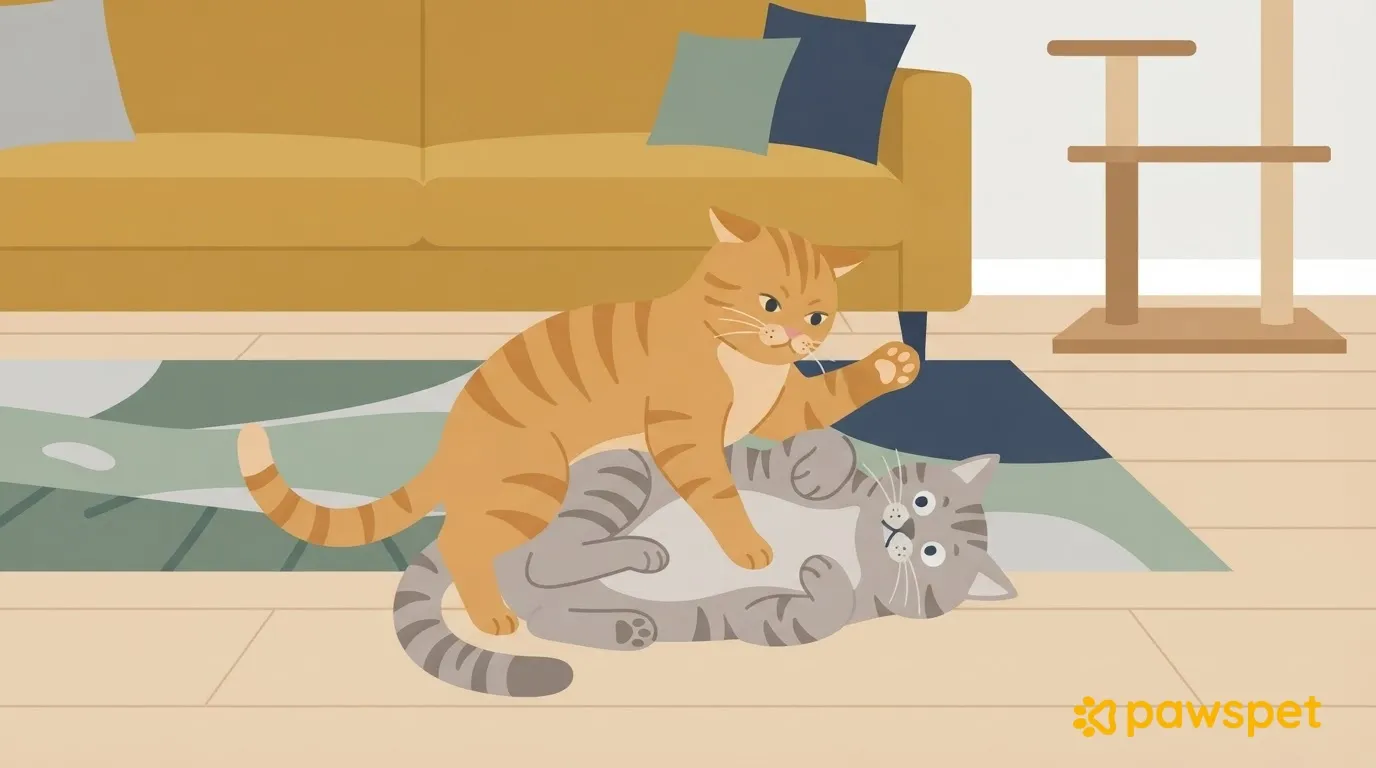
Two cats playing take turns, pause, make few vocalizations, and keep their bodies relaxed before seeking each other out again. A fight may involve hissing or growling, flattened ears and puffed-up fur, one cat always chasing while the other always runs away, and one cat avoiding the other afterward. There can also be tension without a scuffle, expressed through staring and blocked pathways, and it should be taken seriously all the same.
Play or fighting: signs to look for
| Sign | Usually during play | Usually during a fight |
|---|---|---|
| Roles | They take turns: one chases while the other runs away, then they switch | Fixed: one always chases while the other always runs away |
| Vocalizations | Few or none | Hissing, growling, and high-pitched, prolonged vocalizations |
| Ears, tail, and fur | Ears in a natural position, relaxed tail, smooth coat | Flattened ears, puffed-up or tense tail, puffed-up fur |
| Pauses | Frequent: they stop for a moment and then start again | None, or they stay still and stare at each other |
| Biting and claws | Gentle bites, claws almost always retracted | Forceful bites and swats with claws out |
| After the incident | They seek each other out again and stay close without tension | One avoids the other or hides; there may be tufts of fur or scratches |
Look at the signs together, not just one: an isolated hiss does not mean a fight, and two quiet cats can still be tense. Every cat has their own style, gentler or rougher, and young cats often play more energetically: focus especially on whether they take turns and seek each other out again afterward. If the signs point to play, there is no need to interrupt.
Quiet tension
Not all conflicts involve scuffles and hissing. Sometimes they show up in everyday behavior:
- The one keeping watch: stares at the other cat, positions themselves by pathways, litter boxes, or food bowls, or displaces them from resting spots.
- The one avoiding: eats quickly, hides, changes rooms or schedules, and sometimes goes outside the litter box.
A single stare does not tell you much: what matters is repeated behavior and changes in the other cat’s habits. Scarce or poorly distributed resources are often behind it: if food bowls, litter boxes, and comfortable spots are all in the same corner, the cats are forced to cross paths, and spreading them across different areas can reduce these encounters. Even without scuffles, take the situation seriously because the cat avoiding the other may not be able to eat, rest, or use the litter box in peace. If the change is sudden, though, have your veterinarian assess the cat first.
Keep a diary of incidents
For one or two weeks, record every incident, even a brief one:
- date and time;
- room;
- cats involved;
- what happened beforehand: a meal, visitors, a closed door, a cat seen through the window, play with you;
- signs observed, using the table as a guide;
- how it ended.
A diary can reveal recurring patterns, help you understand where to intervene, and give your veterinarian or a behavior professional concrete information that is more reliable than a recollection.
To keep your notes all in one place, you can log each incident in the PawsPet app as a «Behavior Monitoring» activity. Open the «Activities» tab and tap the yellow «+» button at the bottom right: «New Activity» will open. Tap «Select activity type», expand «General», and choose «Behavior Monitoring» (you can also find it by searching for its name). Under «Animals», select all the cats involved from your pets, write the room, cause, and signs in «Notes», and tap «Save». The «Location» field is for addresses and maps, not for the room.
Log the incident as soon as it is over, when the cats are calm again. The app does not interpret behavior: it stores your notes, and you interpret the patterns. To review incidents, open the ☰ menu in the top left from the «Activities» tab, choose «List», and use the «Animal» and «Category» filters to view a particular cat or this activity type.
What to do during a fight and what to avoid
Your safety and the cats’ safety come first:
- Keep your hands away. Do not separate them with your bare hands or pick up an agitated cat: they may react instinctively and hurt you.
- Interrupt from a distance. Make a brief noise, such as clapping your hands, without shouting, or place a cushion or piece of cardboard between the cats.
- Leave an escape route. Do not block doors or hallways: a cat that wants to move away must be able to do so.
- Separate them. Once they move apart, keep them in different rooms until they are calm, without punishing them or forcing them to get close again right away.
- Check for injuries. Even a small bite warrants advice from your veterinarian.
When to involve a veterinarian and a behaviorist
Start with your veterinarian if:
- tension suddenly develops between cats that got along;
- a cat stops eating or using the litter box;
- a cat hides almost all the time;
- a cat has injuries, even small ones.
Pain or illness can change behavior, so a medical check comes first. If fights keep happening afterward, also contact a feline behavior professional. In either case, bring the diary, including dates, rooms, and signs.
If there are no injuries or signs of illness, observe the cats for a week using the table and record incidents before changing everything.
FAQ
Can cats that grew up together start fighting as adults?
Yes. Their relationship can change as they grow or after events such as moving house or a new arrival in the home. If the change is sudden or the tension persists, ask for help as described above.
Should I let them carry on until they work it out themselves?
An isolated hiss followed by calm may resolve on its own. Repeated fights, however, tend to get worse: separate the cats and address resources and spaces, such as food bowls, litter boxes, and resting spots.