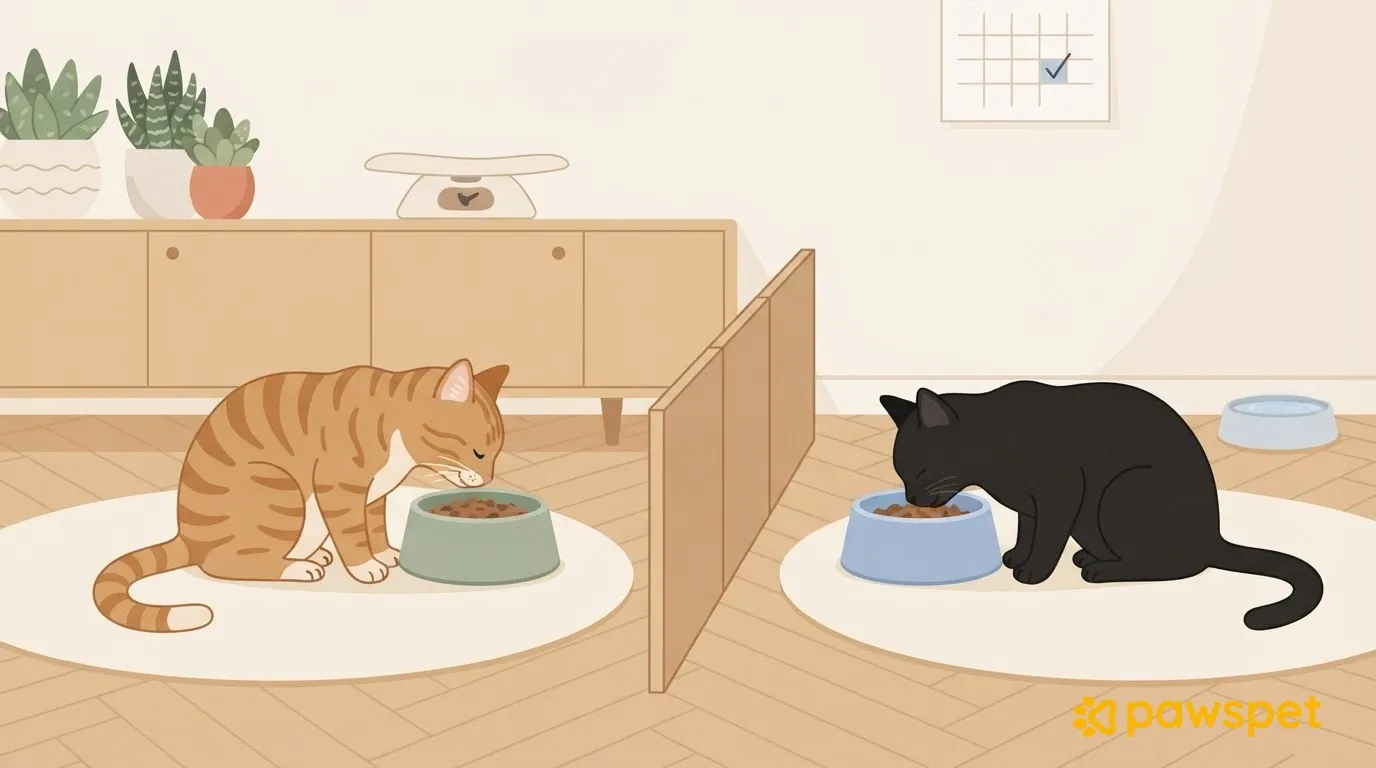
When you have cats with different diets at home, or one cat also eats another cat’s portion, you need to separate meals by space and time: use set mealtimes instead of leaving food out all the time, give each cat a feeding station (even in separate rooms, with the door closed during meals), pick up leftovers, and track their weight. Your vet sets the rules for prescribed diets. Here’s how to organize everything in five steps.
Start with the strictest diet
The most restrictive diet sets the rules for the whole household. Common situations include a prescribed diet, a cat on a weight-management plan, a kitten eating age-appropriate food alongside an adult, or a senior cat who eats slowly. Before arranging the bowls, ask your vet:
- whether the other cats can eat that diet too;
- what to do if the cat on a diet eats other food;
- how many meals a day to serve and at what times.
Write down the answers: they’re the basis of your plan.
A written plan for every cat and everyone who feeds them
Write a plan for each cat, even on a sheet of paper posted in the kitchen, including:
- what they eat;
- how much, as decided with your vet or stated on the label;
- mealtimes;
- where they eat;
- foods to avoid, including the other cats’ food.
The plan is for anyone who feeds the cats. For example, you’ve already served dinner, but someone coming home later doesn’t know and serves a second meal; the cat on a diet eats twice, or the bowls get switched. Family members and cat sitters should follow the same plan: whoever serves the meal writes down the time and the cat’s name.
If more than one person feeds the cats, you can share each cat’s profile in PawsPet so everyone sees the same diet: in the profile, tap the ⋮ menu (three dots) in the top right, choose «Collaboratori», then «Aggiungi collaboratore» and search for the person by name or email (they must already have a PawsPet account). With «Visualizza» on «Salute», the person can see the diet and recorded measurements but can’t change them; with «Modifica», they can also record them.
Alternatively, from the same menu, «Condivisione» lets you turn on a public, read-only link that also shows diets, treatments, allergies, and details such as the microchip: share it only with people you trust and turn it off when it’s not needed (if you turn it back on, the same link becomes valid again).
Separate meals by space and time
For timing, choose set mealtimes instead of leaving food out all the time: that way, you know who ate and how much. For space, give each cat their own feeding station.
Separate rooms and a closed door
If your home allows, have each cat eat in a different room, with the door closed for as long as the slowest eater needs to finish. Then pick up leftovers so no one else can eat them. If the cats stay in the same room, keep their bowls separate and far apart, not facing each other. Offer water in several places, away from the food bowls.
A fast eater and a slow eater
A slow eater may be interrupted: give them the more sheltered spot or one farther from the cat who finishes quickly. Supervise the first few meals: if the slower cat hesitates, leaves food behind, or seems agitated, move the feeding stations before settling on the arrangement.
Shelves and selective-access bowls
A shelf only helps if the cat who needs access can climb up and the other cat can’t; otherwise, you’ve just moved the bowl higher. There are also bowls that open for a single cat: they’re an option to consider, with your vet if the diet is prescribed, not a guarantee.
How to tell if one cat is eating for two
Some signs, which don’t prove anything on their own:
- one cat gains weight while the other loses weight or stays the same;
- one cat waits by the other cat’s bowl;
- portions disappear too quickly;
- repeated vomiting after very fast meals, which you should tell your vet about.
Weigh each cat regularly, always using the same method (same scale, same time of day), and write down the readings: the trend matters, not a single measurement.
To keep track of each cat’s progress and show it at a vet visit, you can record weight and BCS (body condition score) in PawsPet from the «Misurazioni» tab in the cat’s profile, using the «+» button: the app shows a chart and the change since the previous reading. In the «Salute» tab, under «Dieta, terapie e trattamenti», use «Aggiungi» to note the diet name and amount, frequency and times («Ricorrente»), and, if you like, a reminder. You set the amount with your vet: the app records it, it doesn’t decide it.
When to contact your vet
Contact your vet if:
- one cat’s weight changes noticeably;
- a cat eats much less than usual or stops eating;
- prescribed diets have been mixed up more than once;
- vomiting or diarrhea keeps happening.
Bring the plan and the weights you’ve recorded: they can help piece together what happened. If a cat stops eating, don’t wait.
Where to start: This week, write a plan for each cat, try scheduled meals at separate feeding stations, and record each cat’s starting weight.
FAQ
Can I leave dry food out all the time if only one cat is on a diet?
It usually makes monitoring harder because you don’t know who ate what. Decide with your vet, who knows each cat’s diet.
Is it serious if the cat on a diet eats the other cat’s leftovers once?
It depends on the diet and why it was prescribed: there’s no one-size-fits-all answer. Ask your vet what to do; in the meantime, pick up the leftovers.