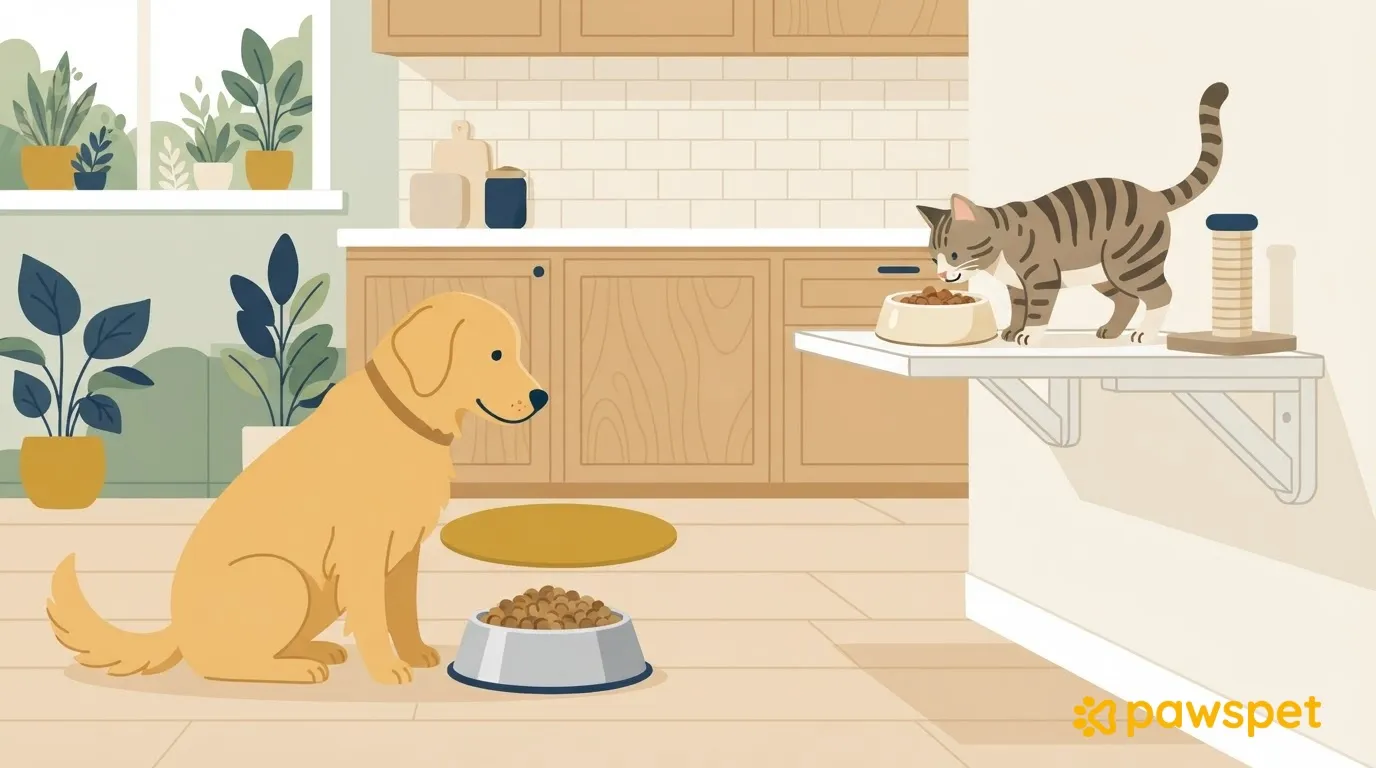
If the dog empties the cat’s bowl, separate their meals by space and time, without making them eat close to each other. Put the cat’s bowl somewhere the dog can’t reach and the cat can get to without crossing the dog’s area, serve meals at the same time in different areas, pick up leftovers, then check how things are going by observing them and monitoring their weight. The reason is practical: dog and cat foods are formulated for different species, so if one eats the other’s portion, it becomes difficult to monitor portions and weight, and competition can make the cat eat too quickly or skip a meal. For questions about diet, consult your veterinarian.
Separate their spaces: where to put the cat’s bowl
The right choice depends on the dog’s size, the cat’s agility, and the space in your home.
| Solution | When it helps | Limitations |
|---|---|---|
| A stable raised surface | The dog can’t reach it and the cat can get to it easily | Not enough for large dogs or dogs that jump; not very suitable for older cats or cats that struggle to jump |
| A room reserved for the cat: a gate with a cat pass-through or a door left ajar | When you need an area the dog can’t enter | Works only if the dog is larger than the cat; make sure the door can’t close |
| A dedicated shelf in the cat’s safe area | The cat already has an area where it feels safe | The dog must not be able to reach it |
| Feeders that open by recognizing the microchip | If the other solutions aren’t practical at home | Check the manufacturer’s product information to assess this category; the cat needs to get used to it gradually |
Whichever solution you choose, make sure that:
- the cat can see who is approaching while it eats;
- it has water in its area too;
- the bowl is kept away from the litter box;
- the dog’s bowl is out of the cat’s reach, if needed.
Separate mealtimes: schedules, eating at the same time, and leftovers
Serve meals at the same time, each in its own area: keep the dog in its area, behind a gate or a door, until the cat has finished too. Stay nearby the first few times so you can step in if either animal approaches the other. At the end of the meal, pick up the bowls, whether empty or with wet food left in them: neither animal can clean up the other’s leftovers, and you can see how much each one has eaten.
If the cat is used to having food available all the time, leave it only in a spot the dog can’t reach. Alternatively, consider switching to scheduled meals, but talk to your veterinarian first, especially if the cat has health problems or is on a special diet.
If the cat is the one eating from the dog’s bowl, use the same approach with their roles reversed: feed the dog in its area, keep the cat out until the dog has finished, and pick up the bowl at the end of the meal.
Check over the following weeks: signs and weight
Signs it’s working:
- the cat finishes its portion without running away;
- the dog doesn’t linger in front of the cat’s area;
- neither animal steals food from the other.
Signs to take seriously:
- the cat leaves its food when the dog arrives, eats only at night, or eats less;
- the dog stiffens, growls, or stands still over the bowl.
If the dog guards its bowl, don’t provoke it or test it by approaching the bowl to see how it reacts: separate them for meals using a door and ask a dog trainer or behavior consultant for help. If the cat’s appetite decreases or its weight drops, contact your veterinarian.
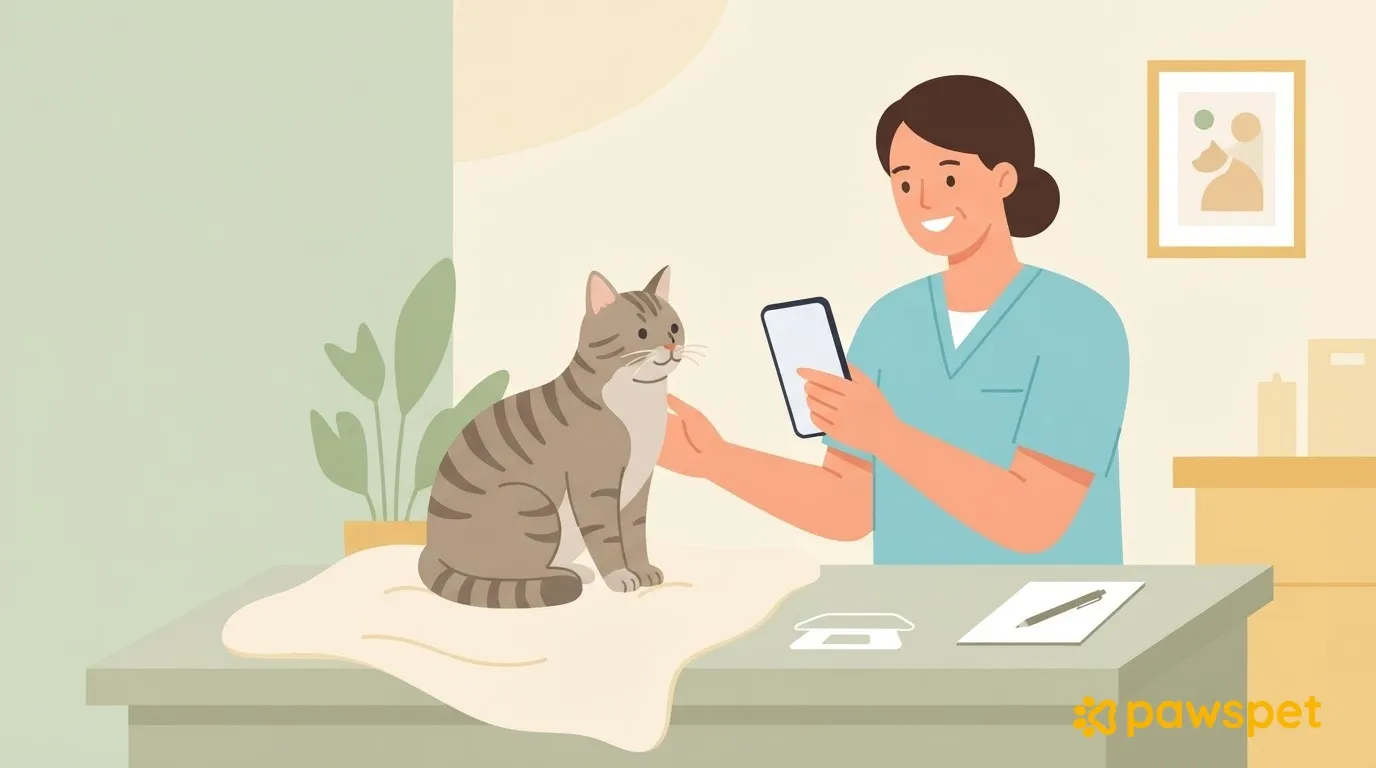
To keep track of both animals’ weight over the following weeks, you can record it in the PawsPet pet owner app: from the “Pets” tab, open the animal, then “Measurements” and the “+” button. You’ll find a chart for each animal and the change compared with the previous measurement; the app only indicates whether the weight is going up, down, or staying the same, not whether it’s right for them. That assessment is up to your veterinarian.
Prescription diets, treats, and supplies kept out of reach
If either animal is on a diet recommended by a veterinarian, the separation needs to be strict, and everyone in the household needs to know about it. If the other animal eats any of that food, ask your veterinarian what to do. Keep bags, cans, and treats closed and out of reach, and don’t leave treats unattended in shared areas.
To keep track of the diet recommended by your veterinarian, you can add it as a “Diet” in the “Health” record for each animal in the PawsPet app: with “Recurring” and “Generate reminders in activities,” each serving becomes an activity you can check off.
The plan at a glance
- Today: choose a spot for the cat’s bowl and a barrier.
- Over the next few days: try serving meals at the same time, each in its own area.
- Over the following weeks: watch for signs and weigh both animals.