Taking your cat in the car, maybe for a vet visit, can turn into a small odyssey: desperate meowing, scratching at the carrier, escape attempts, drooling, vomiting, or peeing out of fear. Many owners end up postponing important checkups precisely because their cat “can’t stand the carrier.”
The good news is that you can significantly reduce your cat’s stress during transport by working on three key elements:
- Getting used to the carrier (at home, calmly, with positive reinforcement)
- Managing the car ride (safety, sounds, smells, duration)
- Organizing the vet visit (before, during, and after)
In this practical guide, we’ll look at how to get your cat used to the carrier, what to do if your cat is stressed in the car, and how to take your cat to the vet without unnecessary stress, with simple but effective tips you can apply right away.
1. Why is your cat so stressed in the car and at the vet?
To understand how to help your cat, it’s useful to start with the most common causes of discomfort during transport.
1.1 The main sources of stress for cats
A cat may experience transport as a threat for several reasons:
-
Loss of control over their territory
Cats are territorial animals: home is their safe world. The carrier and the car “tear” them away from that familiar territory. -
Negative past experiences
If every time they go into the carrier they end up at the vet for blood draws, injections, or handling, they’ll start associating carrier = something unpleasant. -
Noise, vibrations, movement
Cars produce sounds, jolts, braking, turns, and unfamiliar smells. All stimuli that an unaccustomed cat may perceive as threatening. -
Lack of control and confinement
Being closed in a carrier, in an unfamiliar environment, with no chance to escape, can trigger panic. -
Feeling car sick
Some cats suffer from true motion sickness, with nausea, vomiting, and drooling.
2. Choosing the right carrier for your cat
Before working on the habit, it’s essential to choose a suitable, safe, and comfortable carrier. An uncomfortable or unstable model makes everything harder.
2.1 Essential carrier features
For transporting your cat by car and to the vet, look for a carrier that:
- Is rigid and stable (hard plastic, well structured)
- Is the right size:
- The cat should be able to turn around and lie down comfortably
- It should not be too large (otherwise it “shifts” and feels unsafe)
- Has front and/or top openings:
- A top opening is often more convenient for placing in a nervous cat
- Is easy to open and disassemble:
- Many vets prefer to remove the top shell for the exam while the cat stays in the lower part, so they feel safer
- Has good ventilation, but also the option to cover the sides with a cloth to reduce visual stimuli
Avoid:
- Very soft, easily deformable fabric carriers (often unstable)
- Models that open only from the front if your cat is very fearful
- Makeshift cages or cardboard boxes: they are not safe, especially in the car
2.2 One carrier for multiple cats: yes or no?
In general:
- Cats that are very bonded and compatible: they can travel together if the carrier is large enough, but it may create stress if one of them is scared.
- Cats that fight or have tense dynamics: better to use separate carriers to avoid stress-related aggression.
3. How to get your cat used to the carrier (at home, calmly)
The real secret to stress-free cat transport is not pulling out the carrier only when it’s time to go to the vet. It needs to become a neutral or even positive object in your cat’s daily environment.
3.1 Keep the carrier available at all times
Turn the carrier into a “special den”:
- Leave it open in the house, in a quiet corner
- Put inside:
- A soft blanket with the smell of home (or your cat)
- A few kibbles or treats from time to time
- A soft toy or a small cushion
At first, your cat may ignore it. Don’t force anything: let them discover it on their own.
3.2 Associate the carrier with positive experiences
To help your cat build a positive association:
- Give treats only when they approach or enter the carrier
- Play near the carrier, rolling balls or using a wand toy that “goes through” it
- Use synthetic feline pheromones (sprays or diffusers), if recommended by your vet, spraying them on the blanket and inner walls (15–20 minutes before letting the cat in)
3.3 Gradual habit-building with carrier closure
Once your cat starts going in on their own:
- Close the door for a few seconds, staying nearby and speaking in a calm voice.
- Offer a treat through the grates.
- Open it again shortly after, before they start protesting.
- Gradually increase the closure time: from 10 seconds to 1–2 minutes, always accompanied by treats and reassuring speech.
The goal is for your cat to experience being closed in as something temporary and non-threatening.
4. Before you leave: preparing the cat, carrier, and car
Good preparation can make the difference between a manageable ride and a very stressful experience.
4.1 What to put in the carrier—and what not to
Inside the carrier:
- Yes:
- An anti-slip blanket or mat (so they don’t slide around on turns)
- Fabrics with familiar smells
- An absorbent pad under the blanket if your cat tends to pee
- No:
- Small toys that can roll around and agitate the cat
- Sharp or hard objects that could cause injury if the carrier moves
4.2 When and how much to feed your cat before the trip
To reduce the risk of vomiting:
- Avoid large meals in the 3–4 hours before travel
- Keep water available until shortly before leaving
- Use very small treats if you want to reward them in the carrier
If your cat often gets motion sickness, talk to your veterinarian: do not give anti-nausea or sedative medications without professional guidance.
4.3 Preparing the car
Before leaving:
- Secure the carrier stably (see safety section)
- Set the car temperature:
- Never too hot, and never direct air conditioning on the carrier
- Minimize:
- Loud music
- Fully lowered windows (strong drafts can be uncomfortable)
- Keep the dashboard or back seat clear so the carrier can be secured properly
5. Transporting your cat by car: safety and comfort
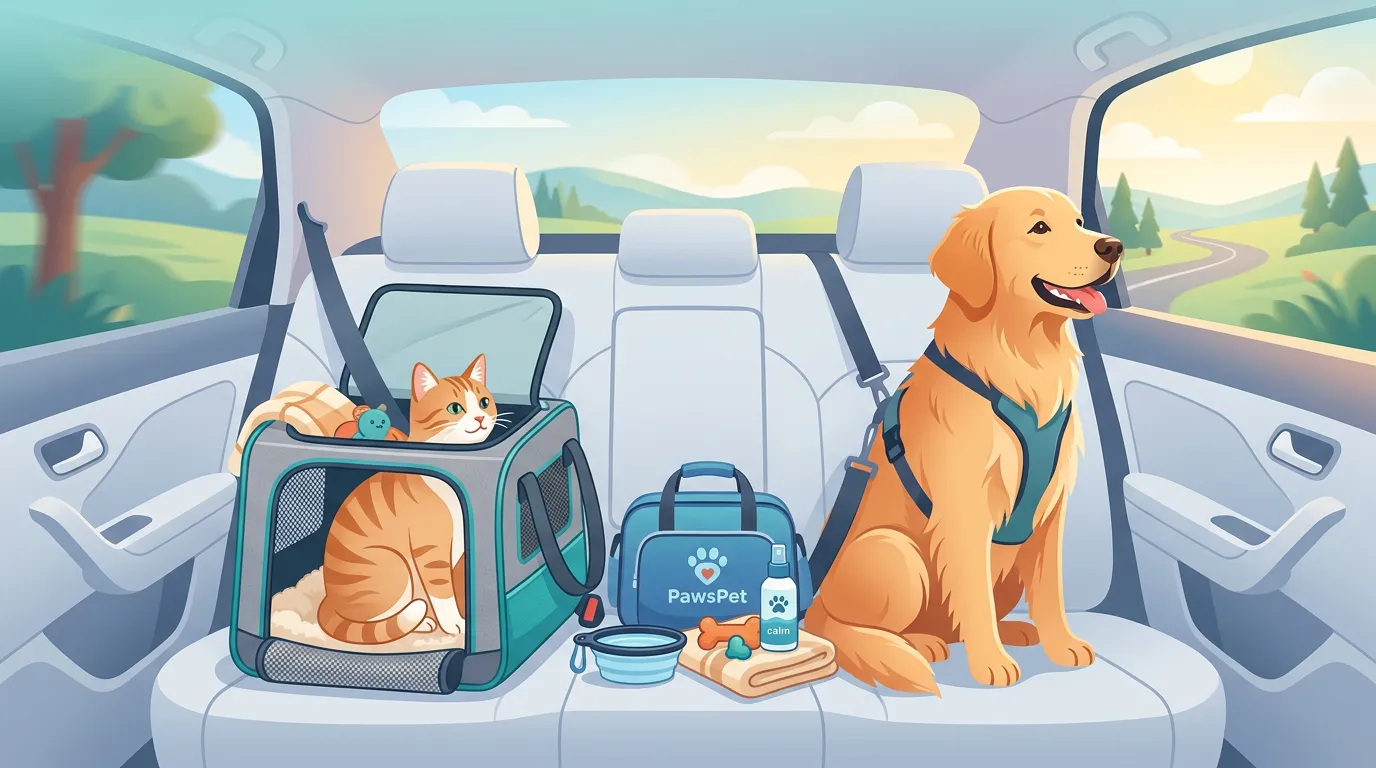
5.1 How to secure the carrier in the car (safety first)
By law and common sense, your cat should always travel inside a closed carrier, and the carrier must be secured.
Recommended options:
- Back seat:
- Place the carrier lengthwise, against the seat back
- Secure it with the seat belt running over and behind it
- The cargo area of a station wagon/SUV, if it is connected to the cabin:
- Place it crosswise near the back seat
- Secure it with straps if available
Avoid:
- Putting the carrier on the front seat (the airbag can be dangerous in a collision)
- Leaving the carrier loose so it can slide around on every turn
5.2 Noise, light, smells: how to reduce stimuli
For a sensitive cat, every extra stimulus adds stress. You can:
- Partially cover the carrier with a light cloth (do not block all ventilation)
- Keep the volume low (radio, conversations)
- Avoid:
- Smoking in the car
- Using very strong air fresheners before the trip
6. Training your cat for short car rides
For a cat stressed in the car, a gradual desensitization process is useful: slowly getting them used to the different parts of the trip.
6.1 Stages of car-transport acclimation
You can proceed step by step, on different days:
-
Cat in the carrier, at home
- Close it for a few minutes, reward, then open it again.
-
Cat in the carrier, car parked
- Bring the carrier to the car.
- Put it on the seat, secure it, stay with them, speak calmly.
- No movement, just the new setting and smells.
-
Engine on but car stationary
- Start the engine and let them hear the noise.
- Sessions of a few minutes, then back home and a reward.
-
Very short trip (2–3 minutes)
- Drive around the block or the neighborhood, then go back home.
- No vet at this stage: the goal is to show that sometimes you go by car and come back without negative experiences.
-
Slightly longer trips
- 5–10 minutes, always associated with coming back home and something positive (a meal, play).
7. Taking your cat to the vet without too much stress
The before, during, and after phases of the visit also affect your cat’s anxiety.
7.1 Before the visit: smart organization
- Book strategic time slots:
- If possible, choose less crowded times (ask the clinic which periods are quietest).
- Ask whether there is a separate waiting area for cats or a raised spot where you can place the carrier away from dogs.
- Prepare all documents in advance:
- Health booklet
- Previous test results
- Notes about symptoms, medications, unusual behavior
With an app like PawsPet you can:
- Record your cat’s medical history, vaccinations, treatments, and vet appointments
- Keep visit and medication reminders handy
- Quickly share essential information with the vet (weight, medications taken, etc.)
7.2 In the waiting room: how to handle your cat
- Do not open the carrier.
- Avoid exposing them directly to other animals (especially excited dogs).
- Place the carrier:
- On a chair or shelf (up high, cats feel safer than on the floor)
- Maybe covered by a cloth on 2–3 sides
If your cat is very anxious, ask the clinic whether it is possible to:
- Wait in the car until it’s your turn
- Enter through a secondary entrance (some clinics offer this for very stressed cats)
7.3 During the veterinary visit
- Staying calm helps your cat: if you’re tense, they’ll notice.
- Speak in a low, reassuring voice.
- Let the vet:
- Open the carrier from the top, if needed
- Examine the cat while they remain on part of the carrier (many feel safer that way)
Don’t hesitate to:
- Tell the vet how your cat handles transport and the visit.
- Ask for tailored advice on pheromones, habituation routines, and any medications (only if truly necessary).
8. Cat peeing, vomiting, or panicking in the carrier: what to do
Some cats show strong physical reactions to travel stress.
8.1 Pee and poop in the carrier
It can happen because of fear or nausea. To handle the situation better:
- Use absorbent pads under the blanket.
- Always bring:
- Pet-safe wet wipes
- A spare towel
- Never scold the cat: they are not being “naughty,” they are scared.
If it happens regularly, talk to your vet: a slower desensitization plan or additional strategies may help.
8.2 Vomiting and drooling
Possible causes:
- Motion sickness
- Very intense stress
- Underlying medical conditions
What you can do:
- Reduce the meal before travel
- Make sure the carrier is stable and the ride is as smooth as possible
- Ask your vet whether these may help:
- Specific supplements
- Motion sickness medication (prescription only)
Do not give human medication or DIY remedies.
9. How technology can help you organize transport better
The more organized you are, the fewer last-minute rushes you’ll need, and the less stress your cat will accumulate.
With an app like PawsPet you can:
- Store all your cat’s veterinary visits (vaccines, checkups, procedures)
- Set reminders for:
- Upcoming vaccine boosters
- Periodic checkups
- Parasite prevention treatments (often a reason for extra visits if not done regularly)
- Keep everything in one profile:
- Cat identification details
- Any chronic conditions
- Ongoing treatments
This allows you to:
- Reduce “urgent” trips caused by forgetfulness or disorganization.
- Arrive at the vet prepared, with all the necessary information, without scrambling through loose papers at the last minute.
10. Practical checklist: cat transport with little stress (or almost)
To sum up, here is an operational checklist to use before every trip:
10.1 Checklist before the day of the appointment
- Carrier chosen and in good condition
- Carrier has been left open at home for some time
- Cat is at least somewhat used to going in on their own
- Blanket with home smell inside
- Any pheromones used if recommended by the vet
- Updated medical data (weight, medications) saved in PawsPet or elsewhere
10.2 Checklist on the day of the appointment
- No excessive meal in the previous 3–4 hours
- Carrier set up with anti-slip mat and blanket
- Absorbent pad under the blanket if needed
- Documents ready (booklet, tests, notes)
- Carrier secured in the car
- Comfortable car temperature
- No loud music, no strong smells in the car
- Vet’s phone number within reach
11. When to ask for help from your vet or a behavior specialist
Not all cats react the same way. Some, despite good work at home, still experience transport as highly anxious.
It may be helpful to consult:
-
Your veterinarian:
- To rule out physical issues that worsen stress
- To assess whether specific protocols are needed (pheromones, supplements, and in selected cases anti-anxiety medication)
-
A veterinary behaviorist:
- To set up a personalized desensitization plan
- To teach you targeted techniques for your specific case (especially if the cat is aggressive or might hurt themselves)
Remember: the goal is not to have a cat that is “perfectly relaxed” (that’s not always realistic), but to minimize stress and ensure safety and well-being during necessary trips.
Conclusion: calmer trips for better care
Transporting your cat by car and to the vet does not have to be a nightmare. With:
- A suitable, well-prepared carrier
- Gradual habituation at home and in the car
- Good veterinary visit organization
- Support from the vet (and, if needed, a behavior specialist)
you can significantly reduce anxiety, meowing, escape attempts, and overreactions.
If you want to make everything even easier, you can use the PawsPet app to:
- Keep your cat’s records and health information organized
- Receive reminders for visits and treatments
- Arrive at the vet with everything under control, reducing surprises and last-minute rushes
Less stress for you, less stress for your cat… and calmer, more useful visits for their health.
FAQ about transporting your cat by car and to the vet
How do I get my cat used to the carrier if they hate it?
Start by leaving the carrier open at home all the time, with a soft blanket and tasty treats inside. Don’t close it right away: let your cat explore it freely, perhaps by dropping a few snacks inside. Then gradually start closing the door for just a few seconds, rewarding every calm behavior. Avoid taking the carrier out only on the day of the vet visit, otherwise it will always be linked to negative experiences.
What should I do if my cat meows nonstop in the car?
Meowing is often a sign of fear or discomfort. Make sure that:
- The carrier is stable and doesn’t slide around
- The car is not too hot or too cold
- Noise (radio, voices) is kept moderate
- The route is as smooth as possible, without sudden braking
Speak to them in a calm voice, without scolding. If the meowing is very intense and accompanied by other signs of stress (drooling, vomiting, labored breathing), speak with your vet to consider additional strategies.
Can medication be used to calm a cat during travel?
There are medications and supplements that can help some cats that are particularly anxious or prone to severe motion sickness, but they must be prescribed by a veterinarian after a proper evaluation. Never use sedatives or human medications on your own: they can be dangerous. In many cases, proper carrier training and a few environmental adjustments are already enough to greatly reduce stress.
Is it better to cover my cat’s carrier in the car?
For many cats, partially covering the carrier with a light cloth helps reduce visual stimuli and therefore stress. Cover 2–3 sides while still keeping good airflow. If you notice your cat calms down when they have less to look at, it’s a useful strategy. If, on the other hand, they seem calmer when they can look around, leave at least one side uncovered. Experiment gently and observe their reactions.