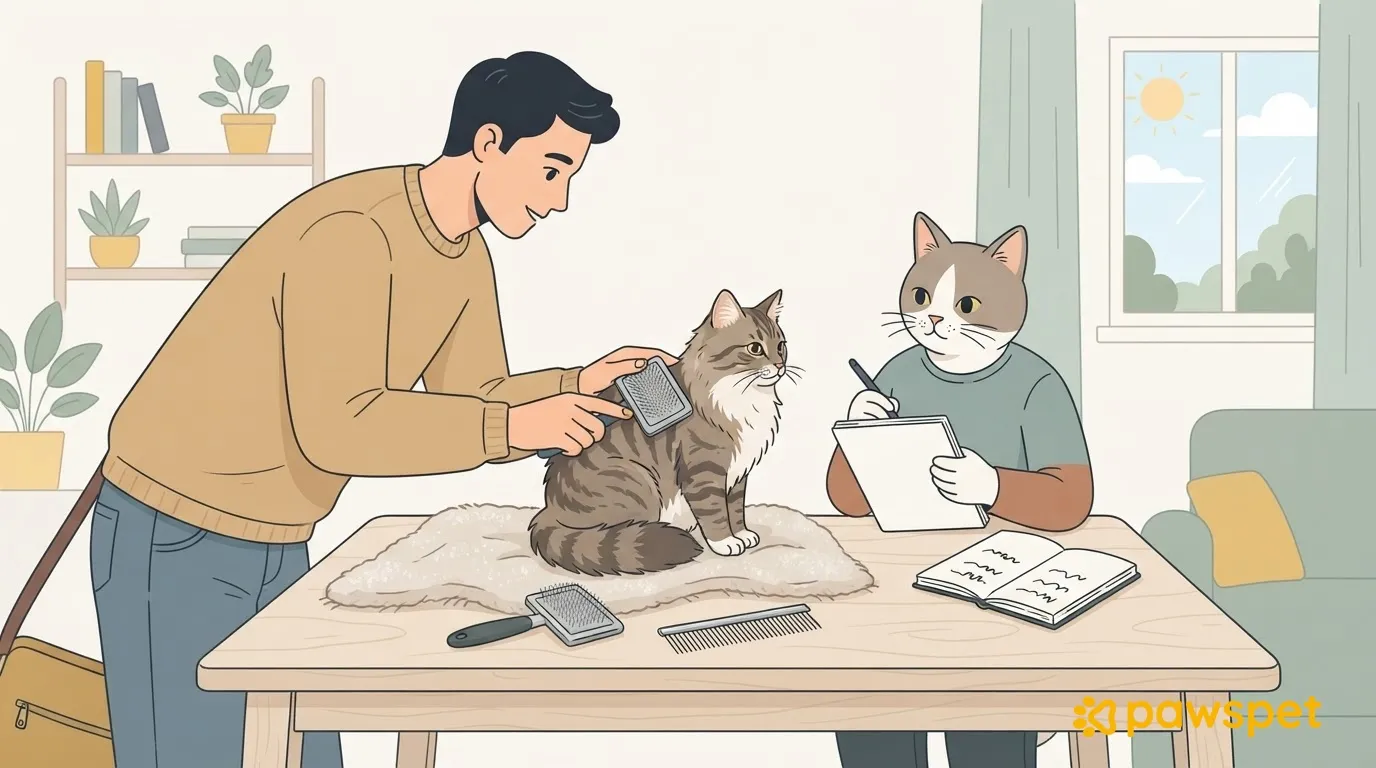
Before you leave, decide whether your cat’s brushing should continue, leave brief written instructions, and practice together with the person who will be staying with them, whether that’s a cat sitter, family member, or neighbor. If your cat won’t let that person touch them, it’s better to ask them only to observe the coat and leave grooming until you return. This is especially important for medium- or long-haired cats: more than technique, what matters is a clear handoff.
Before you leave: decide whether brushing should continue
Four things can guide your decision: coat length and tendency to mat, how long you’ll be away, how comfortable your cat is being touched by that particular person, and any existing mats. There are three options: continue with short sessions, only observe and report, or wait until you return.
| Situation | What to ask |
|---|---|
| Long or medium-length coat, prone to mats, cat is comfortable with the person staying | Continue: brief sessions on areas your cat accepts, at your usual frequency |
| Your cat lets that person touch them only a little or not at all | Observe and report: no brushing; grooming can wait until you return |
| Short absence and a coat that doesn’t mat easily | Wait: no coat-care requests; you’ll take care of it when you return |
If there are already mats or felted areas, have them taken care of before you leave by a groomer who works with cats or by your veterinarian, not by the person staying with your cat.
The written care sheet
Copy this list, fill it in, and leave it somewhere easy to see; also send a copy to the person staying with your cat.
- Tools: where they are and which one to use, identified by type (for example, a soft brush or comb), preferably one your cat already knows.
- Frequency and duration: the frequency of your usual routine and a short maximum session length, so they can stop before your cat gets annoyed.
- Where to start: the areas your cat accepts, such as the cheeks and neck.
- Areas to avoid: the areas your cat rejects, such as the belly, tail, or paws.
- Signs to stop immediately: tail lashing, rippling skin along the back, ears turned sideways or flattened, your cat turning toward the hand or moving away.
- Never: use scissors, pull at mats, bathe your cat, try new products, restrain or chase them.
- Take photos and report: new mats, redness, scabs, visible parasites, clumps of fur coming out, or your cat stopping grooming or hiding.
- Who to contact: you and your regular veterinarian, with contact details written down.
If you use the PawsPet app, you can keep the schedule and instructions close at hand: from the «Activities» tab, tap the yellow «+», choose your cat under «Pets» and the «Brushing» type (under the «Hygiene» category), set «Repeat» to your chosen frequency, add a reminder for yourself using the bell icon, write the instructions in «Notes», and save. If the person staying with your cat already has a PawsPet account, from the «Pets» tab open your cat’s profile, tap the ⋮ menu, choose «Collaborators» and «Add collaborator», search for them by name or email, and grant them «View» access to «Activities»: they’ll find your cat under «Shared with me» and see their «Activities» sheet. «View» access to «Health» is already selected, so check the permissions and grant only what’s needed. Access doesn’t expire automatically: when you return, remove them from the same screen. The public «Sharing» link doesn’t show activities, so written instructions are still the option for anyone who doesn’t use the app.
Practice together before you leave
Have a practice session a few days before your trip. The person staying with your cat lets them come over and tries a few gentle strokes on the areas they accept, while you observe. Agree in advance that if your cat pulls away, the session ends—and it’s fine to skip it. The practice shows whether the tool pulls or your cat doesn’t accept that person, so you can change the plan before you leave, for example by switching to observation only.
If a mat appears or something seems wrong
The person staying with your cat should not cut or pull at it: scissors can injure your cat. They should just take a photo of the mat and let you know; then you can decide whether to wait until you return or contact a groomer who works with cats.
Redness, wounds, a bad smell, patches of hair loss, your cat stopping grooming, eating less, or hiding are reasons to contact the veterinarian without waiting for your return: make that clear on the care sheet. Don’t ask the person staying with your cat to figure out what’s wrong; just ask them to describe what they see and send photos.
When you return: check and ease back into the routine
As soon as you’re home, calmly check the areas where mats usually form: behind the ears, armpits, belly, inner thighs, and base of the tail. If your cat is more elusive after you’ve been away, start again with short sessions and let them set the pace. For any felted areas, contact a groomer who works with cats or your veterinarian.
Do today: write the care sheet and schedule a practice session together before you leave.
Frequently asked questions
What if a short-haired cat isn’t brushed for a few weeks?
Usually, the main thing is to keep an eye on them: if their coat or behavior changes, contact your veterinarian. If you’re unsure, ask your veterinarian before you leave.