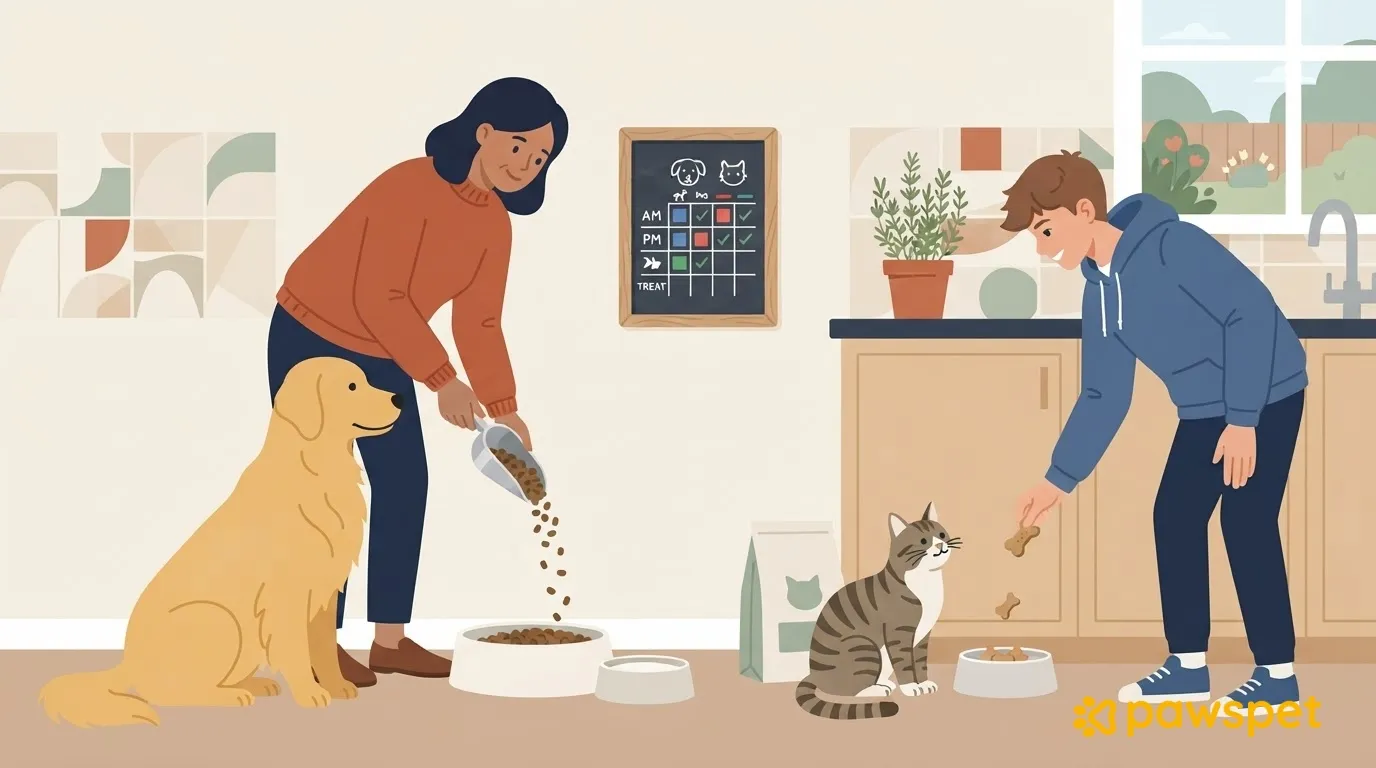
If several people at home feed the same dog or cat, four rules can help prevent meals from being doubled or skipped: assign one person to each meal, prepare portions using the same measure, record each meal right afterward, and keep treats in a single supply. The amount is not up for discussion: stick to what the veterinarian or label specifies.
Why meals get doubled at home
When schedules are staggered, one person may fill the bowl before leaving, then someone who comes home midmorning finds the dog asking persistently and gives in, not knowing the dog has already eaten. Children want to give treats, and guests do not know the household routine. No one is acting in bad faith: the information simply has not been shared.
There is also a practical reason: if no one knows who fed the pet, it is harder to notice that the animal has skipped a meal or is eating less than usual. These are things to note and tell the veterinarian about if they happen repeatedly or if the animal does not seem well; it is up to the veterinarian to assess them.
Divide up the tasks: who, when, and how much
Assign each meal to a specific person, not to “whoever happens to be around,” using a weekly chart posted near the bowls. Here is an example with three people:
| Day | Morning | Evening |
|---|---|---|
| Monday | Anna | Marco |
| Tuesday | Anna | Marco |
| Wednesday | Marco | Giulia |
| Thursday | Anna | Marco |
| Friday | Giulia | Anna |
| Saturday | Marco | Anna |
| Sunday | Giulia | Giulia |
Use the same measuring cup or scale for everyone: the amount should remain what the veterinarian or label specifies, but using the same tool means the portion will be identical no matter who prepares it.
Then prepare the day’s portions: one person, for example the night before, divides the food into two containers labeled “Morning” and “Evening.” Whoever is on duty uses the container for their meal: if it is empty, the meal has already been served. Anyone coming home does not have to guess: they can check the containers.
Wet food needs one extra rule: decide who opens the package and where leftovers go, always in the same place, in a closed, clearly identifiable container. Follow the label’s storage instructions.
A record everyone can see
Start with the simplest option: a sheet of paper or a whiteboard on the fridge, with a check mark and the initials of whoever fed the pet at each meal, or a message in the family group chat (“Morning meal given, G.”). There is just one rule: mark it down right after the meal, not later.
If you use the PawsPet app, you can keep the record there too. In the “Activity” tab, tap “+”, choose the “Feeding and Supplies” type (under “General”), select the pet, and under “Repeat” choose “N times a day”: you can set up to 6 times, for example morning and evening. Tap “Save”; then, after each meal, tap the circle to the left of the row: it turns green. If only one person at home uses the app, keep everyone’s shared record on paper or in the group chat instead—it is better to have just one.
The pet’s owner can add other household members as collaborators, as long as they already have their own PawsPet account: from the pet’s profile, tap ⋮ in the top right, then “Collaborators” and “Add collaborator,” and choose permissions for each area. New collaborators start with “View” access to “Health”: if you have recorded the food and amount in the “Diet, therapies, and treatments” section of the “Health” profile, they can view them.
Treats: one supply and one rule
Treats do not have set times, so it is easy to lose track of how many have been given. The solution is one container in a place everyone knows, stocked with the day’s treats, with the amount agreed on together in line with the veterinarian’s guidance. Training treats should come from there too, not from a second box. When the container is empty, treats are finished for the day—for everyone.
Do not give table scraps without discussing them with the veterinarian first. For children, one simple rule is enough: ask an adult and take treats only from the container.
When something changes
Write down any new food or amount recommended by the veterinarian right away in the record (and in the diet section of the “Health” profile, if you have recorded it), and tell everyone the same day, in person or in the group chat, so no one carries on with the old routine. Whoever notices a refused meal should note it, along with the time; if it happens repeatedly, tell the veterinarian.
For guests, grandparents, or babysitters, two lines next to the record are enough: who is feeding the pet today, where the container is, what to mark, and “no treats from outside the container.”
For tonight, two steps are enough: prepare tomorrow’s portions in containers labeled “Morning” and “Evening,” and put the record up next to the bowls.