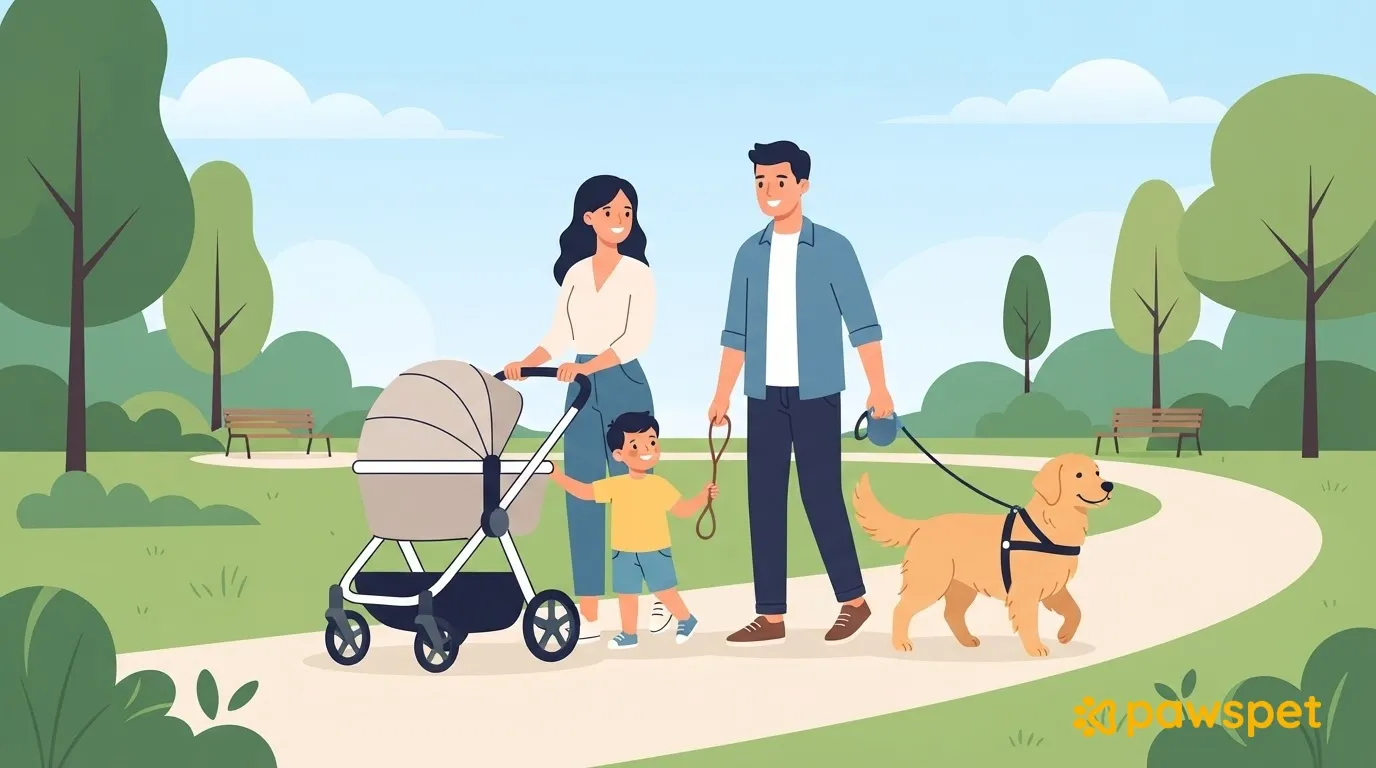
An adult should always hold the leash used to control the dog, even when a child asks to hold it. A child can participate with a second leash only if the dog walks without pulling or reacting to things it encounters, on a quiet route. A stroller requires preparation or a second adult. Longer days make it tempting to go out together, but before setting off, decide who will look after the dog and who will look after the children.
Who holds the leash
The second leash attaches to the harness or collar: it is for participation, not for controlling the dog. The adult always holds the main leash. To offer the second leash to a child, all the conditions in the first column must be met.
| The child can hold the second leash if | Better not if |
|---|---|
| The dog walks without pulling | The dog pulls or lunges |
| The dog stays calm around other dogs, bikes, and cats | The dog barks or lunges |
| The child stops when asked | The child is tired or very excited |
| The route is familiar and not busy | There are busy roads or crowded parks |
Reassess these conditions during the outing: if the child gets tired or the route gets crowded, skip the second leash.
Never tie the leash to a child’s wrist or waist, or to the stroller. Do not give a child a retractable leash. If the dog pulls or reacts, hold the leash yourself and work on handling with a trainer.
Walking with a stroller and a dog
The preferred option is to go out with two adults: one pushes the stroller while the other handles the dog.
If you’re alone, prepare for the combination first: try short routes, walking the dog beside an empty stroller and rewarding the dog. Plan for stops, too: you need to be able to stop the stroller and attend to the dog without handing the leash to a child to free up a hand.
During the outing, keep a secure hold on the leash, without attaching it to the handle. When you stop, for example to pick up dog waste, apply the stroller brake without letting go of the leash.
If the dog isn’t ready, separate the outings: take the dog out with an adult, then go for a short walk all together when a second adult can help.
Wheels, running, and encounters
Scooters and bikes
Wheels and running near the dog can excite it or prompt it to chase; the leash can get tangled. Set clear distances and roles: children ride ahead with another adult, at a distance from the dog, or use bikes and scooters in a suitable area separate from the dog’s path.
If you’re the only adult and can’t also supervise the children on wheels, choose to walk together that time. Don’t play running games with the dog on leash. Follow the local rules on leashes and areas where dogs may be off leash.
Unfamiliar dogs and off-leash dogs
Children should not approach dogs they don’t know. They should ask an adult first, and the adult should ask the owner’s permission and accept a no. The adult decides whether to allow a brief greeting or change course: permission does not mean you have to stop.
If an off-leash dog approaches, the child should stand behind the adult, stay still with their arms close to their body, and not run, while the adult manages the situation.
If family outings aren’t enough for the dog
Walks at a child’s pace can be short, slow, and full of stops: being outside together doesn’t always meet the dog’s needs. Many dogs also need a walk with an adult, with more time to explore or a longer route, adjusted to their age and health. If in doubt, ask your veterinarian.
Include this possibility when planning the day, rather than expecting the dog to always adapt to the children’s schedule.
To track duration and distance, open the «Attività» tab in the PawsPet app on your phone and tap the red «Avvia registrazione» button: choose at least one pet that has already been added and the «Passeggiata» activity type, then start GPS tracking and grant location permission when prompted. From the ☰ » «Statistiche» menu, you can see the «Minuti di attività» compared with the daily goal, which is calculated automatically from your pet’s data: this is a planning aid, not a substitute for veterinary advice.
Before you go
Prepare what you need and assign tasks before you get to the sidewalk:
- Second leash, only if conditions allow.
- Bags and someone responsible: an adult picks up the waste, or an older child can do it with a bag and under supervision.
- Wipes or hand sanitizer.
- Water and a bowl for the dog, separate from the children’s water bottles.
- Dog treats.
- Charged phone.
For your next outing, choose a short, familiar route and decide on everyone’s roles before you set off: who holds the leash, who looks after the children, and who pushes the stroller.