Taking your dog out for a walk at night can be a very peaceful moment: less noise, fewer people, cooler temperatures. But darkness brings real risks for the dog’s safety and for the owner too: poor visibility, cars seeing you too late, obstacles in the road, unexpected encounters.
In this article we’ll look at how to make night walks with your dog safe, which reflective and light-up accessories to choose (such as the light-up dog collar, harnesses and leashes), how to plan safer routes, and which habits to adopt to minimize danger.
Why walking your dog at night requires extra attention
A night walk with your dog is not just “a normal walk, but in the dark.” Several factors change:
- Reduced visibility: cars, bicycles and other pedestrians see you and your dog later.
- Altered perception of space: potholes, branches, open manholes, glass and other hazards can be hard to spot.
- More wildlife or cats in some areas, which can trigger sudden chases.
- Quieter streets, which can create a false sense of safety (for example, crossing without paying attention).
- Risk of getting lost: if your dog slips out of the leash, it’s much harder to spot them in the dark.
That’s why it’s essential to work on three areas:
- Active safety: how you behave and how you manage your dog.
- Passive safety: accessories, visibility, equipment.
- Organization: times, routes and digital tools (such as GPS and apps) that help you prevent problems.
Basic safety rules for walking your dog in the dark
1. Always use a leash, even if your dog is “perfect”
At night, it is strongly discouraged to let your dog off leash, even in places where you normally do so during the day.
Main reasons:
- Reduced visibility: a car may not see them crossing the road.
- Unexpected triggers: a sudden noise can scare them and make them run.
- Harder to find them again: if they wander off, it’s much more difficult to track them in the dark.
Practical tips:
- Use a fixed leash (1.20–2 m / 4–6.5 ft) instead of retractable ones, which can be more dangerous in the dark.
- Keep the leash short when crossing streets.
- Avoid attaching the leash only to the collar if your dog pulls a lot: a well-adjusted harness is better.
2. Choose safe routes for night walks
Not all streets are the same when the sun goes down. Even if your dog is used to a certain route during the day, it may not be ideal in the dark.
Try to prefer:
- Well-lit streets, with regular streetlights.
- Wide sidewalks, without double-parked cars forcing you into the road.
- Well-lit parks that are frequented by people, where dogs are allowed.
- Areas you know well, where you already know about potholes, roots, grates and steep drops.
Better to avoid:
- Isolated or poorly frequented areas, especially late at night.
- Routes with heavy fast traffic and few pedestrian crossings.
- Completely dark country roads without high-visibility clothing/equipment.
3. Plan the time and duration
Not all night outings are the same:
- The evening walk (e.g. between 8 p.m. and 11 p.m.) is often the ideal time to let your dog unwind calmly.
- The last outing of the night (late at night), especially if it’s short and only for bathroom breaks, can be more “technical” than fun.
Suggestions:
- If the day has been quiet, make the evening walk a bit longer to make up for it.
- In summer, take advantage of the cooler evening air for longer walks, but always pay attention to visibility.
- In winter, remember it gets dark early: even an afternoon walk can effectively be a walk “in the dark.”
Visibility: how to be seen clearly on a night walk with your dog
Visibility is the heart of dog safety in the dark. You need to make sure that:
- You are clearly visible.
- Your dog is clearly visible, from every direction.
- The dog–person pair is clearly recognizable as “something moving” to drivers and cyclists.
Reflective accessories for dog and owner
Reflective dog accessories are essential, especially in urban areas or near roads.
For your dog you can use:
- Reflective harness: ideally with reflective bands on the chest, sides and back.
- Collar with reflective inserts: helps signal the movement of the head.
- Reflective leash: perfect for making the dog–person distance visible to drivers.
- Reflective bands for the legs or chest (used carefully, without tightening).
For yourself:
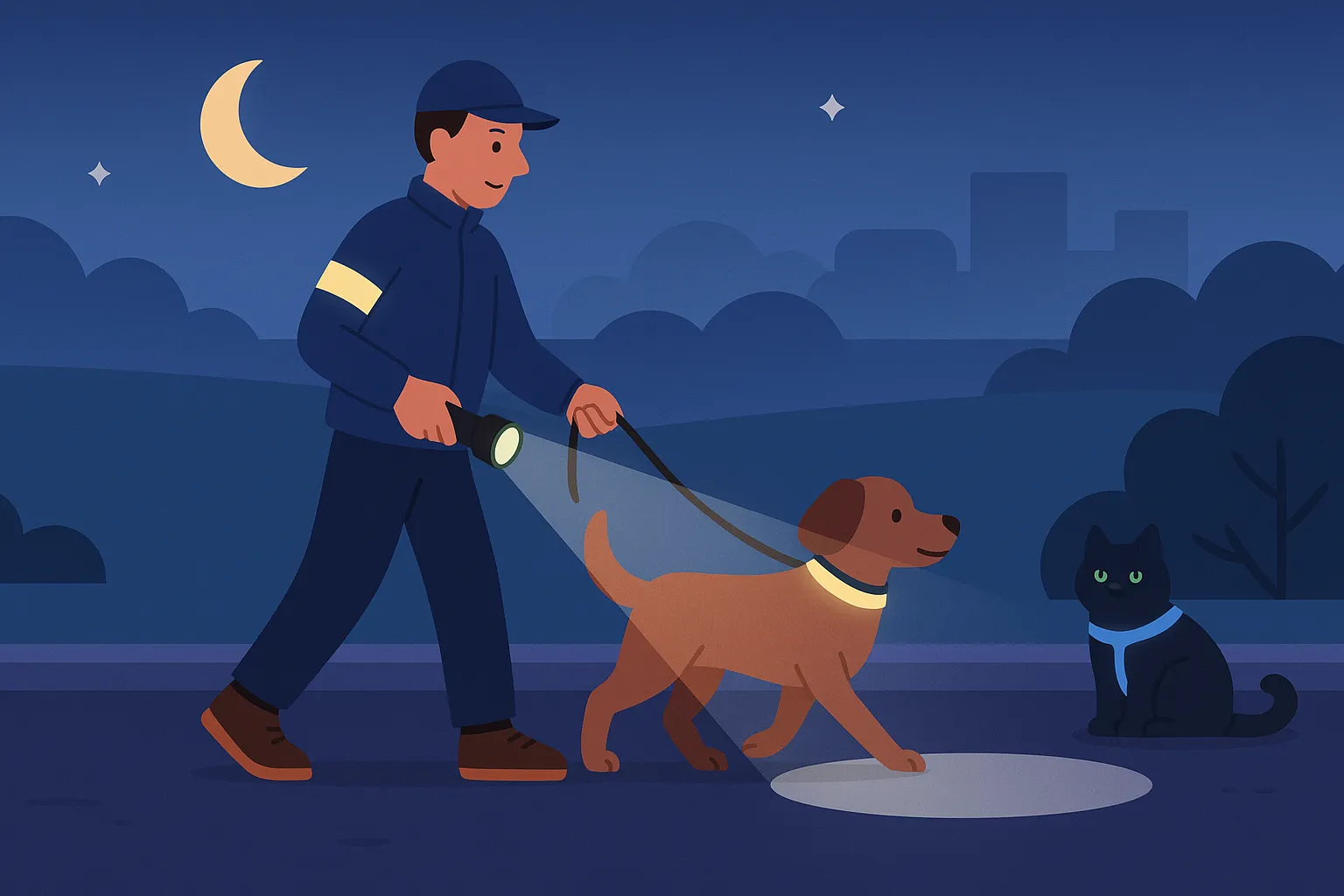
- High-visibility jacket or vest, like those used for work or cycling.
- Reflective armbands on arms and ankles.
- Backpack or bag with reflective inserts.
Light-up dog collar, leashes and lights: what to choose
A light-up dog collar is not just a “fashion” accessory: it’s a real lifesaver when you’re on dark streets or in poorly lit parks.
Types of light-up dog collars
There are several options:
-
Full LED collar
- Worn like a normal collar.
- Has a continuous or dotted light strip.
- Runs on batteries or USB charging.
- Often has steady light or flashing modes.
-
Light strip or ring added to the collar
- Slips over the existing collar.
- Adjustable and cut-to-size.
- Very handy if you have more than one dog (you can use it only when needed).
-
Clip-on light for collar or harness
- Small light that clips onto the collar ring or harness.
- Often waterproof.
- You can attach more than one (e.g. front and side).
What to consider:
- 360° visibility: ideally, your dog should be visible from every direction.
- Battery life: check how long it lasts in continuous mode.
- Water resistance: if you walk in the rain or in damp areas.
- Weight and size: especially for small dogs.
Lights for the leash and for you
In addition to a light-up collar, you can increase safety with:
- Leashes with built-in LEDs: they illuminate the leash line, making the dog–person connection clearly visible.
- Small headlamps (like those used for running or hiking): they keep your hands free and light the path.
- Rear lights (like bike lights) attached to a backpack or jacket, so you can be seen from behind.
An effective strategy is to combine:
- Reflective gear (which works when lit by others).
- Active lights (which emit their own light, such as LED collars, torches and clip-on lights).
Harnesses, leashes and gear: what changes at night
Night is the worst time to discover that the leash is worn out or that your dog’s harness opens too easily.
Choosing a safe harness for night walks
For walks in the dark, the following are preferable:
- H-style or Y-style harnesses:
- They wrap the chest better.
- They reduce the risk of your dog backing out and slipping free.
- Harnesses with:
- Double adjustment points (chest and sternum).
- Strong buckles that are well maintained.
- Built-in reflective inserts.
If your dog tends to panic (thunder, motorcycles, fireworks):
- Consider so-called anti-escape harnesses with a third strap around the waist.
- Attach an ID tag with your phone number and, if possible, also a QR tag or small tag holder.
Leash: recommended length and materials
For a night walk with your dog, it is advisable to use:
- Length 1.20–2 m / 4–6.5 ft:
- It gives you control without constantly holding your dog back.
- It keeps your dog close when needed.
- Strong, non-slip material:
- Nylon or technical fabrics with grip, especially if it’s raining.
- Quality clasp:
- No signs of wear or a loose, soft opening.
Be careful with retractable leashes:
- In the city or near roads, in the dark, they are often not recommended:
- The line is almost invisible to cars and cyclists.
- Your dog can move farther away than you think in just a few seconds.
- If you really want to use one, limit the extension and use it only in very safe areas far from traffic.
Dog GPS: why it’s especially useful at night
A dog GPS does not replace a leash, collar or good handling, but it is an extra safety net, especially when visibility is low.
When dog GPS really makes a difference
It can be very helpful if:
- Your dog is anxious/nervous and tends to run off when there are loud noises.
- You live in rural areas or places with many dark trails.
- You take night walks in woods or large parks.
- Your dog is staying with a dog sitter or in a boarding facility that takes them out in the evening.
Benefits:
- If your dog slips out of the harness or leash, you can track their location in real time.
- Some devices send alerts if the dog leaves a safe zone (geofence).
- You can share your dog’s location with other people (family members, dog sitters).
With the PawsPet app you can:
- Register your dog, saving in one place:
- full profile
- microchip number
- vet contact details
- Note walking habits and times and keep track of usual areas, so if something happens you know which places to check first.
How to manage your dog at night: behavior and training
Accessories help, but real safety also comes from:
- Basic dog training.
- Constant attention from the owner.
- Common sense when choosing routes.
Useful commands for walking in the dark
Training a few commands is especially important:
- “Come” / reliable recall: essential if your dog gets loose.
- “Heel” or “close”: to keep them near you in critical areas (crossings, narrow passages).
- “Wait” / “Stop”: before crossing the street.
- “Leave it”: if they pick something up from the ground in the dark (food, dangerous objects).
To reinforce these commands:
- Train them in advance, in calm and well-lit environments.
- Use a high-value reward (treats, play, praise).
- Repeat short sessions during the evening walk, in safe spots.
Managing anxiety and sensory overload
Some dogs at night:
- Are more confident and relaxed (fewer visual stimuli).
- Others become more insecure (shadows, amplified sounds).
Signs of discomfort:
- Tail low or tucked between the legs.
- Ears back, repeated yawning, panting without physical reason.
- Tendency to pull toward home or stop often.
What you can do:
- Choose shorter, familiar routes.
- Keep a calm pace, without forcing them.
- Reward your dog when they show calm exploratory behavior (sniffing, walking calmly).
- If the fear is intense, consider a training or behavior support program with a qualified professional.
Practical checklist: what to bring for a night walk
For your dog
- Collar with ID tag and clearly readable phone number
- Well-adjusted harness, preferably with reflective inserts
- Strong leash (fixed is better, 1.20–2 m / 4–6.5 ft)
- Light-up collar or clip-on light
- Optional dog GPS fully charged
- Waste bags
- Treats for rewards or difficult situations
For you
- High-visibility jacket/vest
- Any reflective armbands or bands
- Small torch or headlamp
- Charged phone (with useful numbers: vet, family, emergency veterinary care)
- House keys in a safe place, easy to reach
With PawsPet you can:
- Save your dog’s vet contacts, microchip number and health notes in the app, so you always have them with you even at night.
- Set reminders for parasite prevention and regular check-ups, which are important if your dog walks through tall grass or damp areas even in the evening.
Extra tips for city vs. countryside living
In the city
- Pay attention to:
- Poorly lit crosswalks.
- Cyclists and e-scooters, often silent and fast.
- Broken glass and litter on the ground near bins.
- Keep your dog on the inside edge of the sidewalk, away from the road.
- In poorly lit off-leash areas:
- Consider whether it’s really safe to let them off leash, or whether it’s better to stay with a long leash.
- Always use a light-up collar and/or harness so you can see where they are.
In the countryside or suburban areas
- Consider using:
- High-visibility jackets for both you and your dog.
- A headlamp to light the ground.
- Watch out for:
- Holes, ditches and trenches.
- Possible wild animals.
- Don’t assume no cars will pass: at night they may be moving faster than expected and notice you late.
Quick tips: how to increase safety right away
Practical tips box
- Choose at least one reflective accessory and one light-up accessory for both you and your dog.
- Do a monthly check of the harness, collar and leash:
- stitching
- clips
- worn spots
- Practice using a headlamp: it keeps your hands free to manage the leash.
- Set up a complete dog profile in the PawsPet app, including:
- name and photo
- microchip
- emergency numbers
- If a route makes you even slightly uncomfortable at night, change it: your sense of safety is essential for helping your dog stay calm.
Conclusion: making night walks safe and enjoyable
A night walk with your dog can become one of the best moments of the day: fresh air, less chaos and more quality time with your four-legged companion.
For it to be truly enjoyable and safe, remember to:
- Take care of visibility: light-up collars, reflective harnesses, visible leashes.
- Choose routes and times carefully.
- Regularly check equipment and the condition of collars and leashes.
- Work on basic commands and your dog’s comfort in the dark.
- Consider a dog GPS if you frequent isolated areas or if your dog is particularly energetic or timid.
With PawsPet you can manage in one place:
- your dog’s data,
- the contacts of trusted professionals,
- health reminders,
to enjoy evening outings with greater peace of mind.
Try the PawsPet app and turn every walk — even in the dark — into a safe, organized and calm moment for you and your dog.
FAQ about walking your dog at night
Is it safe to walk your dog at night?
Yes, a night walk with your dog can be safe if:
- you use the right leash, harness and reflective accessories,
- you choose well-lit, familiar routes,
- you always keep your dog on a leash near traffic,
- you pay attention to the environment (cars, bikes, people, other animals).
Safety depends mainly on how you plan the outing and how visible you are.
Is a collar or harness better for walking in the dark?
In general, a harness is preferable, especially if:
- your dog pulls a lot,
- they are easily frightened,
- they have already shown escape attempts.
A harness offers greater control and reduces the risk of your dog slipping out by backing away. For visibility, the ideal setup is to combine a reflective harness + light-up collar or clip-on light.
Is a light-up dog collar really useful, or is a reflective one enough?
They complement each other:
- Reflective accessories work only when illuminated (for example by car headlights).
- A light-up dog collar emits its own light, making the dog visible even from far away, in parks or on poorly lit streets.
For optimal safety during night walks, it’s recommended to have both.
Can a dog go off leash at night in a fenced area?
If the area is truly fenced and secure, it may be possible, but:
- first check carefully for escape points (low fences, holes, gates).
- Make sure the area is well lit enough for you to see your dog.
- Still use a light-up collar or reflective accessory to track their movements.
Even in a fenced area, always consider the dog’s personality and the surrounding environment (noise, other dogs, nearby roads). If in doubt, it’s better to use a long leash and manage freedom in a controlled way.