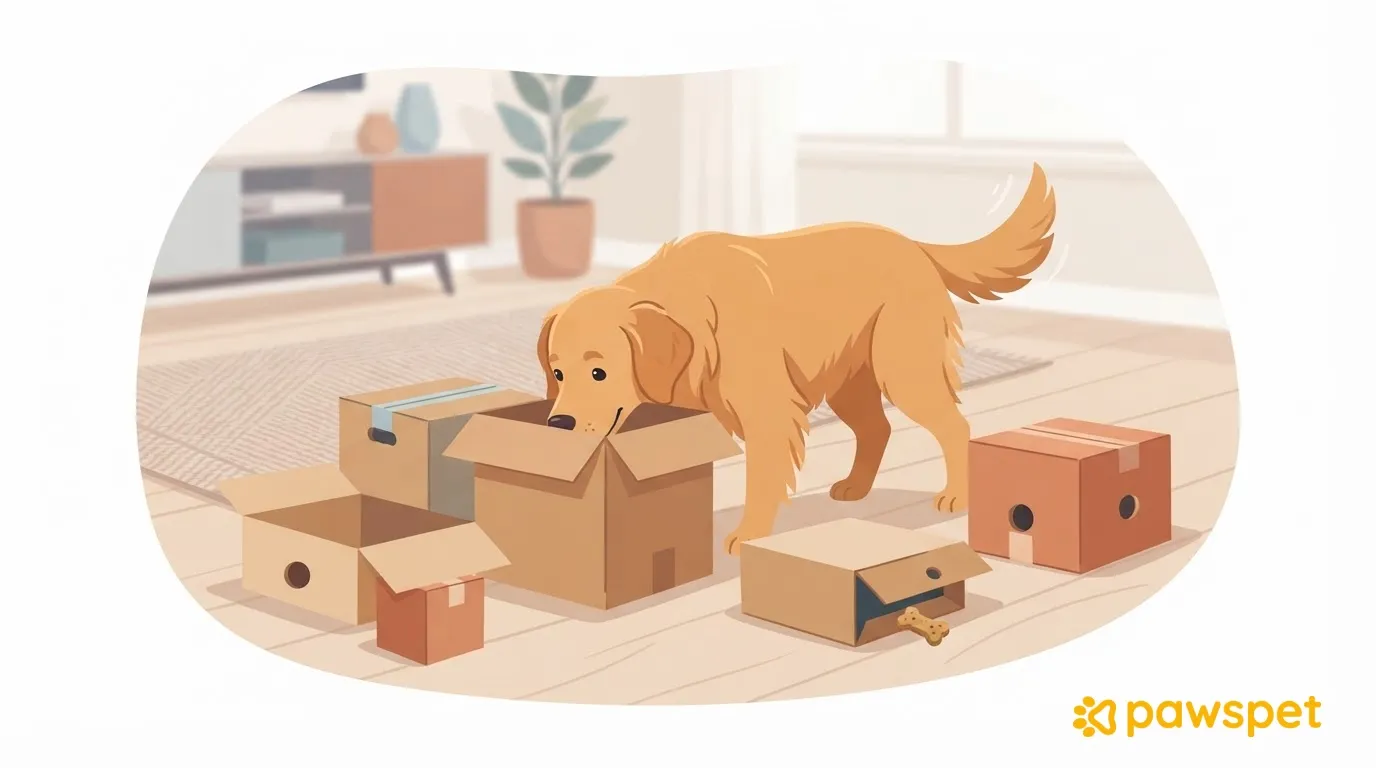
For a first indoor scent search, all you need is three or four clean cardboard boxes, small treats your dog already likes, and a few minutes. The secret to the box game is to start at a very easy level and change just one thing at a time. That way, your dog understands what to do and can succeed from the very first searches. It’s a handy activity for the short, rainy days of late January, when you spend more time indoors.
What you need: boxes, treats, and a quiet space
Boxes. Get three to six boxes of a similar size, such as shoe boxes or shipping boxes. They should be clean and free of tape, staples, plastic labels, polystyrene, and bubble wrap. Discard any boxes that have held detergents or chemicals.
Treats. Use small pieces: part of your dog’s daily food allowance or their usual treats are best, deducted from the day’s total. Prepare just a few pieces per session. If your dog is on a diet recommended by a veterinarian, use only foods you’ve agreed on with them. Avoid foods that are dangerous for dogs, such as chocolate, grapes and raisins, onions, and products containing xylitol.
Space. Choose a room without other animals or children running around, with nonslip flooring or a rug. Supervise the game from start to finish, and put the boxes away when the session is over.
The first session, step by step
- Put one open box on the floor. Show your dog the treat and place it inside, clearly in view, while they watch.
- Choose a start word, such as “search,” and say it only once the treat is already in the box.
- Let your dog go to the box on their own, without pointing to or touching it. When they find the treat, praise them calmly and repeat.
- After a few successful searches, move on to two or three open boxes with just one treat, still while your dog watches.
- Finish after a few successful searches, while your dog is still eager to play.
If your dog can’t find the treat, don’t help with your hands or point to the box: make the step easier. Move the box closer, use just one box, or leave the treat more visible. Then finish with a successful search.
How to make the search more challenging
Change one variable at a time. Move on to the next level when your dog solves the current one easily, over several sessions.
| Level | What changes | When to move on |
|---|---|---|
| 1 | Starting point: one open box, dog watches | Finds the treat right away and confidently |
| 2 | More open boxes, dog watches | Goes straight to the right box without hesitation |
| 3 | Dog doesn’t watch while you hide the treat: wait in another room or with a family member | Searches calmly and finds it without your help |
| 4 | Flaps partly closed or clean paper loosely crumpled over the treat | Opens or moves it on their own without getting upset |
| 5 | Boxes scattered around the room or one inside another | Checks the boxes one by one |
| 6 | More treats or a second room | Final level: change one detail at a time |
If your dog can’t find the treat a couple of times in a row, go back to the previous level. The levels are guidelines.
How often and for how long
A few minutes per session is enough, a few times a week or more often if your dog enjoys it. Stop before they get tired. These aren’t fixed rules: observe your dog and adjust the pace. To help you keep up with sessions, you can use the PawsPet app to create a recurring activity from the “Activities” tab (for example, one of the “Home training” type) with “Repeat” and a reminder, and mark each occurrence as done.
Mistakes to avoid and signs of frustration
- Pointing to or touching the box. That solves the problem for your dog. Let them get there on their own.
- Long sessions or too many treats. A few successful searches are better than a game that ends in boredom. Keep treats small and count them as part of your dog’s daily food allowance.
- Making things harder all at once. If you change too many things at once, your dog may get confused: go back to the table.
Signs of frustration. If your dog barks, scratches frantically, or walks away, they may be frustrated: go back to an easier level or take a break.
If your dog tears up or swallows cardboard and paper. Stop the game and switch to sturdy containers they can’t break, always under supervision. If they have swallowed a lot or seem unwell, contact your veterinarian.
Two dogs. Let them play one at a time and keep the other in a separate room to avoid competition over food.
The plan for the first week
- First few days: levels 1 and 2, a few searches per session, with your dog watching throughout.
- Then: level 3, with your dog not watching while you hide the treat.
- If level 3 goes well: level 4, with the flaps partly closed.
- After each session: note the level you reached and start from there next time.
Move on to the next step only when your dog meets the table’s criterion, even if it takes several days.
Frequently asked questions
Can I do this with a puppy?
Yes, keep it simple and very short: levels 1 and 2, with just a few searches. Puppies like to chew during teething: make sure yours doesn’t chew the cardboard, and switch to sturdy containers if they do.
What if my dog doesn’t seem interested?
Try treats they like more, choose a time away from meals, and go back to an easier level. If food isn’t motivating, you can try DIY nose games by hiding one of their toys instead of food.