Household strings pose three different risks to a kitten: chewing on live electrical cords, getting tangled in looped cords, and swallowing strings or rubber bands. The solutions differ: protect or unplug electrical cords, tie looped cords up high, and store other items in closed containers. Playing with a string is still an option, but only when you’re there to supervise.
Electrical cords and chargers
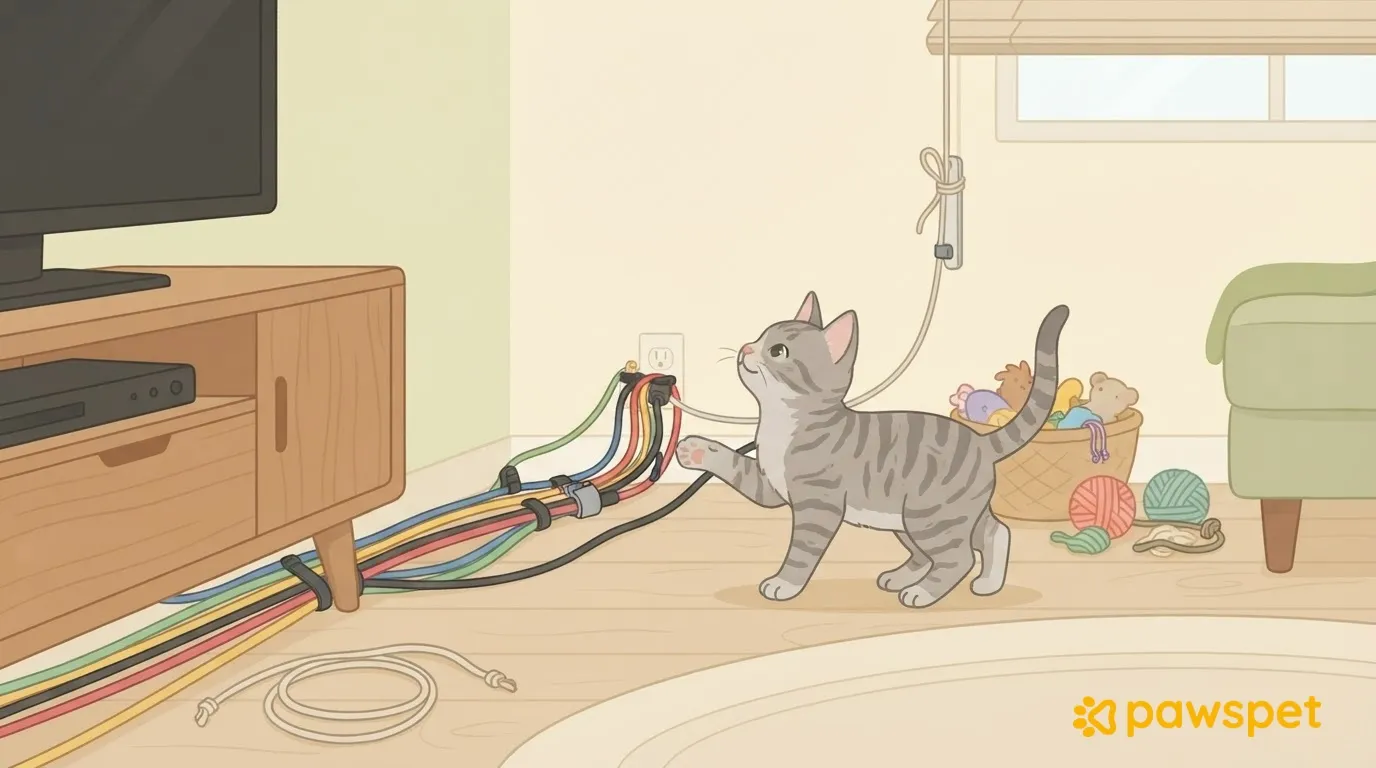
You don’t have to remove every cord. Protect the ones you need, and unplug and put away those you don’t use. Check behind the TV and desk, near the nightstand, and along extension cords on the floor. In June, when fans and portable appliances are in use, include their cords and any chargers left on the floor in your check.
- Run cords behind furniture or through cable raceways secured to the wall.
- Cover exposed sections with cord sleeves, without leaving accessible coils.
- Put power strips in dedicated cable management boxes.
- Unplug chargers when they’re not needed and put them away instead of leaving the cord dangling.
Check frequently for bite marks. If a cord is damaged, stop using it and replace it rather than repairing it with tape. Don’t assume any sleeve or box is “cat-proof”: check that your kitten can’t reach any exposed parts.
Cords for curtains, blinds, and roller shades
A hanging loop may look like a toy, but it can also trap a kitten’s head or paws. Check both curtain cords and the chains on blinds and roller shades.
Wrap the cords around a cleat secured high on the wall. Where the system allows, shorten the cords and separate the loops; secure the chains so they don’t dangle. If the curtains are tempting, keep them raised during the first few months, while still securing the cords and chains.
Strings, rubber bands, and small items to put away
The solution here is to put items away in a closed space as soon as you’re done using them, rather than leaving them out between uses. Here’s a room-by-room check:
- Bathroom: Put dental floss and hair ties away; don’t leave them in an open wastebasket.
- Living room: Put away yarn, sewing thread with the needle, and gift ribbons after each use.
- Bedroom: Keep loose laces in drawers and hoodies with drawstrings in a closed closet.
- Kitchen: Put away string and food packaging rubber bands, including those just removed from packages.
Use closed containers and lidded baskets. Keep your sewing kit in a designated place and close it as soon as you’re done. Swallowed string or a rubber band can be dangerous and requires immediate contact with a veterinarian.
String toys: only with supervision
You don’t need to give up feather wands or toys with a string tail: play with your kitten, then put them in a drawer as soon as you’re finished. Being in the room while you do something else isn’t the same as supervising play.
Before you start, check that no pieces can come off. When your kitten plays alone, leave out toys without long strings or small parts.
If you find your kitten with a cord in its mouth or suspect it swallowed something
- If your kitten is in contact with a plugged-in cord, don’t touch it: turn off the power at the main switch first, or unplug the cord only if you can do so safely.
- Contact your veterinarian immediately or an emergency veterinary clinic, even if your kitten seems fine. Do this if you suspect it swallowed a string or rubber band, too, and follow the instructions you receive.
- Don’t pull a string protruding from the mouth or anus: tell your veterinarian.
- Don’t try home remedies.
Save your veterinarian’s number and the number of a nearby emergency veterinary clinic in your phone now.
The cord check to repeat
Repeat these five checks when you move furniture, add an appliance, or your kitten starts reaching higher:
- Cords in use are hidden or protected, with no bite marks.
- Unused chargers are unplugged and put away.
- Cords and chains are secured, with no hanging loops.
- Strings, twine, rubber bands, and sewing kits are put away in closed containers.
- String toys are put away after use.