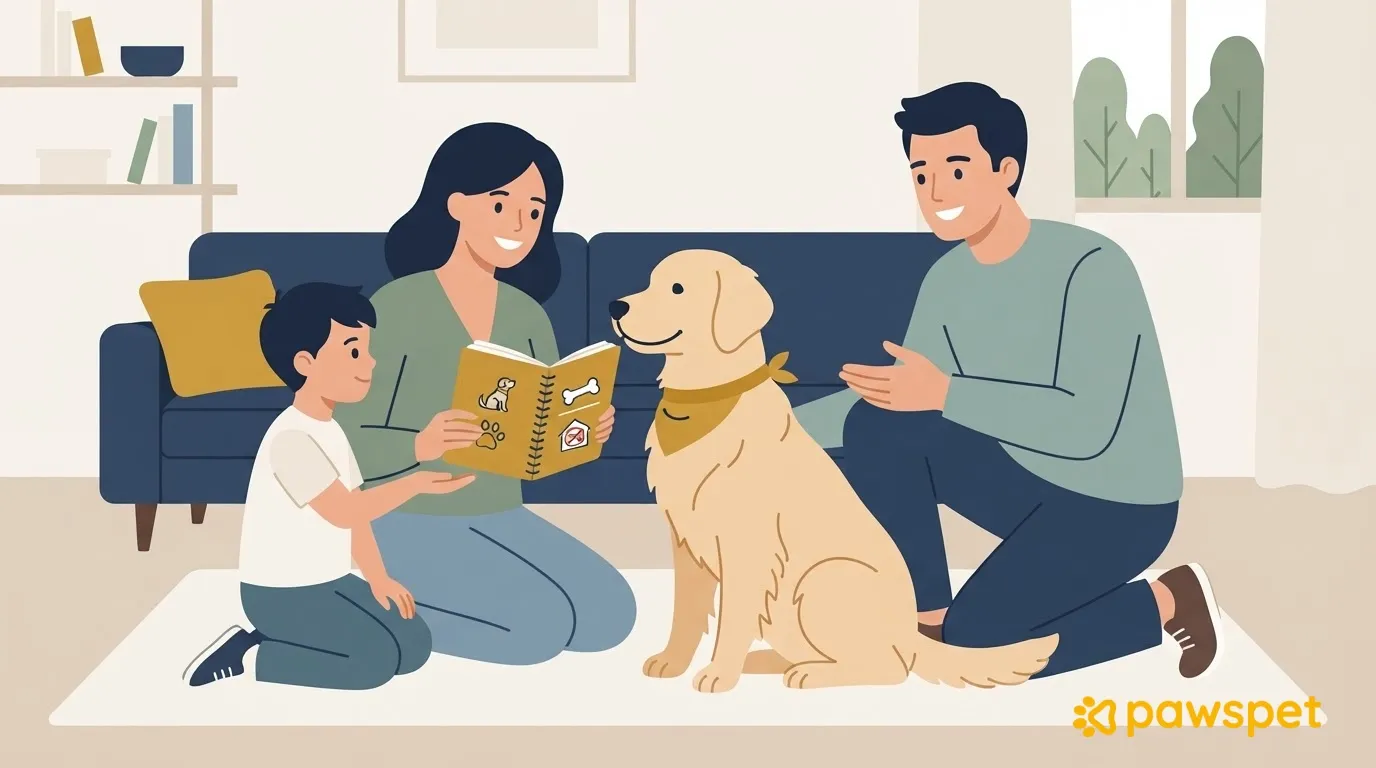
Dogs learn more easily when each word has just one meaning and the rules don’t change depending on who is home. To make that happen, create a small family handbook: a written vocabulary, a few shared rules, one person responsible for each new exercise, and a session log. Summer, when you may be spending more time together, can be a good opportunity to get on the same page.
Why mixed signals confuse dogs
Dogs connect words and gestures with what happens next. If “down” means lie down to you but get off the sofa to Grandpa, the same signal is asking for two different things.
Allowing your dog on the bed and then scolding them for getting up there also makes the situation uncertain. Before assuming they don’t understand, check whether everyone is asking for the same thing.
The family vocabulary
Put up a chart where everyone can access it. These are examples to teach, not official cues: adapt the words and gestures, then keep them consistent.
| Word | Gesture | Exactly what it means | When not to use it |
|---|---|---|---|
| Sit | Hand moving upward | Sit, without lying down | To ask for “down” |
| Down | Palm facing the floor | Lie down | To get off the sofa |
| Off | Point down beside the sofa | Move from the sofa to the floor | To ask the dog to lie down |
| Come | Arms open | Come to me | To scold the dog or call them for something unpleasant |
| Wait | Palm facing forward | Stop until I say “go” | To end the game |
| All done | Hands by your sides | My game with you is over | To ask the dog to stay still |
Follow three rules:
- One word for one action, with no alternative meanings.
- Never use the recall cue to scold your dog or call them for something unpleasant.
- Say the cue once; if your dog doesn’t respond, simplify the request and help without forcing them instead of repeating it ten times.
Household rules and rewards: decide together
Decide together as a family:
- access to the sofa and bed;
- food from the table;
- how to greet visitors;
- how to handle doors and gates;
- whether and how to play roughhousing games.
The important thing isn’t whether you allow the dog on the sofa, but that no one changes the rule. Put safety first with doors, gates, and games.
Agree on what to reward and who gives the reward: for example, if you ask for “sit,” you give the reward—not everyone at once. Use a shared daily allowance of treats, avoiding unagreed extras. Reward what you want to see repeated.
Who teaches and who reinforces: family roles
Choose one adult to be responsible for each new exercise, and work on one at a time. The others can use it with the same cue once the dog understands it.
Give children simple tasks, always with an adult present: for example, asking for “sit” before tossing the ball. They must not chase the dog, hug them tightly, or disturb them while they eat or sleep. No one should use physical punishment.
The session log
A notebook or shared note is enough. Use this format: date · who · exercise · where · how it went · what to change. For example: “June 23 · Anna · sit · kitchen · unsure with noises · try again somewhere quiet.”
Check it before you start to avoid two consecutive sessions on the same exercise or conflicting requests.
In the PawsPet mobile app for owners, open “Activity” → “+” and select “Home Training” in the “General” category. Set the date and time, select the dog, and write the name of the person who led the session in “Notes” as well; then save. Use the “Pet” and “Category” filters to review sessions.
A family member can log sessions if they have a PawsPet account and are invited as a collaborator with “Edit” in the “Activity” area.
When to ask a professional for help
Discuss any sudden change with your veterinarian first: pain or illness can affect behavior.
If fear, reactivity, growling, or biting occurs, don’t insist on continuing the exercises. Ask a dog trainer or behavior consultant for help. You can also involve one if your family can’t reach an agreement. Bring the vocabulary chart and session log to the appointment.
To look for support for your family, you can filter services in the PawsPet app by “Training” or “Behavior Consultation” and review provider profiles and availability.
Your first 15-minute family meeting
Use this agenda:
- Approve the vocabulary and put it up.
- Decide on household rules.
- Choose who will teach the next exercise.
- Start the session log.
- Schedule a short weekly meeting to review challenges and adjustments.
The goal is an agreement everyone can follow, not a perfect dog.
Frequently asked question
What if a grandparent doesn’t want to change their habits?
Involve them in the decision by asking which rule they find difficult. Suggest a simple task using the agreed cue. If they don’t want to use it, ask them to leave that exercise to another family member rather than introducing alternative words.