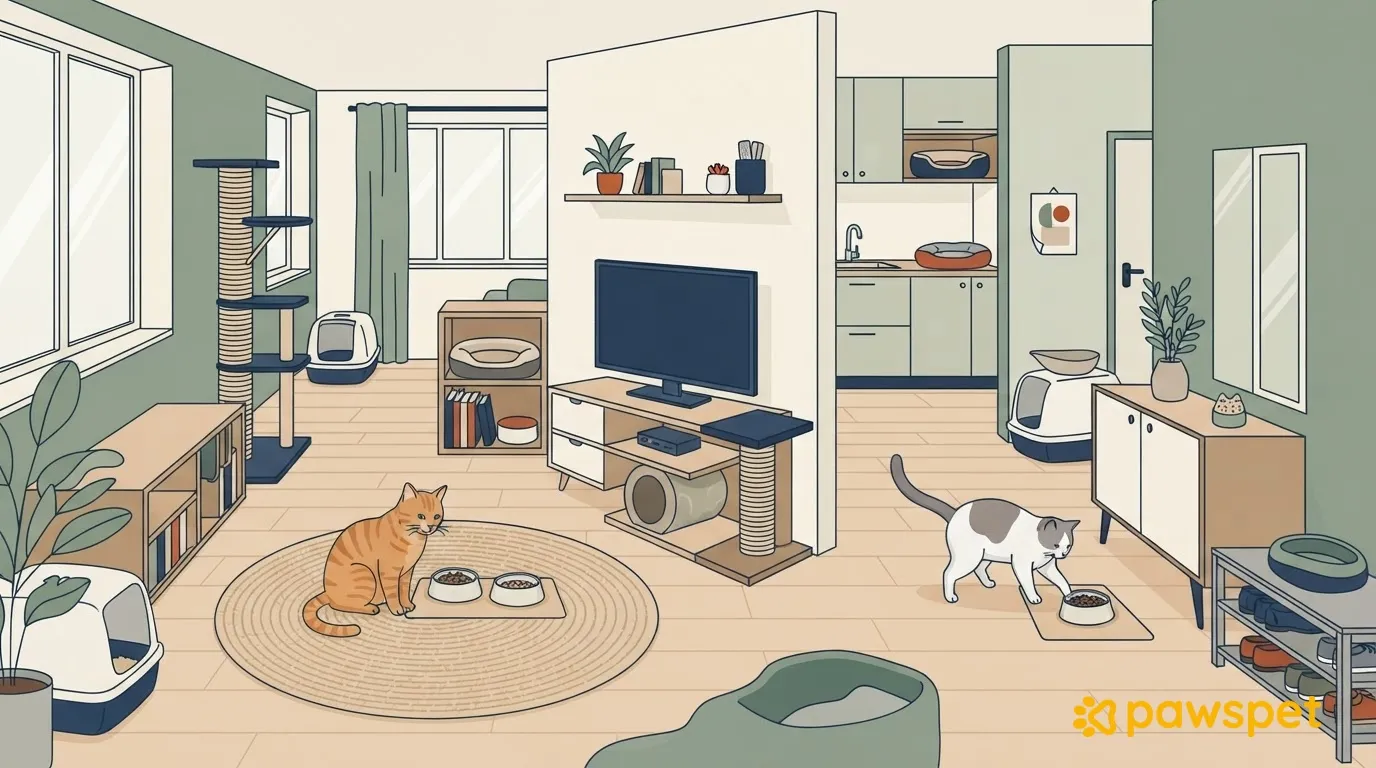
With two cats in a one-bedroom apartment, or a studio, tension often arises when they have to pass through the same narrow spot or share a single station. A practical solution is to duplicate resources in different areas and create alternative routes, so each cat can eat, drink, use the litter box, and rest without crossing paths with the other.
The principle: each cat should be able to avoid the other
Rather than keeping them far apart, the goal is to let each cat choose whether to stay, wait, or go somewhere else without having to pass the other. That’s why it helps to think in terms of stations and routes, not accessories. A station is an area where you group what’s needed for one activity: eating, using the litter box, or resting.
This leads to the two-route rule: each station should be reachable and easy to leave from at least two directions, including via an elevated route. That way, neither cat gets trapped in a dead end, and if the other approaches from one side, they can leave from the other without crossing paths.
This is a practical guideline, not a standard. To try it out, choose a station and imagine one cat staying there: where could the other cat approach from? And where could the cat go if it doesn’t want to walk past the other?
A resource map for two cats
| Resource | How to arrange it | Common mistake in a small home |
|---|---|---|
| Food | Two bowls in spots where the cats can’t see each other, or, if that’s not possible, as far apart as possible | Bowls side by side or lined up on the same piece of furniture |
| Water | Multiple spots, including some away from the food | A single spot next to the food bowls |
| Litter boxes | Start with at least two, in different areas of the home | One shared litter box, the most vulnerable setup; or two side by side, which may feel like a single station |
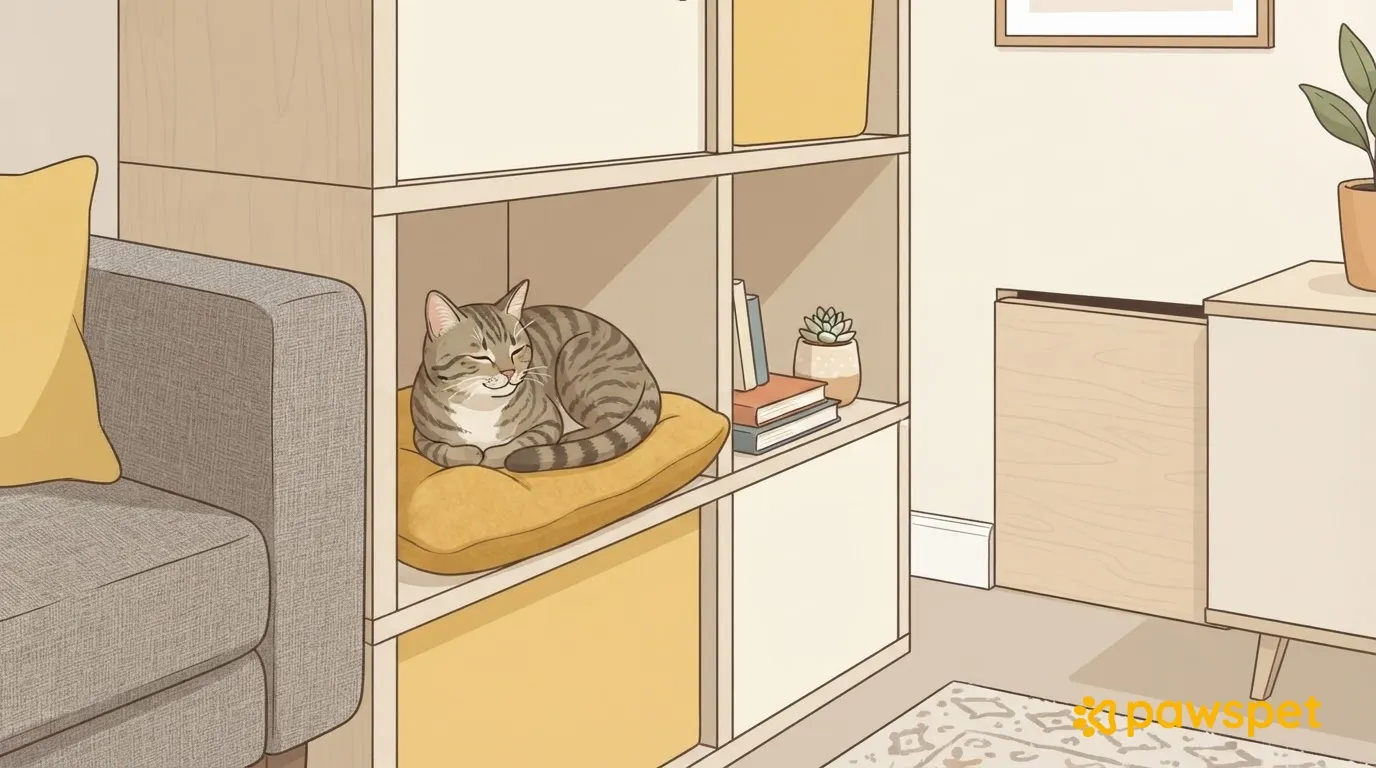
| Resting spots | Multiple places at different heights; duplicate the most sought-after ones, such as the warmest and highest spots | One coveted spot that one cat ends up guarding |
| Scratching posts | More than one, near passageways and resting spots | Just one, which becomes another contested spot |
| Play | Separate play sessions, or two toys, one for each cat, to avoid competition | A single toy for both cats, which becomes an object of conflict |
In a small space, two nearby resources often count as one: their location, not their number, is what really separates them.
Passageways, doors, and dead ends
In a small home, problems arise where only one cat can pass at a time. Here are common bottlenecks, with one solution for each:
- Narrow hallway. If one cat stops, the other can’t get through: offer a second route, such as an elevated path on stable surfaces (how to create one is a separate topic).
- Bedroom door. If left ajar, it becomes a single narrow opening: use a doorstop to keep it open.
- Space between the bed and the wall. With a cat inside, it’s a dead end: if it’s the only access to an area of the home, move a piece of furniture to create a second way through.
- Litter box at the end of a bathroom with no exit. The cat inside can be trapped by the other: move it to a more open area or add a second box somewhere else.
- Food bowl in a main thoroughfare. The cat eating blocks the way: move the bowl out of the route.
To break the line of sight between two stations, you can use a low piece of furniture, a curtain, or a few boxes.
Signs of tension to watch for
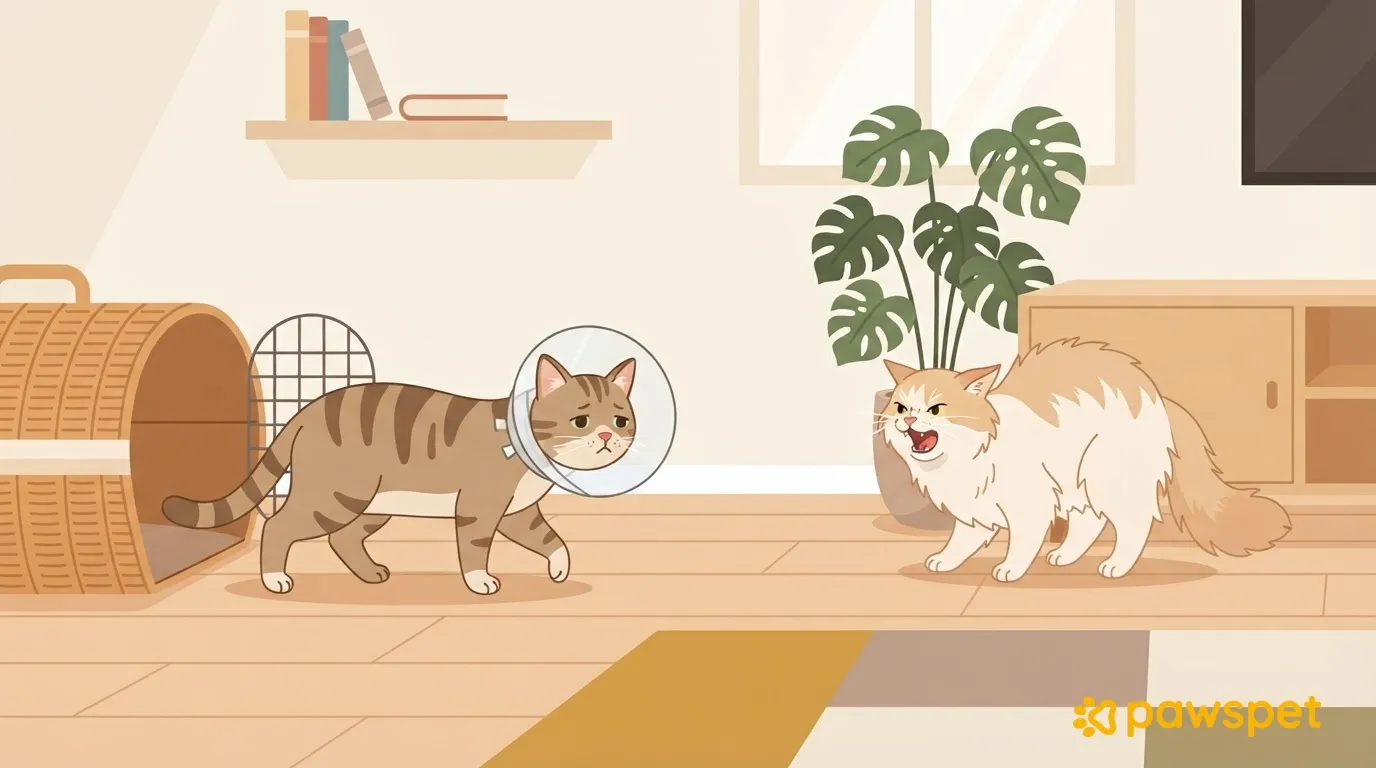
Notice whether these behaviors keep happening in your home. They’re not a diagnosis, but they can point to where you should take a closer look:
- fixed, prolonged staring at the other cat;
- one cat blocking doors and hallways;
- waiting near the litter box or food bowls while the other cat is using them;
- chasing the other cat as they leave the litter box;
- one cat eating quickly or leaving food behind;
- one cat avoiding a room or hiding more than usual;
- eliminating outside the litter box (this can also have health-related causes: see below).
During play, the cats take turns and pause spontaneously. Tension, on the other hand, keeps recurring in the same spot, with the roles never changing. Note where and when it happens, even in a note on your phone: this can help you figure out whether the problem centers on a particular place in the home.
To notice whether one cat is eating less, you can weigh both cats regularly and record their weight in the “Measurements” section of each cat’s profile in the PawsPet app, where a chart shows how their weight changes over time; talk to your veterinarian about any changes.
When to ask for help
Contact your veterinarian first if you see fights that cause injuries, a cat that stops eating, elimination outside the litter box, or a cat that is always hiding: pain and illness can change behavior, and rearranging the home isn’t enough to address them.
If your veterinarian finds no health-related causes and the tension continues, a feline behavior professional may be able to help: bring your notes about where and when it happens.
To get started, work on one resource at a time: first add a litter box or food bowl, keep the new setup for a week, and see whether the signs decrease; then move on to the next one.