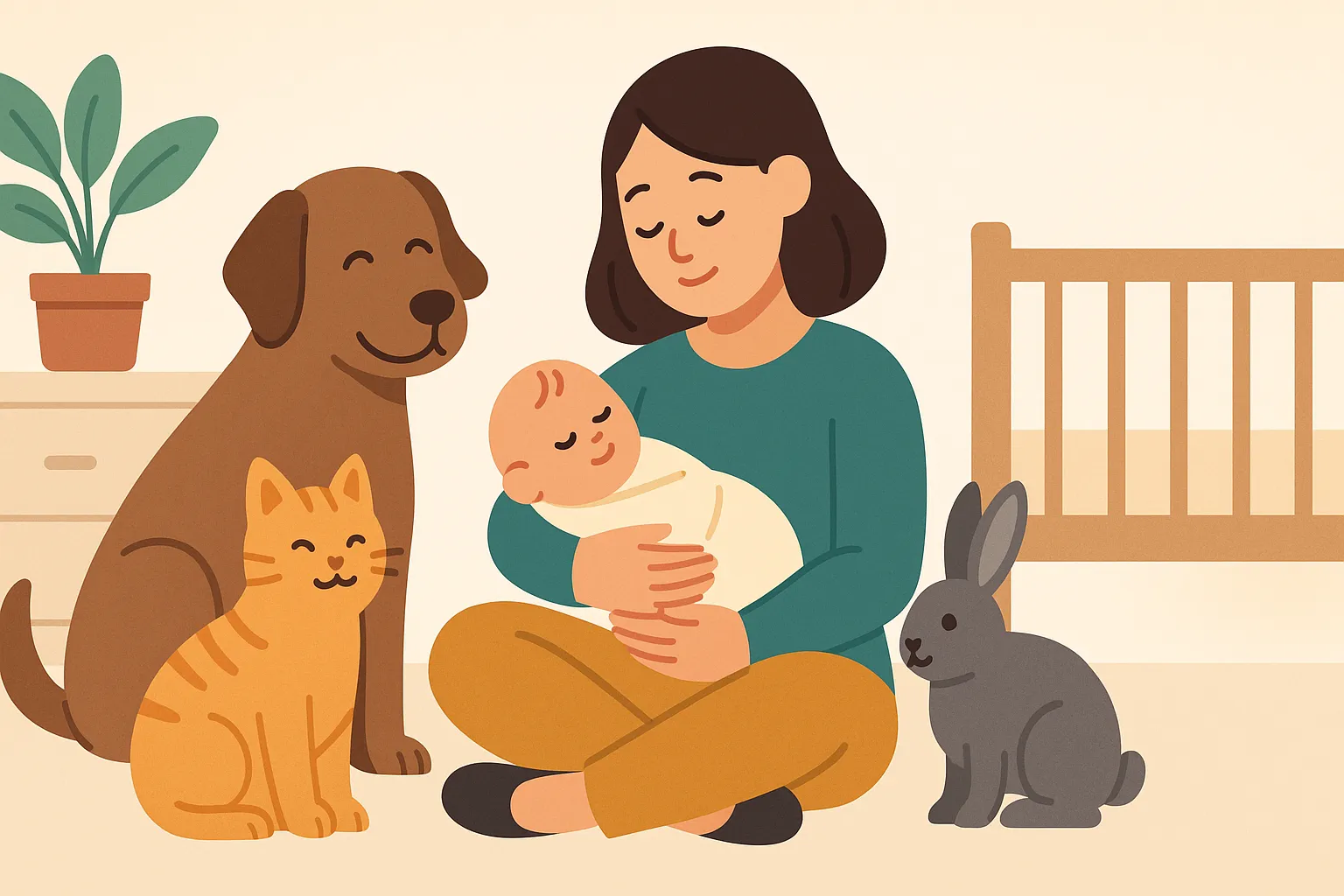
When a baby is about to arrive at home, one of the first questions many owners ask is: how can we manage dog, cat and newborn under the same roof in a calm and safe way?
Living together with children and pets can be wonderful: it helps little ones develop empathy, respect and a sense of responsibility. But for it to work, it is essential to prepare the dog and cat before the baby arrives, manage spaces, routines and rules properly, and take care of child safety with pets.
In this practical guide, we’ll look at:
- how to prepare your dog for the baby’s arrival;
- how to help your cat cope with changes in the home without stress;
- how to organize spaces and daily routines;
- how to handle the first meetings between newborn, dog and cat;
- how to prevent jealousy, fear and problematic behaviors;
- safety rules for children and animals.
1. Understanding the dog and cat’s point of view
Before getting into practical tips, it is important to put ourselves in our animals’ paws.
1.1 What changes for them with the baby’s arrival
For dogs and cats, a newborn means:
- new smells (diapers, creams, milk, pharmacy items, hospital);
- new sounds (crying, squeaks, musical toys);
- new objects (strollers, high chairs, cribs, playpens);
- changes in routine (meal times, walks, playtime);
- less attention from the owners, at least in the early days.
All of this can lead to:
- stress and confusion;
- possible jealousy (especially if the dog/cat was used to a lot of attention);
- fear of the new “noisy creature”;
- attempts to seek contact again (jumping on the owner while they are holding the baby, getting into the crib, and so on).
Preparing your dog and cat in advance for the baby’s arrival helps minimize these issues and supports a calm coexistence.
2. Preparing your dog for the baby’s arrival
2.1 Start early: ideally 3–4 months before birth
If possible, start preparing your dog during pregnancy:
- changes are gradual;
- the dog has time to adjust to new rules and routines;
- you avoid stacking baby-related stress on top of sudden restrictions.
Things to do in advance
- Introduce new access rules (e.g. no bed or sofa, if you know you won’t want that later).
- Get them used to being alone for short periods even when you are at home (useful when you’ll be busy with the baby).
- Work on basic cues such as:
- sit;
- stay;
- off;
- come;
- leave it.
These cues will be invaluable when you are holding the baby and need to manage your dog safely.
2.2 Get your dog used to new sounds, smells and objects
You can start “bringing the baby into the house” symbolically even before birth.
Newborn sounds
- Play recordings of baby cries and vocalizations at low volume, even from YouTube or apps.
- Pair the sounds with something positive for the dog:
- a treat;
- a special toy;
- calm voice and gentle petting.
Increase the volume gradually, based on the dog’s reaction.
Smells and objects
- Bring into the home: unopened diapers, creams, detergents, blankets.
- Let the dog sniff the items, without scolding, but with clear rules: for example “sniff – away,” followed by a small reward when they move away on request.
- Set up in advance:
- crib;
- changing table;
- playpen or activity mat.
- Teach your dog that some of these spaces are off-limits (we’ll see how below).
2.3 Managing jealousy: attention yes, but structured
Many owners, afraid of jealousy, start cuddling the dog more during pregnancy, then, once the baby arrives, attention drops all at once. That contrast can be frustrating.
Better to:
- keep attention levels during pregnancy similar to what you can realistically provide after birth;
- introduce:
- scheduled play sessions;
- more predictable routines.
2.4 When to involve a trainer or veterinary behaviorist
A consultation with a professional is recommended if your dog:
- has a history of bites, growling, or aggression;
- excessively guards food, toys or the owner (resource guarding);
- is very anxious, fearful or reactive to noises and sudden movements;
- gets overexcited easily and struggles to calm down.
A personalized plan reduces risks and helps you face the new dog–baby coexistence with greater peace of mind.
3. Preparing your cat for the baby’s arrival
Cats often struggle a lot with environmental changes. Good preparation reduces the risk of:
- urine marking;
- scratching furniture and objects;
- withdrawing or, on the contrary, becoming clingy and vocal;
- changing eating habits or litter box use.
3.1 Managing your cat’s spaces
Before the baby arrives:
- Decide which rooms the cat may enter and which ones they may not (for example, if the nursery will be off-limits).
- If you want to keep the cat out of the nursery, start months in advance:
- close the door or use a baby gate/net;
- reward the cat when they choose other resting spots.
Safe high places
Many cats handle life with small children better if they can observe from above:
- shelves or tall cat trees;
- radiator hammocks;
- bridge shelves connecting different areas of the home.
These “vertical escape routes” are essential for reducing stress.
3.2 Litter box, bowls and routine
Cats appreciate stable rituals. When the baby arrives:
- try to keep feeding times the same;
- avoid constantly moving:
- the litter box;
- food bowls;
- scratching posts.
If you must move the litter box or other resources, do it:
- gradually, a few inches at a time;
- while recreating similar conditions (same litter, same type of container, same quiet environment).
3.3 Helping your cat get used to the new arrival
As with dogs, you can:
- introduce new smells in advance (creams, closed diapers, fabrics);
- set up the crib or baby bed early, allowing the cat to:
- sniff the item;
- explore it at first;
- then, gradually, prevent access if you want them to stop jumping into it (see next section).
Cat in the crib: how to handle it
If you do not want the cat to jump in:
- initially use a breathable cover or keep the crib covered when the baby is not in it;
- teach a cue like “down” or “off,” always with positive reinforcement (reward when they come down);
- offer comfortable alternatives nearby (cushions, beds, hammocks) so the crib doesn’t become the only cozy place.
4. Organizing spaces and house rules
A good dog–cat–baby coexistence starts with clear, consistent rules.
4.1 Baby zones, pet zones, shared zones
It helps to think of the home as divided into 3 types of areas:
- Baby zones
- crib, changing table, bed;
- diaper-changing corner;
- floor play mat (in the early months).
- Pet zones
- beds, scratching posts, shelves;
- feeding area;
- litter box.
- Shared zones
- sofa (if allowed);
- rugs and larger play areas.
General rules
- Baby zones:
- no litter boxes or bowls nearby;
- no animal left alone with the newborn.
- Pet zones:
- absolute respect, even from adults (avoid constantly moving objects or disturbing them while they eat or use the litter box).
- Shared zones:
- only under close supervision;
- dogs and cats must be able to move away easily.
4.2 Protecting sensitive resources (food, litter, toys)
For child safety with pets, it is useful to prevent conflict situations:
- Do not leave the newborn or small child:
- near the bowl while the dog or cat is eating;
- within reach of the litter box.
- If you have a dog:
- consider using dividers or gates to separate the feeding area from common pathways.
- If you have a cat:
- place the litter box and bowls in a spot not easily reachable by a crawling child;
- keep that area always accessible to the cat, without sudden closed doors.
5. The baby arrives: the first days at home
5.1 The first dog–baby meeting
Arrange the first meeting calmly and, if possible, with another person who can hold the dog on a loose leash, without tension.
Helpful steps:
-
Let the dog greet you first
Enter the house without the baby in your arms, let the dog sniff you, say hello, and release some excitement. -
Introduce the baby gradually
- When the dog is calmer, the other person enters with the baby.
- Keep the dog at a safe distance so they:
- can smell the air;
- but do not immediately reach the baby.
-
Associate the baby with positive experiences
- speak in a calm voice;
- reward them (treats, praise) when they:
- stay calm;
- avoid jumping;
- sit on cue.
-
Never force direct contact
- if the dog seems uncomfortable (lip licking, yawning, stiffness, avoiding eye contact, repeated nose licking, constant paw licking), respect that;
- allow them to move away.
5.2 The first cat–baby meeting
With cats, the approach can be a bit more “open,” but still controlled:
- Do not chase the cat around to “show them the baby.”
- Let the cat approach when they feel safe:
- they often will, out of curiosity and drawn by the new smells.
- If you notice tension (ears back, tail low or stiff, dilated pupils):
- do not force them to stay;
- offer escape routes and high hiding spots.
6. Creating positive associations with the baby
The goal is for your dog and cat to connect the baby’s presence with pleasant things, not just with restrictions and prohibitions.
6.1 Strategies with the dog
- Use high-value rewards only when the baby is present:
- extra tasty treats;
- special toys (stuffed Kongs, long-lasting chews).
- Give targeted attention:
- short cuddle sessions while the baby sleeps (if you feel comfortable);
- mini training sessions of 3–5 minutes.
6.2 Strategies with the cat
- It is often useful to offer:
- treats or lickable paste while you hold the baby;
- wand toy play sessions when the baby is in the room (at a suitable distance).
- If the cat enjoys petting, allow it:
- always within your comfort level and safety;
- avoiding holding the cat together with the baby, especially if the cat is easily agitated.
7. Child safety with pets
Safety comes first, for all family members: newborns, children, dogs and cats.
7.1 Golden rule: never alone
- Never leave a newborn/child alone in the same room with:
- a dog, even if they are “the sweetest”;
- a cat, even if they are “so gentle”.
- Even an animal with no history of aggression can:
- get startled unexpectedly;
- react to a sudden movement or a sensitive area being touched by accident.
7.2 Signs of stress in dogs
To prevent problems, learn to recognize signs of discomfort:
- turns their head away when the baby approaches;
- yawns often out of context;
- licks their nose or lips repeatedly;
- stiffens when the baby is near;
- constantly moves away or looks for escape routes;
- growls, shows teeth, or barks threateningly.
In these cases:
- increase the distance between dog and baby;
- do not punish the dog for growling (growling is an important warning signal);
- consult a professional.
7.3 Signs of stress in cats
In cats, signs of discomfort can be subtler:
- ears pinned back, tail puffed up or twitching nervously;
- very dilated pupils;
- rigid stillness or, on the contrary, sudden escape;
- hissing, growling, scratching if they feel trapped.
Here too:
- never force contact with the baby;
- create more safe hiding spots up high;
- speak with your veterinarian or a feline behavior consultant if the situation continues.
8. As the baby grows: crawling and first steps
Often, the trickiest period for dog–cat–baby coexistence is not the newborn stage, but when the little one:
- starts to crawl;
- tries to pull themselves up by grabbing everything;
- begins to grab, pull and squeeze.
8.1 Teaching your child to respect animals
Even if they are very young, you can start sending a few messages early on:
- “Gentle hands” (guiding their hand);
- “No pulling tails”;
- “No shouting near the dog’s/cat’s ears.”
Use a simple, consistent language repeated by every adult in the family.
8.2 Protecting dog and cat from unintentional child behavior
A small child does not yet control their movements. Your job is to mediate:
- Do not allow the child to:
- jump on the dog;
- squeeze the cat in forced hugs;
- put fingers in the animal’s eyes, ears or mouth.
- Create off-limits areas for the child:
- the dog’s bed;
- the cat’s scratching posts and resting areas.
Explain to the child, as they grow, that:
- “When the dog/cat is in their bed, we leave them alone.”
9. How technology can help you (and where it really makes sense)
Apps like PawsPet can support you in the daily management of dogs and cats during a time when your schedule is tight and you are often exhausted.
9.1 Keeping routine and health under control
With a dedicated app, you can:
- record each animal’s profile (age, weight, any conditions);
- keep track of:
- vaccinations and boosters;
- parasite treatments;
- veterinary visits;
- set reminders for:
- important medications;
- scheduled care (e.g. nail trimming, ear cleaning, grooming).
When a baby arrives, these functions help you avoid forgetting about your dog’s and cat’s health, despite the new routine.
9.2 Professionals at your fingertips
If you have doubts about dog–baby or cat–newborn coexistence:
- it can be useful to keep in the app a list of:
- veterinarians;
- dog trainers;
- feline behavior consultants;
- with the option to:
- contact them quickly;
- book appointments;
- save notes and instructions.
That way, you move from “quickly searching online at the last minute” to organized, structured support.
10. Practical checklist: dog, cat and new baby at home
10.1 Before the baby arrives
- I have decided which rooms the dog and cat may enter.
- I have set up (or reviewed) the rules: sofa, bed, nursery.
- I have gradually introduced baby items (crib, changing table, stroller).
- I have played baby sounds at low volume for my dog/cat.
- I have established a basic routine for feeding, walks and play.
- I have contacted a trainer/behavior veterinarian if my pet has a history of aggression or severe anxiety.
- I have created safe spaces (up high for the cat, protected beds for the dog).
10.2 When coming home with the newborn
- I let the dog/cat greet me first, without the baby in my arms.
- I introduced the baby calmly, without forcing direct contact.
- I associated the baby’s presence with positive experiences (treats, play, attention).
- I never left the dog or cat alone with the newborn.
10.3 In the following months
- I maintained, as much as possible, stable feeding and walking times.
- I am watching for any signs of stress or discomfort in the dog and cat.
- I am gradually teaching the child how to behave with animals.
- If I notice growling, hissing, fleeing or unusual behavior, I contact a professional.
Conclusion: a relationship that grows together
A good children and pets coexistence does not happen by chance: it is built with preparation, patience and respect for everyone’s needs.
- Dogs and cats need:
- safe spaces;
- predictable routines;
- clear and consistent rules.
- The baby needs:
- to be protected;
- to learn respect for animals from an early age;
- to grow up with a positive relationship with them.
By organizing the home, preparing your dog and cat in advance for the baby’s arrival, and paying attention to safety, you can turn this delicate period into a wonderful opportunity to create a deep bond between your child and their four-legged friends.
If you want to make the daily management of health, routines and professional contacts for your dog or cat easier, you can try the PawsPet app: it will help you keep everything under control even when the days get more intense with the new arrival.
FAQ about dogs, cats and newborns
Can a dog and a newborn sleep in the same room?
It is preferable that the dog does not sleep in the same room as the newborn, at least in the early stages, for safety and hygiene reasons. If they have always done so, you can consider a gradual transition to a bed just outside the room, using treats and positive reinforcement. In any case, never leave the dog and baby alone without supervision.
How can I stop my cat from getting into the newborn’s crib?
You can:
- set up the crib in advance and train the cat not to jump in, using covers and “down/off” cues with rewards;
- offer comfortable alternative spots nearby;
- use a net or breathable cover when the baby is not in the crib.
Remember not to physically punish the cat: prevention and rewarding desired behavior work better.
What if the dog is jealous of the newborn?
Watch for signs of discomfort (restlessness, excessive attention-seeking, growling when you approach the baby). Help the dog by:
- keeping the routine as stable as possible;
- giving them exclusive moments, even if brief;
- associating the newborn’s presence with positive experiences (rewards, play).
If jealousy signals are strong or growling/bites appear, it is essential to contact a dog trainer or veterinary behaviorist.
Can a cat be dangerous for a newborn?
A healthy, vaccinated cat followed by a vet is generally not dangerous if hygiene and common-sense rules are respected:
- no litter box or bowls in the baby’s areas;
- no unsupervised contact;
- trimmed nails and regular veterinary checkups.
A cat may scratch or bite if frightened or if they feel trapped, which is why it is important never to force contact and to teach, as the child grows, a respectful approach.