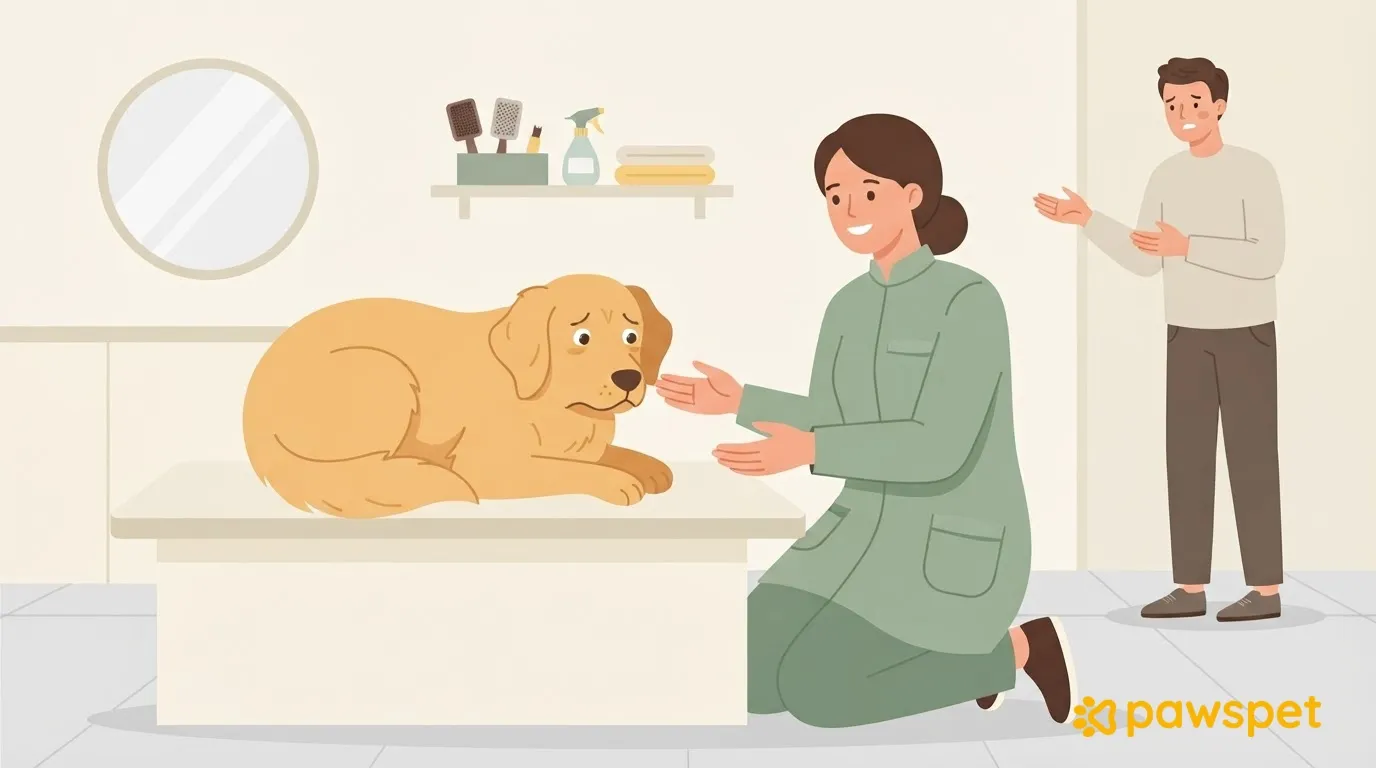
If your dog is afraid of grooming, the most helpful thing you can do is tell the groomer everything before the appointment, with specific examples of what scares your dog and how they react. That gives you a basis for agreeing on adjustments such as breaks, a short wait, and splitting the work across more than one visit. If your dog panics, has growled, or has bitten, involve your veterinarian and a trainer before trying again.
Describe the fear with examples, not adjectives
“He’s a little anxious” doesn’t say much: the groomer won’t know what to expect or what to watch out for. Instead, describe three things you’ve observed:
- When it happens: on arrival, while waiting, during the bath, with the dryer, with the clippers, during nail trimming, ear cleaning, or when your dog is lifted.
- What your dog does: trembles, freezes, pulls away, tries to escape, or growls.
- What has helped before: a break, a treat, starting with an area your dog tolerates better, or a quieter environment.
Here are four sample statements to adapt to what you see (the last is for an adopted dog whose history you don’t know):
- “He’s calm during the bath, but when the dryer starts, he trembles and tries to escape.”
- “He stiffens when they lift him onto the table; a break before continuing has helped in the past.”
- “When they trim his nails, he pulls his paw away and gets more and more agitated after a few attempts.”
- “I adopted him recently and don’t know his history, so I’m not sure how he’ll react to the dryer or clippers.”
Growling and biting: tell the groomer beforehand, even if it happened once
If your dog has growled, tried to bite, or bitten, mention it first. It’s understandable to worry that being upfront could lead to a refusal, but sharing everything helps protect your dog and the professional, who can prepare in advance rather than discover the problem halfway through the appointment.
Describe what happened with three details: when it happened, what was going on, and what happened just before. For example: “It happened once during nail trimming: he tried to pull his paw away several times, then growled and tried to bite.”
If your dog is already used to wearing a muzzle, tell the groomer: that’s useful information for the salon. If your dog isn’t familiar with one, don’t ask the groomer to use one or try to introduce one on the day of the appointment.
A professional may decide not to proceed if the situation isn’t safe. Being upfront isn’t about getting turned away; it’s about finding a solution together.
Adjustments to agree on with the groomer
With your description in hand, ask what can be arranged:
- a quieter time of day and a shorter wait;
- breaks during the appointment, starting with what your dog tolerates best;
- splitting the services across multiple appointments, for example, a bath one day and nail trimming another;
- doing only part of the work calmly, with this agreed in advance;
- an agreement about when to stop and call you;
- a shared decision about what you’ll do (stay or leave): there’s no one rule that works for every dog.
Alternatively, ask the professional whether a different setting, such as mobile grooming where available, might suit your dog better. It may not.
What you can do before and during the appointment
- Arrive on time so the wait stays short.
- Take your dog for a calm walk before the appointment so they can relieve themselves.
- If the salon allows it, bring a familiar item or treats your dog already knows and tolerates.
- Stay reachable throughout the appointment so the salon can call you if they need to stop.
- When you pick your dog up, ask how it went and note what worked and what didn’t. This will help you describe things for the next appointment.
When to get extra help
If your dog panics, hurts themselves, growls or bites, or their fear gets worse from one appointment to the next, stop before trying again. Grooming alone may not be enough in these cases.
A veterinarian can assess whether physical discomfort is contributing to your dog’s reactions—for example, if they always react to being touched in a particular area—and whether another kind of support might be needed. That’s for the veterinarian to assess, not the groomer.
A dog trainer or behavior consultant can create a gradual plan to help your dog get used to handling and noise.
A practical first step: write down a description of your dog’s fear, with examples and any growling or biting, and send it to the salon before booking the next appointment. If you’re looking for a trainer or consultant for a gradual plan, you can use PawsPet to search for behavior consulting or training services near you, then compare their prices and reviews before booking.
FAQ
Can I ask the groomer to give my dog something to calm them down?
No. Any medication or other drug-based support must be assessed by a veterinarian, who can consider your individual dog. Don’t ask the groomer or decide on your own before the appointment.
What should I do if the salon says no?
This can happen when the professional doesn’t think they can work safely, and the decision depends on the situation. Ask what would be needed to try again, such as shorter appointments or partial grooming, and in the meantime, talk to your veterinarian and, if the fear is severe, a trainer.