When your baby starts crawling or taking their first steps, the change is due to their mobility, not your dog’s temperament: your little one can now reach the dog’s bed, bowls, and toys on their own. The solution has two parts: remove situations where your dog might feel cornered, and give them a safe retreat your baby can’t reach. Whenever no adult can keep an eye on them, even for a few minutes, you need a physical barrier. Here’s how to do that without isolating your dog.
Map out the potential trouble spots
Walk around your home at your baby’s height: you’ll see what they can reach and where your dog has no escape route.
| Area of the home | What could happen | What to change |
|---|---|---|
| Dog bed or sofa where your dog sleeps | Your baby reaches your dog while they’re resting | Move the resting spot to a retreat your baby can’t reach |
| Food and water bowls | Your baby approaches while your dog is eating | Pick up the food bowl after meals; keep water where your baby can’t reach it |
| Toys and chews on the floor | Your dog and baby compete for the same item | Keep your dog’s toys in their retreat; leave only your baby’s toys on the floor |
| Hallways and corners | Your dog gets stuck between your baby and the wall | Always keep the path to the retreat clear |
| Feeding area and high chair | Food falls, and your baby’s hands are near your dog’s face | Keep your dog in their retreat with a chew |
| Doors and stairs | Your baby follows your dog through a narrow opening or onto the stairs | Use a barrier in areas they should share only when an adult is present |
Set up a retreat your baby can’t reach
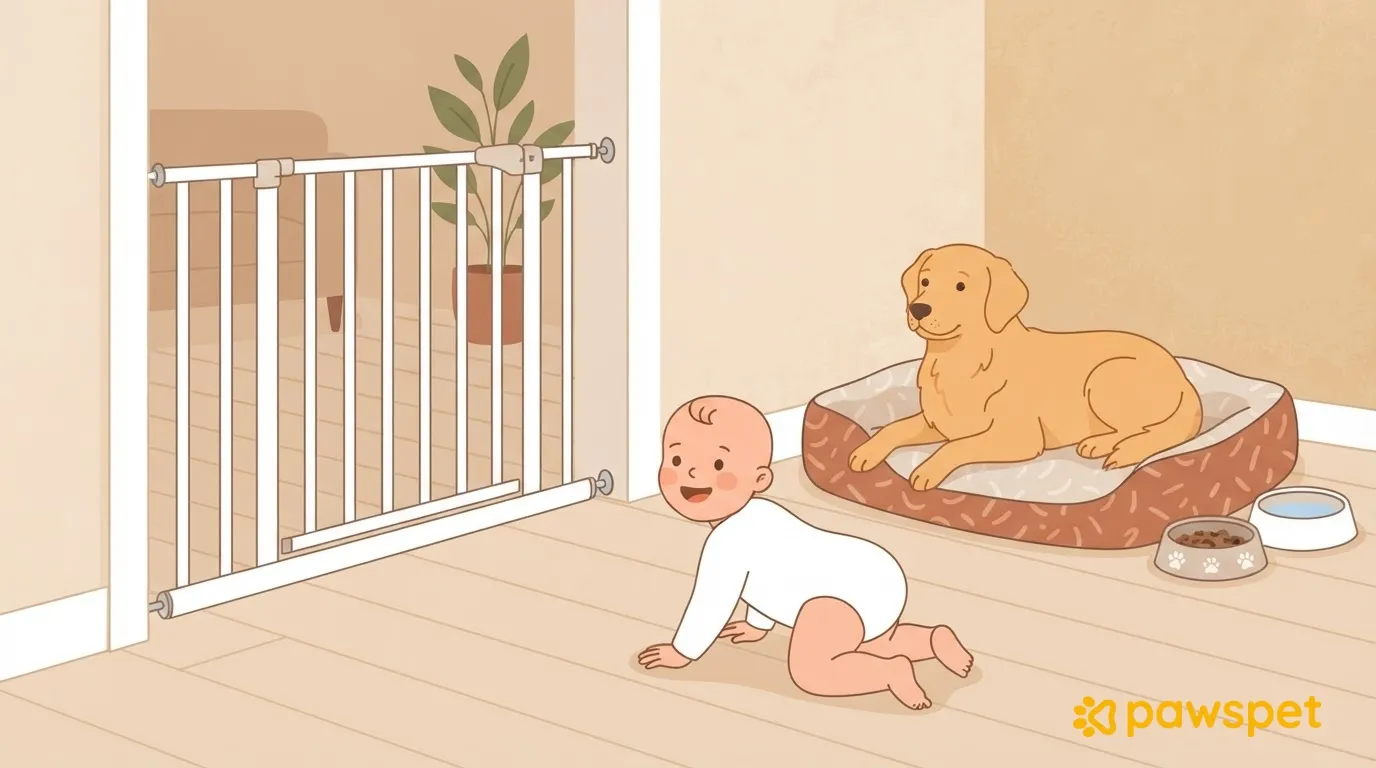
Choose a safe area for your dog: somewhere quiet, away from busy areas, where they already like to rest and can get to without passing close to your baby. To protect the space, close off a room or corner with a baby gate; a playpen is suitable only if your dog is already used to it.
The rule applies to the whole family: when your dog is in their retreat, no one disturbs them. If you need them to come out, call them rather than going in to get them.
Make it inviting: add a comfortable blanket and a chew or toy your dog gets only there. Keep the first times you close it off short, with an adult nearby. Never use it as a punishment.
If your dog is used to sleeping on the sofa where your baby now plays, offer them an equally comfortable alternative in their retreat.
Baby gates and playpens: when to use them
Use a barrier whenever no adult can keep an eye on them: while you’re cooking, on the phone, or caring for another child; during energetic play; and when guests arrive. At other times, your dog and baby can share the space, but only with an attentive adult present: supervision is covered in another article.
In small homes, it may be easier to fence off your baby’s play area rather than your dog’s, as long as your dog always has a clear path to their retreat and water.
Choose barriers suited to your dog’s height and strength, and install them according to the manufacturer’s instructions. If the separation lasts a long time, always leave your dog with water.
Bowls, meals, and toys: reorganize your dog’s resources
Feed your dog in their retreat or while your baby is in another room, pick up the food bowl after meals, and keep water where your baby can’t reach it.
During mealtimes, your dog shouldn’t have to wait under the high chair: falling food and your baby’s hands near their face make the situation uncomfortable for both of them. The retreat, with a chew, is a better option.
Your dog’s toys and your baby’s toys can often look alike: keep them separate, and put small items belonging to your baby out of your dog’s reach. If you suspect your dog has swallowed something, call your veterinarian right away.
If your dog stiffens or growls near food or toys, don’t punish them: increase the separation and ask a veterinarian or behavior professional for help.
Don’t cut back on your dog’s walks and playtime
More barriers and less time together can leave your dog bored or frustrated. Make time each day for a walk and a play or scent-work session with an adult, for example while your baby is asleep or with their other parent, and ask family members for help. If walks become shorter, in the «Services» tab of the PawsPet app you can search for «Walk» services in your area, filter by «Distance», and, for the professionals listed, read «Reviews» and check «Availability».
Where to start this week
- Walk around your home at your baby’s height.
- Choose the retreat: quiet, away from busy areas, and reachable without passing your baby.
- Install the barrier according to the instructions and check that your dog can always reach the retreat.
- Move the bowls and toys to their new locations.
- Set a specific time for your dog’s daily walk.
One step at a time, your home will find a new balance, and your dog will remain part of the family.