With a cat and a child who is around two years old, safety depends on adults and the spaces they provide, not on the child's ability to remember the rules. Every moment calls for either active supervision or separation, and the cat must have places the child cannot reach and always be able to leave. No one is to blame: tail-pulling is curiosity, and a cat's scratch is self-defense.
Why adults matter most at this age
A child who crawls or walks acts on impulse: grabbing fur and tails, chasing the cat, bumping into it while it sleeps, putting hands in its bowl or litter box. They can't yet read the signals cats use to say “enough.” Even a calm cat may defend itself with claws or teeth if trapped, grabbed, or suddenly woken. You can start teaching basic rules, but spaces and supervision are what keep everyone safe.
Active supervision or separation: choose every time
Active supervision means an adult is in the same room, focused on both the child and the cat, and within arm's reach to intervene. Being in another room, or in the same room while looking at your phone, doesn't count.
When you can't provide it, separate them. The child stays in a safe area (for example, a playpen, if you use one), or the cat stays in its own area, with water, a litter box, and a place to rest, behind a baby gate or, briefly, a closed door.
Here's how to choose in five common situations:
| Situation | What to do |
|---|---|
| Adult cooking at the stove | This isn't supervision: put the cat in its own area or the child in a safe area. |
| Adult showering or on the phone | Separate them first: if you aren't watching both, it isn't supervision. |
| Child wakes from a nap and looks for the cat | Keep the cat out of the bedroom; have an adult there to guide the first interaction when the child wakes. |
| Playing on the rug with an adult sitting nearby | Active supervision, if you're watching both and within arm's reach: the cat is free to leave. |
| Hectic moments: crying, tantrums, coming home in the evening | It's better to separate them: keep the cat in its own area or up high until things settle down. |
Cat spaces the child can't reach
The idea is to make the home do the work, rather than relying on rules.
Up high
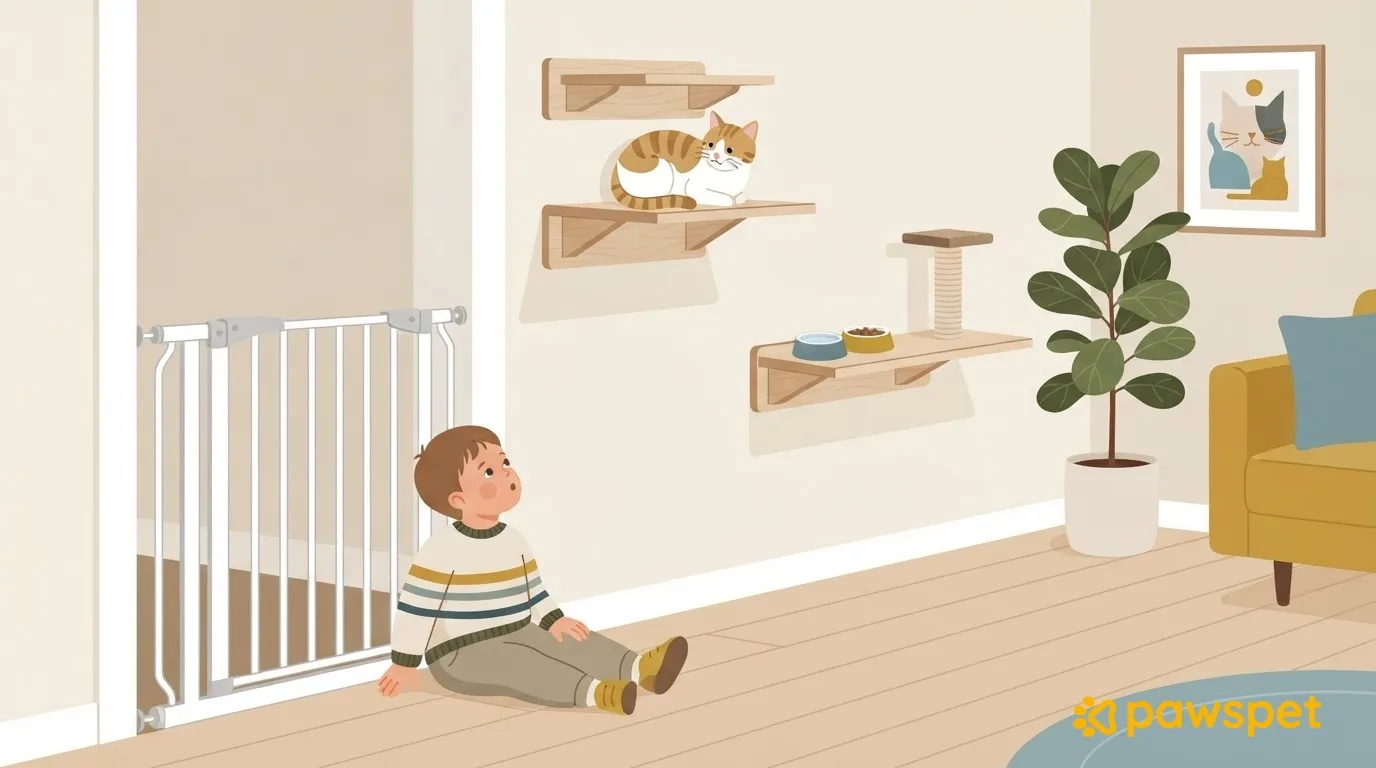
Shelves, tall cat trees, or the top of a piece of furniture can let the cat observe without being reached, as long as they're stable. A windowsill is fine only if the window has been secured. Check that the child can't reach it by climbing.
Behind a baby gate
Choose a baby gate the child can't get over but the cat can jump over or pass through using a cat door. This creates a room or hallway just for the cat. Before relying on it, check that the model suits that spot in the home, that the cat actually uses it, and that the opening can't trap the child.
Litter box, bowls, and bed
Keep the litter box out of the child's reach, and do the same with bowls and the cat's bed: place them away from walkways and play areas. The cat can eat and rest more peacefully, and the child's hands stay away from bowls and litter for hygiene reasons. If you need to move them, do it gradually, keeping them in places the cat can easily reach.
Keep escape routes clear at all times
A cat that can get away has less reason to defend itself. So:
- never leave the child and cat shut together in a room;
- don't trap the cat under furniture or in a corner;
- don't pick it up to “show it” to the child;
- leave doors to the cat's areas open or ajar when the two are together.
If the child follows the cat, calmly take the child somewhere else, not the cat.
First behaviors to teach, with an adult's help
Three behaviors, always guided by an adult:
- Say hello from a distance. A wave and “hi, kitty,” without touching.
- Guided petting. The adult guides the child's open hand for one slow, brief stroke in a spot that cat enjoys, then stops.
- The words “gentle” and “stop.” Use “gentle” to slow down and “stop” to halt; all adults use them consistently.
Keep the child's face away from the cat's muzzle, and try only when the cat approaches on its own and is relaxed.
Checklist for today
- I know where the cat stays when I can't watch.
- There's a high-up place in the rooms where the child spends time.
- The litter box and bowls are out of reach.
- Doors to the cat's areas are open or ajar.
- The adults have agreed on the words “gentle” and “stop.”
- An attentive adult is present for every interaction between the child and the cat.
Frequently asked questions
My child pulled the cat's tail: what should I do?
Calmly interrupt, move the child away, and let the cat leave. Try teaching the right action—the guided pet—in another moment. If there's been a scratch or bite, take care of the child first and contact the pediatrician when needed.
How can I tell if the cat is struggling with living together?
Look out for the cat avoiding the child's rooms, hiding much more than usual, eating less, or eliminating outside the litter box. Give the cat more spaces of its own, and if the changes persist, talk to your veterinarian: these signs aren't a diagnosis.