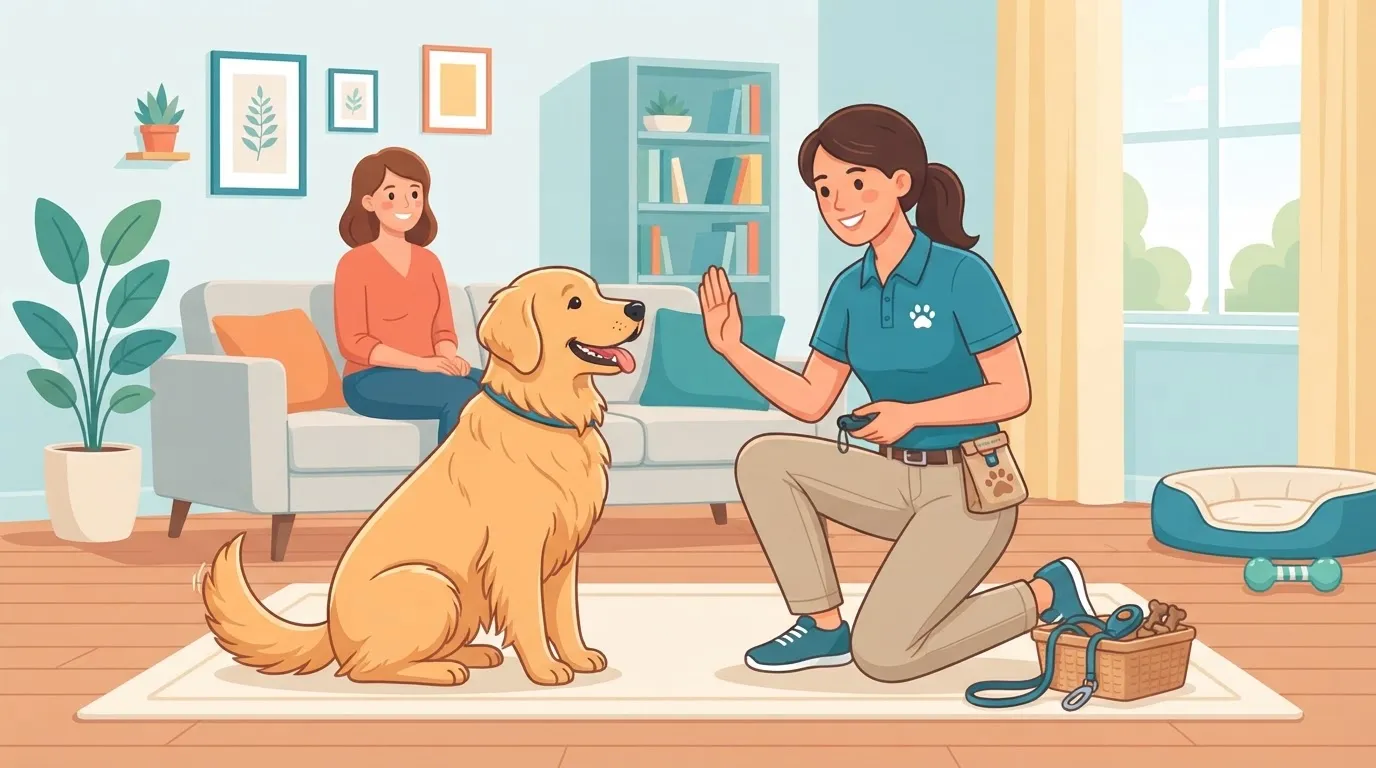
Understanding whether you need a dog behavior educator or a trainer for your dog is not always straightforward. You look for someone to help because your dog pulls on the leash, barks too much, is afraid of everything… but then online you find educational boarding facilities, instructors, consultants, dog centers with a thousand different titles and wildly varying prices.
In this article we’ll look at things in a practical way:
- the real difference between a dog behavior educator and a trainer
- when you need one, and when the other may be more useful
- how much a dog behavior educator costs on average (and what the price depends on)
- how to read and truly evaluate online reviews
- how to choose the right professional for your dog (and for you)
At the end you’ll find a ready-to-use checklist and a few tips for using digital tools like PawsPet to better organize your dog’s education journey.
Dog behavior educator or trainer: what’s the real difference?
In everyday language, “dog behavior educator” and “trainer” are often used as synonyms, but they are not the same thing, neither in goals nor in approach.
What a dog behavior educator does
A dog behavior educator mainly focuses on:
- dog–human relationship
- everyday behavior (management at home, on walks, in the city)
- prevention of behavioral problems
- teaching basic skills (recall, stay, walking on leash, frustration management, self-control)
The focus is: “How can we live well together in the real world, day after day?”
Typical goals with a behavior educator include:
- dog jumping on guests
- puppy having accidents indoors
- dog pulling hard on the leash
- dog afraid of noises or other dogs
- dog barking nonstop when left alone
In many cases, the dog behavior educator also works on more complex behavioral issues, often in collaboration with a veterinary behavior specialist.
What a dog trainer does
A trainer more often works on:
- teaching specific exercises
- sporting or working disciplines (obedience, agility, search, protection and defense, rescue dogs, etc.)
- training for specialized activities (search dogs, working dogs, etc.)
The focus is: “How do we achieve and refine a specific performance?”
Typical goals with a trainer include:
- preparing the dog for sports competitions
- teaching complex exercises (send to target, scent discrimination, work at long distances)
- refining high-level obedience for work/sport
Many professionals today combine educational and training skills, but it is still useful to understand their different basic orientation.
When you need a dog behavior educator
In most cases where an owner searches for “dog education lessons,” the most suitable figure is a dog behavior educator.
Typical situations where you should call a behavior educator
They can help especially when:
- you have a puppy and want to set things up properly from the start
- you have an adult dog adopted from a shelter and need a gradual adjustment to family life
- the dog has fears (people, noises, the city, other dogs)
- the dog shows reactivity (barking, growling, lunging at dogs or people)
- it causes damage at home, chews furniture, destroys objects
- it has difficulty being left alone
- walks are stressful: pulls, stops, doesn’t want to move, lies down, freezes
In all these cases, the goal is not to “train an exercise,” but to build emotional and relational skills: trust, safety, clear dog–human communication.
Dog behavior educator and veterinary behavior specialist
If the dog shows:
- severe aggression (bites, serious bite attempts)
- intense panic attacks
- obsessive, repetitive, uncontrollable behaviors
the ideal path often includes:
- a visit to a veterinary behavior specialist to assess possible medical/neurological components;
- hands-on work with a dog educator/trainer who applies the recommended plan.
When you need a dog trainer
A trainer may be the right figure if:
- you want to do dog sports with your dog (agility, obedience, rally-o, nosework, etc.)
- you want to prepare your dog for operational activities (search, rescue, specific work)
- you already have a good basic foundation in everyday education and want to “go further,” working on precision and performance
However, keep in mind: if the dog has management problems in everyday life, it is almost always better to start with:
- a basic educational program,
- work on calmness, emotions, self-confidence, and the relationship,
before thinking about any advanced training program.
How to tell whether the professional is right for you, regardless of the title
Beyond “dog behavior educator or trainer,” focus on a few very concrete aspects.
1. Declared working method
Always ask:
- what kind of approach do they use (positive reinforcement-based methods? do they use physical punishment/coercive tools?)
- how they structure the first lessons
- what they expect from you at home between lessons
A good educator/trainer:
- involves you, doesn’t work “only on the dog”
- explains the why behind the exercises
- is transparent about realistic timelines and the limits of the program
2. Attitude toward the dog
Observe how they behave in person with your dog:
- they respect the dog’s timing, they don’t force it physically
- they observe a lot before intervening
- they don’t dismiss fears or signs of stress
- they don’t blame you, but help you understand what you can change
3. Clarity about goals
A serious professional will help you:
- define specific and realistic goals
- understand which results are likely and which are not
- make an estimate of timelines and steps, not just “we’ll see how it goes”
Individual lessons, group classes, at-home or at the training field: which should you choose?
The best format depends on the dog, the owner, and the goals.
Individual lessons
Ideal when:
- the dog is unsure, fearful, or reactive
- there is a specific problem to work on (for example, pulling on the leash)
- you want very personalized guidance
Advantages:
- a path tailored to you
- the chance to work exactly in the critical situations (home, street, city)
- progression adapted to your pace
Group lessons
They can be very useful for:
- puppy socialization
- working on self-control with other dogs present
- learning how to manage the dog in the presence of more distractions
But be careful:
- groups that are too large or poorly managed can create stress instead of helping
- dogs with strong fears or reactivity should not start here
At-home lessons
Recommended when:
- the problem shows up mainly at home (damage, separation anxiety, conflicts with other animals)
- you have trouble getting around
- you want to work on everyday habits in the real context
Lessons at a field/dog center
Useful for:
- learning exercises in a controlled environment
- starting work without too many distractions
- having the possibility to structure paths, agility fields, equipment
How much does a dog behavior educator cost? Realistic price ranges
“How much does a dog behavior educator cost?” is one of the most common searches. Prices vary a lot depending on:
- geographic area
- the professional’s experience and training
- type of lesson (individual, group, home visit, field)
- length and structure of the package
Indicative price ranges (Italy)
The following numbers are just rough averages:
-
Individual lessons at a field/center
- €35–60 per lesson (45–60 minutes)
-
Individual home lessons
- €45–80 per lesson (depending on travel and time)
-
Lesson packages (e.g., 5–10 sessions)
- often include a small discount on the single session
- for example, 5 individual lessons for €180–250, 10 lessons for €350–500
-
Group courses (puppy class, adult basic)
- €15–30 per lesson
- or €100–200 for a cycle of 6–8 sessions
-
Educational boarding or boarding with training included
- daily boarding fee + educational work fee
- on average €35–60 per day total, but it can vary a lot
When asking for a quote, always clarify:
- the exact duration of each session
- what is included (message/email support between lessons, video material or handouts)
- whether the price changes for special travel needs
How to read online reviews without being misled
When you search for “dog behavior educator or trainer” online, you’ll find many Google listings, websites, and social pages full of reviews. Useful, but critical thinking is needed.
What to read between the lines
In positive reviews, pay attention to:
- mentions of clear communication with the owner
- references to gentle methods, respect for the dog, no coercive tools
- comments on real improvement in everyday life, not just “they’re great with dogs”
In negative reviews, try to understand:
- whether there are repeated complaints about disrespect toward dogs or people
- whether issues arise around delays, unclear pricing, missed appointments
- whether the criticism concerns a single incident or a consistent pattern
Assess whether it matches what you’re looking for
A highly praised educator for sports disciplines may not be the best choice if your problem is:
- a puppy afraid of everything
- an adopted dog with a difficult past
Look for reviews from people in a situation similar to yours.
Checklist: how to choose a behavior educator or trainer for your dog
You can use this quick list to compare professionals.
Before contacting them:
- do they have an updated website or social profiles?
- do they clearly explain what services they offer (basic education, behavioral problems, sports, etc.)?
- can you find any reference to their training background?
Questions to ask at first contact:
- what methods do they use? Do they use physical punishment or painful tools?
- how many lessons are usually needed for a case similar to yours?
- how does the first meeting work? Is it only an assessment or also practical work?
- do they provide reports or clear exercises for you to do at home?
- do they offer support between lessons (messages, emails, videos)?
During the first meeting:
- do you observe attention and respect toward your dog?
- do they explain in an understandable way what they are doing and why?
- do you feel listened to regarding your difficulties and doubts?
- do you leave the session with at least 1–2 practical exercises to apply right away?
If you answer “yes” to many of these questions, you’re probably on the right track.
Educational boarding, day care, dog sitting: what’s the difference?
In addition to dog behavior educator and trainer, you may have come across other terms:
- educational boarding: a facility where the dog stays and, in addition to accommodation, also receives scheduled educational work
- day care: the dog stays at the facility only during the day, with guided activities and socialization
- dog sitter: a person who takes care of walks and daily management, but not always with structured educational expertise
What to ask an educational boarding facility
- who looks after the dog? Is it a qualified educator?
- how many hours of real educational activity are scheduled per day?
- do they provide reports on the work done (videos, sheets, feedback)?
- is a handover meeting planned when you pick up the dog, so you can continue the work at home?
A well-run educational boarding facility can be a valuable resource, but it doesn’t replace your involvement: without continuity at home, results won’t last.
How to organize the education journey: apps, reminders, and tracking
Dog education is a process, not a one-off meeting. It requires consistency and the ability to monitor small improvements over time.
Digital tools can help you:
- note down the dog education lessons (topics, exercises, difficulties)
- set reminders to repeat exercises every day
- track critical episodes (barking, bites, fears) to show the educator
- always have the professional’s contacts, the veterinarian’s, and the dog center’s at hand
With an app like PawsPet you can:
- create a complete profile of your dog with info on age, personality, any behavioral issues, and notes you can share with the educator
- use reminders so you don’t forget exercises, lessons, and follow-ups
- note, day by day, small changes and progress, so you have a clear timeline to review with the professional
- discover pet services in your area (educators, boarding facilities, day care, grooming) and compare opinions and reviews in one place
It doesn’t replace the professional, but it makes it easier to follow the guidance and maintain the consistency that really makes the difference.
Common mistakes when choosing a behavior educator or trainer
To wrap up the practical part, here are some very common mistakes.
1. Choosing based only on price
Saving money is understandable, but:
- a very cheap but ineffective program can take longer and end up costing much more overall
- a higher price may reflect greater experience and ongoing training
It’s better to evaluate quality/transparency/price ratio, not just the number.
2. Looking for “quick fixes”
Phrases like:
- “One lesson is enough and we’ll solve everything”
- “In a week the dog will be perfect”
are warning signs. Serious work:
- takes the dog’s history into account
- requires time to build new habits
- expects setbacks and ups and downs, especially if there are deep-seated fears
3. Accepting methods that make you uncomfortable
If an educator suggests:
- harsh yanks, choke collars, or painful tools
- techniques that make you feel guilty or uneasy in your relationship with the dog
stop and ask yourself whether this is really the path you want to take. A good professional is able to adapt the method to your sensitivity as well, without compromising the dog’s well-being.
Conclusions: dog behavior educator or trainer, where should you start?
In short:
- if your goal is to live better with your dog in everyday life, starting with a dog behavior educator is almost always the most sensible choice;
- if you want to do dog sports or specialized activities, you’ll need a trainer (often with a solid educational background as well);
- the title matters, but method, respect, clear communication, and concrete results in everyday life matter more.
Take the time to make a few phone calls, ask the right questions, and listen to your instincts. You know your dog better than anyone else: if something doesn’t convince you, you can always change direction.
To better organize the journey, keep track of lessons, progress, and difficulties, you can use digital tools that simplify managing everything related to your dog.
If you want, you can:
- try the PawsPet app to always have your dog’s data, reminders, and notes on the educational journey with you;
- search for and compare pet services (educators, boarding facilities, day care) in your area, reading other owners’ opinions.
A dog guided by a good professional and an informed owner has a much better chance of growing up calm, confident, and able to face the world together with you.
FAQ on dog behavior educators, trainers, and lesson costs
Dog behavior educator or trainer: which should I choose for a puppy?
For a puppy, it is almost always better to choose a dog behavior educator. At this stage you need:
- proper socialization
- establishing good habits (house training, bite management, routines)
- working on self-confidence, calmness, and the relationship
More technical training can come later, once the puppy already has a solid emotional and relational foundation.
How much does a dog behavior educator cost on average in Italy?
It depends a lot on the area and the format chosen, but on average:
- €40–60 for an individual lesson at a field
- €45–80 for a home lesson
- €15–30 for a group lesson
- 5–10 lesson packages with a small discount on the single-session price
Always ask for a clear quote, with number of lessons, duration, and what’s included.
How many dog education lessons are usually needed?
There is no fixed number. For simple issues (leash walking, basic recall, greeting management), often:
- a 5–10 session program can provide a good foundation,
- provided that you practice the exercises at home consistently.
For complex behavioral issues, longer programs and close work with the veterinary behavior specialist may be necessary.
Can I train my dog myself by following online videos?
Videos can be a useful support for learning basic exercises, but they do not replace:
- a personalized assessment of your dog
- adapting the method to its history, personality, and living environment
In particular, if there are fears, aggression, or significant distress, it is strongly recommended to contact a qualified professional, use online materials only as a complement, and always consult your veterinarian to rule out health-related causes.