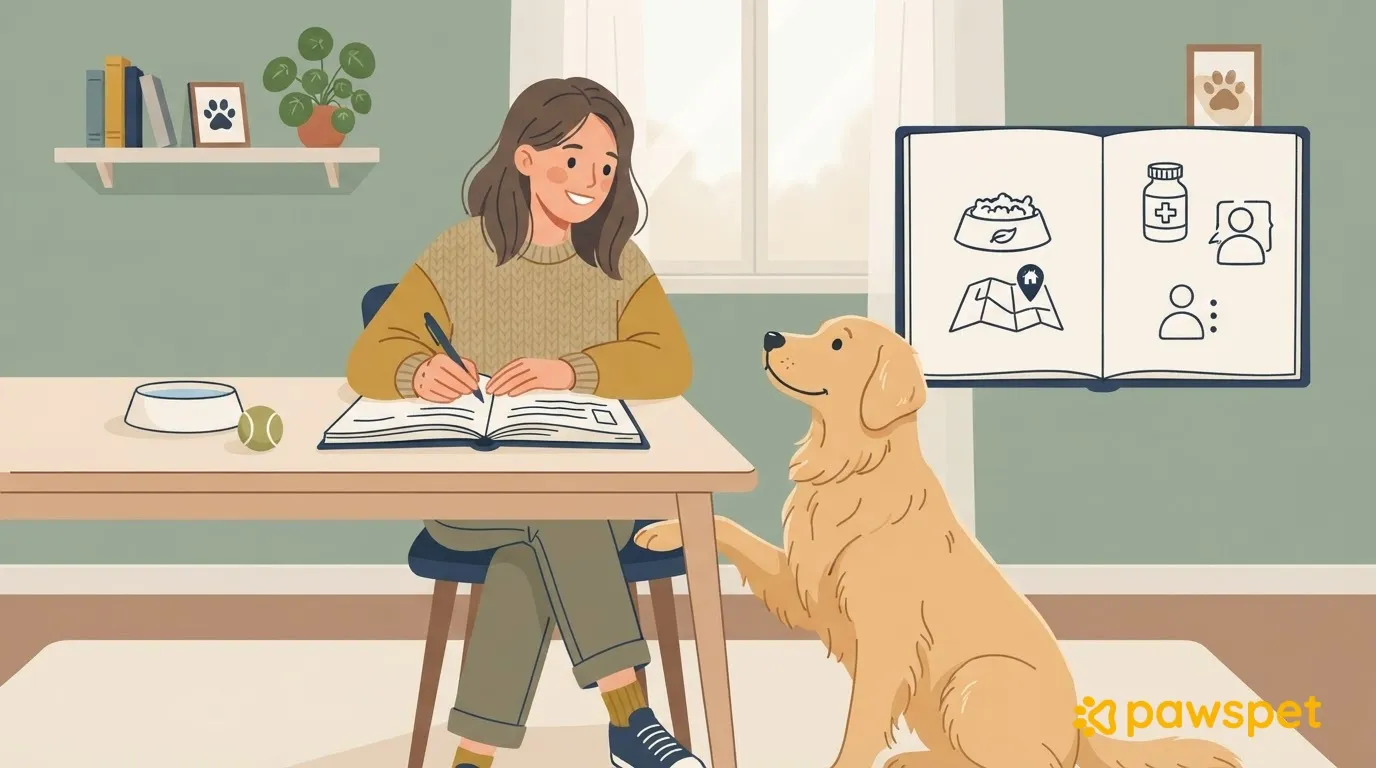
An emergency sheet is a single page, with the update date at the top and six sections in order of urgency: who to call, how to identify your pet, their routine, health, temperament, and where to find things. Keep one copy near the door or on the fridge, and give one to your trusted person.
It will be read by a family member, neighbor, or friend who suddenly needs to look after your dog, cat, or small pet while you can’t be reached. They have little time: in two minutes, standing by the door, they need to understand what to do.
How to set it up so it gets read
One page, short sentences, no abbreviations: the reader doesn’t know your habits. At the top, write your pet’s name, the update date, and your contact details: “Sheet for [name], updated on [date]. Contact: [your name and phone number].” If you have more than one pet, make a page for each.
Write instructions, not descriptions. “Eats twice a day” leaves room for guesswork; “Meal at 7:30 a.m. and 7 p.m., blue bowl, one level scoop” can be followed right away. Along with the paper copy, ask your trusted person to keep a photo of the sheet on their phone.
The six sections to fill in
They’re arranged in order of urgency: anyone who stops at the first section already has the most important information.
Who to call
List names and phone numbers in the order they should be called:
- your number, the one you actually answer;
- your trusted person;
- a backup person;
- your regular veterinarian, including the days and hours they’re available;
- the emergency veterinary clinic you use after hours, if you know it (otherwise ask your regular veterinarian if they can recommend one);
- if you have pet insurance, the policy number and contact details.
How to identify your pet
Name, species, breed or mix, color, distinguishing marks, microchip number, and a recent photo. If your pet isn’t microchipped, write that down. This section is also useful if they get lost: the person looking for them can describe them and show the photo. Example: “White patch on chest, left ear folded.”
Routine
- What they eat, how much, and when, using your usual measurements.
- Water: where the bowl is and when you change it.
- Walks or litter box: times and rules, for example, “Walk at 7 a.m. and 6 p.m., always on a harness”; for a cat, say where the litter box is and when it should be cleaned.
- What’s normal for them (“always leaves a little food”) and what would be unusual (“doesn’t go near the bowl”), and who to notify.
Health
- Current treatments, including doses: copy them exactly from your veterinarian’s written instructions or attach a photo of the prescription. If anything is unclear, ask your veterinarian before filling this in.
- Allergies and foods to avoid.
- Recent problems.
- Where to find the health record and documents.
Write this in a clearly visible place: “Don’t change the treatment or make up a missed dose without speaking to the veterinarian.”
Temperament, fears, and escape routes
- How to pick them up and put them in the carrier.
- What scares them.
- If they tend to bolt through the door or off the balcony: “As soon as the door opens, they try to get out; put them in the bathroom first.”
- How they behave around other animals and children.
- If they’re a cat, their usual hiding places.
Where to find things
For each item, give the exact location, not just the room: “Food and supplies: entryway cupboard, bottom shelf.” Don’t forget:
- food and supplies;
- medications;
- carrier;
- leash and harness;
- spare litter;
- cleaning supplies and bags.
You don’t need to make anything up: these are things you already know; they just need to be organized. If you keep your pet’s microchip number, color, and distinguishing marks in the “Profile” sheet in the PawsPet app, and photos in your pet’s gallery, filling in the identification section takes a minute: tap the microchip number to copy it.
Mistakes that make the sheet useless
- Doses written from memory. Copy them from the prescription or attach a photo of it: the caregiver will follow what they read.
- Treatments that have ended still listed. Remove them as soon as the veterinarian ends them: the reader can’t know they’re over.
- Information scattered across different messages. Gather it on one page: a message can get lost; a sheet on the fridge won’t.
- Keys and full address on a sheet left in plain sight. Don’t write where you keep the keys or your full address: tell your trusted person in person.
- Too many pages. Keep only what a stranger needs to care for your pet; explain the rest in person when you hand over the sheet.
Where to keep it and when to update it
Keep one copy at home in a visible place, one with your trusted person, both on paper and as a photo; if you like, keep one in the carrier so it goes with your pet.
Update it when their food, treatment, veterinarian, or phone numbers change, and always write the new date so the reader knows whether they can rely on it. Replace old copies so two different versions aren’t in circulation. If you record treatments and allergies in your pet’s “Health” sheet in PawsPet, update the paper sheet whenever you update them there.
To get started today: fill in the first two sections, who to call and how to identify your pet, and give the sheet to your trusted person, asking whether every line is clear. Add the other four over the next few days, updating the date.