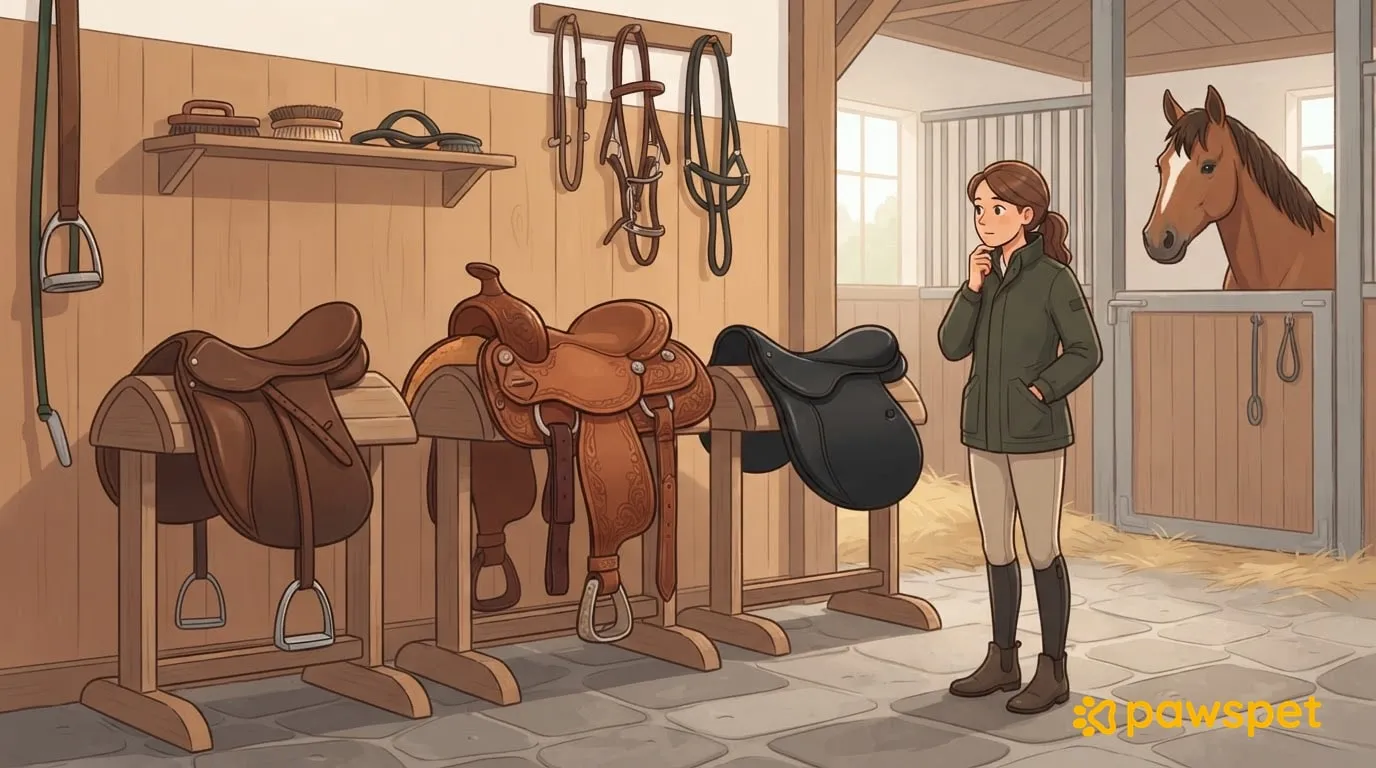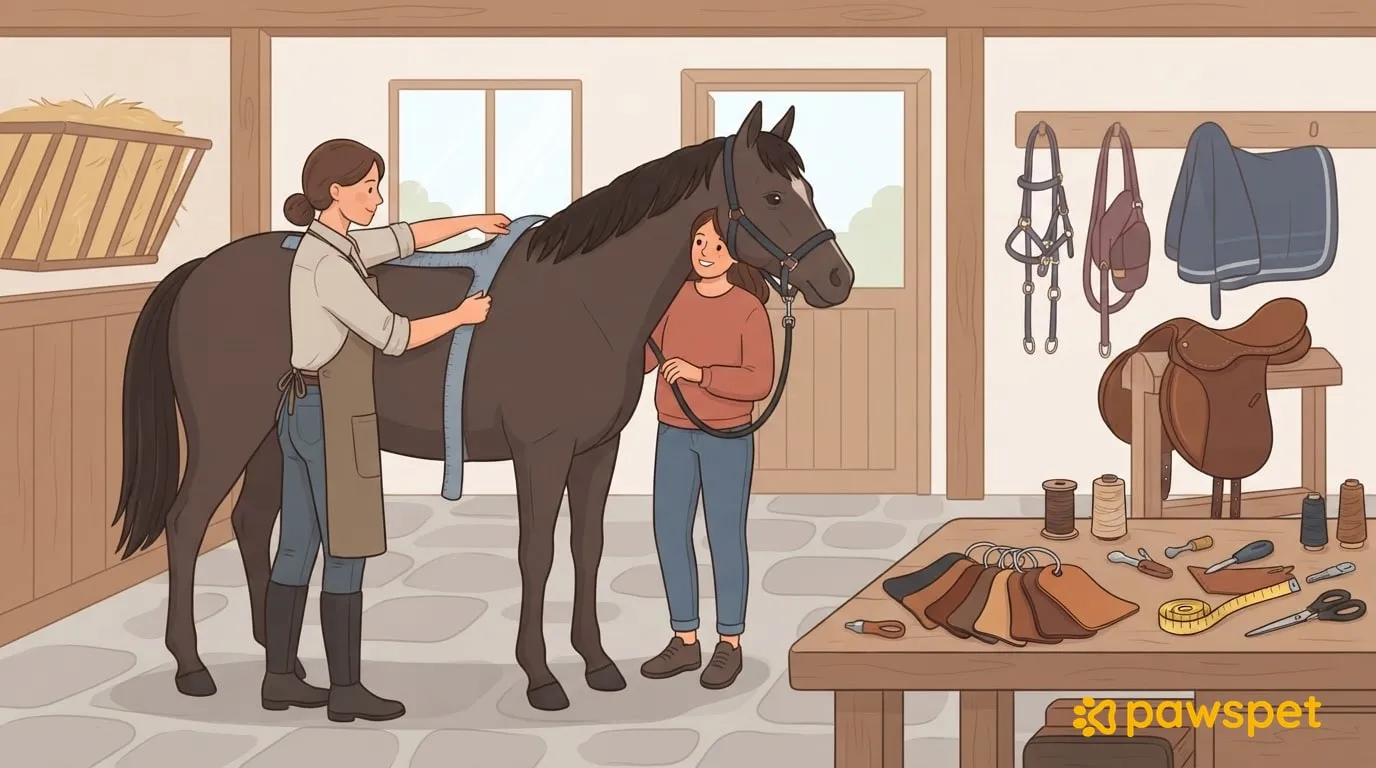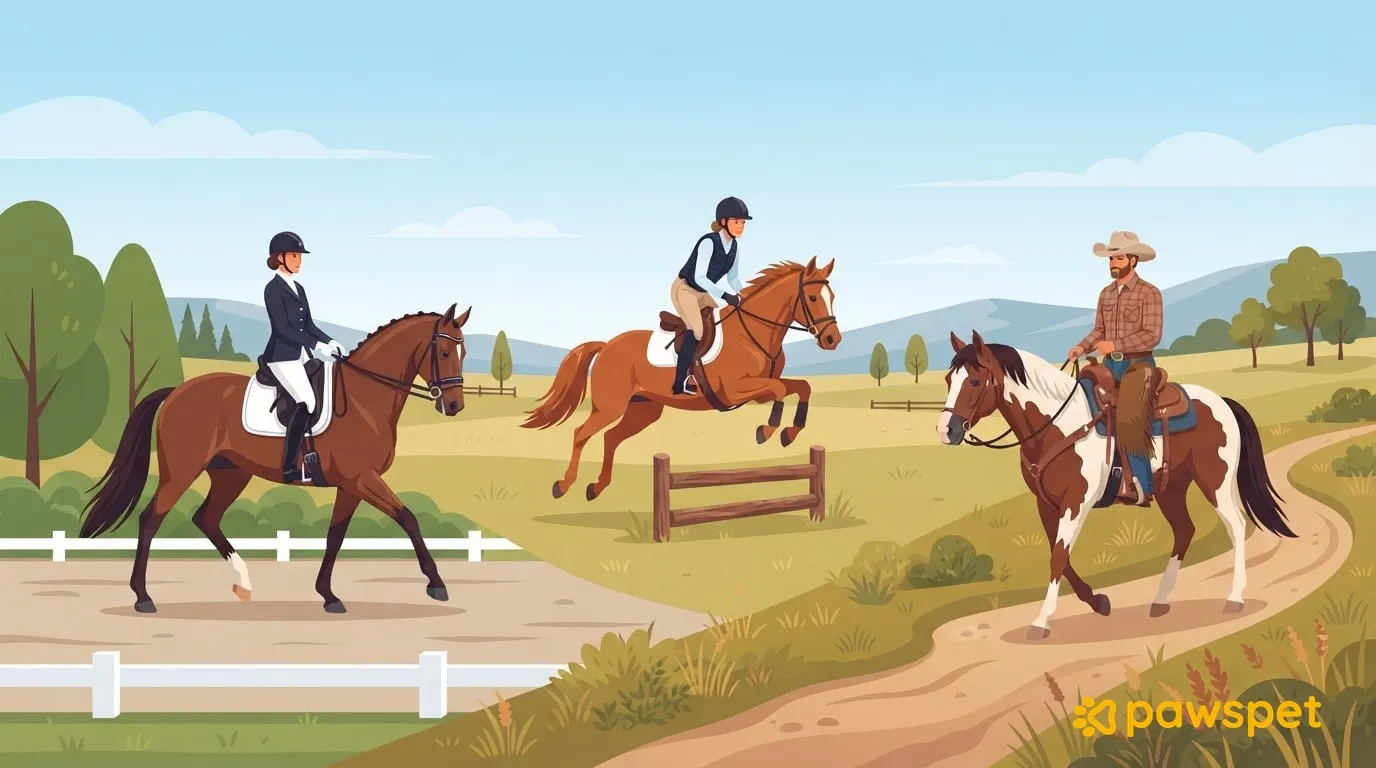
To choose a saddle, start from the riding you actually do, then look at your horse's back and at the rulebook of the competitions you want to enter. Budget comes after that. Dressage and jumping call for almost opposite saddles, and the all-purpose saddle (UK general purpose) is a compromise for riders who do a bit of everything. In competition the rules can decide for you: working disciplines usually require the traditional saddle, and for the treeless saddle the rules change from country to country.
How to choose a saddle: riding styles compared
In short:
- Flatwork, small jumps and hacking, no competing: all-purpose.
- Dressage and jumping, both regularly: in our view, two saddles.
- Long rides: trail (UK trekking) or endurance, counting the luggage too.
- You are learning: with a tree, a deep seat and a high cantle.
- Traditional disciplines in competition: the rulebook usually decides the saddle.
| Riding style | Shape | Seat and flap | Price new | Treeless (our view) |
|---|---|---|---|---|
| Trail (UK trekking) | Heavily padded | Wide seat | €181-3,984 | Trail yes: Freeform Classic with Trail or Spanish Beauty seat; with a load, niche |
| Natural riding | Leaves shoulder and neck free | Depends on the saddle | No price-list category | Yes, with an already independent seat |
| Endurance | Wide bearing surface | Padded seat | €270-3,100 | Niche; there is a tradition of use |
| Western | Tree usually wooden | Often a deep seat | €200-4,318 | Trail: Freeform Pathfinder or Freeform Scout. Competition and ranch: not recommended |
| Dressage | Blocks in front of the knee | Deep seat, long straight flap | €222-6,600 | Schooling: Freeform Classic with Elite Dressage seat. In competition it depends on the country |
| All-purpose | Medium cantle | Halfway between dressage and jumping | €140-3,400 | Depends on use |
| Jumping (close contact; UK jumping saddle) | Low cantle and pommel | Flatter seat, short forward flap | €223-4,789 | Not recommended beyond small fences |
| Eventing, cross-country | Supporting blocks | Forward flap | Two Zaldi models: €1,435-1,649 | Not recommended |
| Working, traditional | As the tradition requires | As the tradition requires | €290-2,980 | In competition, usually no |
| Lessons, beginners | High cantle | Deep seat | Two examples: €288-950 | Not recommended |
| Pony, children | Wide, round gullet plate | Seat of 16.5" or smaller | €65-2,099 | Not recommended |
Prices as found in November 2026 and rounded to the euro, from the price lists of Loesdau (Germany, VAT included, shipping excluded), La Selleria Online (Italy, VAT not stated) and Zaldi (Spain, indicative, taxes excluded). The lists are not alike, the lowest figure is often a Zaldi price, and the lowest and highest prices are often a synthetic model against a leather one: do not compare the ranges directly.
The terms in the table:
- Tree (saddle tree): the rigid internal structure of the saddle.
- Gullet plate: the front part of the tree, above the withers.
- Flap: the leather panel under your leg.
- Cantle and pommel: the raised edge behind the seat and the one in front of it.
- Blocks: the padded ridges that support your knee and thigh.
- Seat: the part where you sit, measured in inches. Shops also talk about seat size.
Dressage saddle
Look for a deep seat with the lowest point set forward, a long straight flap for a lengthened leg, blocks in front of the knee and few behind the calf. The Krämer shop guide advises against it for jumping and cross-country riding, because it gets in the way of a light, forward seat.
Typical mistake: in our view, buying big blocks as a shortcut to a good seat. They support the knee but leave little room to move.
Jumping saddle (close contact)
Look for a short flap cut forward, a flatter seat set further back, a low cantle and pommel, and blocks to support the knee. Try it with the stirrups already shortened: your knee should sit right on the flap, otherwise you lose balance.
Typical mistake: buying the flattest seat because it looks like the best fit. It asks a lot of balance from the rider, and medium and deep seats exist too.
Eventing and cross-country saddle
A jumping saddle also does the job for cross-country, with supporting blocks. There are mono-flap models, with the two layers of the flap stitched together to leave less leather under your leg.
Typical mistake: paying for a label. Saddles sold as "eventing" can be high-end all-purpose saddles, and the difference is hard to spot.
All-purpose saddle (general purpose)
Seat and flap sit halfway between dressage and jumping, for flatwork, small jumps and hacking. If flatwork prevails, choose the variant leaning toward dressage; if jumping prevails, the other one.
Typical mistake: trusting a low price. Many cheap models have a flap that sits too far forward, some have a cantle that is too high, and riders who move up a level find them limiting.
Endurance saddle
Look for a wide bearing surface on the back, with extended or floating panels (the cushions under the saddle), a padded seat, wide stirrups and rings for gear. Endurance riders often ride out of the saddle, and the load passes through the stirrup attachments.
Typical mistake: choosing on weight alone. Pressure matters too: in von Peinen and colleagues (Equine Veterinary Journal Suppl., 2010) the average pressure at the withers distinguished horses with dry spots, with acute signs and controls. The study does not compare saddle types.
Trail, trekking and TREC saddle
Look for a heavily padded saddle with a wide seat and a large bearing surface, for long rides. The western saddle is an alternative, but it is heavy. In TREC the saddle has to cope with orientation, gaits and obstacles: the Spanish rulebook asks for the same saddle, or an identical one, in all phases. There is no TREC category in the price lists: in our view you end up with trail (trekking) or all-purpose.
Typical mistake: counting the rider and forgetting saddlebags and water. There is no validated threshold: 20% of the horse's weight, tack included, is only the most quoted rule of thumb. The studies diverge: the pilot by Dyson and colleagues (Equine Veterinary Education, 2020, 6 horses) stops trials as early as 15%, Christensen and colleagues (Animals, 2020, 20 horse-rider pairs) see no short-term effects up to 23%, and neither measures a trek.
Western saddle
The shape changes with the discipline. Confirm the details with the manufacturer before buying.
| Type | What to look for |
|---|---|
| Reining | Deep seat, fenders (the leathers that carry the stirrup) that let your leg move |
| Cutting | Deep seat, wide front swells that keep you in during stops and turns |
| Barrel | Light saddle, wide swells, high cantle |
| Trail | Deep, padded seat, for long, slow rides |
| Roping, ranch | Thick horn for the rope, low cantle, heavy saddle |
The bars, the two parts of the tree that rest on the back, usually have an angle of 86-94 degrees. The gullet width depends on the horse: Semi Quarter Horse about 6½", Quarter Horse 6¾"-7", Arabian 6½"-6¾", Haflinger 7½", Draft 8".
Typical mistake: in our view, choosing a competition saddle by the name of the discipline without checking the bars on your own horse.
Working equitation, Maremma riding and doma vaquera saddles
Look for the traditional saddle of the culture you compete in. The FITE asks for the traditional tack of the culture you are registered in, and the score includes the saddle. In Spain doma vaquera requires the vaquera saddle with a zalea, the sheepskin cover. In Italy the working tradition is Maremma riding (monta maremmana), with scafarda, bardella and a saddle with the pallino: a Pioneer scafarda costs €1,586 at La Selleria Online. For FISE rules, ask the federation.
Typical mistake: buying a "mixed" saddle, which is banned in Spain in doma vaquera and in working equitation (equitación de trabajo). Watch out for synthetic zalea too: the FFE says to avoid it.
Natural riding saddle
We found no rulebooks and no solid sources: this is the editorial team's opinion. Look for a saddle that leaves shoulder and neck free. There is no price-list category: people use trail, western or treeless saddles.
Typical mistake: confusing closeness with wellbeing. Feeling close to the horse is a sensation for you, with no proven advantage for the horse.
Saddles for lessons and beginners
A deeper seat and a high cantle give security to someone starting out, while in a flat saddle a beginner struggles to hold position. In our view, what matters in a riding school is adapting the saddle to different horses: Thorowgood, for example, sells interchangeable gullet plate bars. Synthetic saddles need less care but may last less. The two examples in the table are Silla Kings (Zaldi) and Wintec Lite (Loesdau).
Typical mistake: putting an adult on a saddle made for a child or a pony: seat too short, rider pushed back, load on the rear.
Saddles for ponies and children
Start from the pony. Look for a seat of 16.5" or smaller and a wide, round gullet plate. With low withers the saddle tends to slide toward the shoulder: you need a wide tree and gullet plate, and a crescent-shaped girth helps.
Typical mistake: saving money with a bareback pad, a cushion you ride on without a saddle. Krämer indicates it for beginners and hacking, excluding trot and canter.
Competition rules: which saddle is allowed
In dressage the FEI wording, taken up by the RFHE 2026, asks for a dressage saddle that fits close to the horse, with long, almost vertical flaps. In Australia an all-purpose saddle is accepted too.
For the treeless saddle the rules change with the country, so read the rulebook of your competition before spending. This is the picture as of November 2026, and "no mention" does not mean allowed.
| Federation and competition | Outcome | Document |
|---|---|---|
| Italy, FISE | No mention found, ask the federation | Dressage 2026 |
| France, FFE | No mention found, ask the federation | Regulation 2027 |
| Spain, RFHE | No mention found in the discipline rulebooks, ask the federation | Doma 2026 |
| FEI | No mention found in the jumping and dressage texts, ask the federation | FEI rules |
| Germany, FN: national dressage, jumping, eventing | Banned: tree prescribed, ponies included. In basic classes it is only recommended | Catalog 02/2026 |
| Canada and Australia: dressage | Allowed, in Canada if English type. At FEI competitions FEI rules apply | Canada 2026, Australia 2026 |
| United Kingdom, British Dressage | To be confirmed: the guide puts a cross against "treeless or close contact" and asks for cantle and pommel. Ask the federation | Guide 2026 |
The reining, working equitation and doma vaquera rulebooks do not name the treeless saddle, but they usually require the western or the traditional saddle. The FEI is moving saddles and tack out of the rulebooks into separate documents and the TackApp: always check the version in force.
One point that is rarely mentioned: many rulebooks, from the FEI to the FN, require the stirrup leather, the strap that carries the stirrup, to hang free of the stirrup bar, the attachment on the tree. A treeless saddle may have no bar: we found no rule on the case, and in our view it can become a question from the steward.
Seat size: how to choose it
Thigh length often matters more than weight. Thorowgood measures it with the leg at a right angle, from the back of the buttock to the tip of the knee. Its chart is an example: other brands fit differently.
| Thigh | Seat |
|---|---|
| Up to 41 cm | 15" |
| Up to 46 cm | 16" |
| Up to 50 cm | 16½" |
| Up to 54 cm | 17" |
| Up to 58 cm | 17½" |
| From 59 cm | 18" |
- How it is measured: usually from the pommel to the middle of the cantle, but manufacturers measure differently. Half an inch is noticeable.
- Trial: at least 20 minutes in all gaits, then a check by a saddler or a saddle fitter, the technician who fits the saddle.
- Western: the chart is for English saddles. For western saddles ask the manufacturer: we found no reliable conversion.
A seat that is too short pushes the rider out of position, but a longer one can exceed the length suited to the back: leg, weight and back have to be read together (Roost and colleagues, Equine Veterinary Education, 2020, pilot on 6 horses and 4 riders).
The checks on the horse are in the guide to saddle types. A back can change a lot in a year: Dyson and Greve (The Veterinary Journal, 2015, a review) recommend repeating them several times a year, especially when the intensity of work changes, and you can log them as a recurring activity on PawsPet. If the saddle always slips to one side, talk to the vet before changing it: in Greve and Dyson (Equine Veterinary Journal, 2015; 205 questionnaires plus examinations) slipping was linked to hindlimb lameness. For the feet, see the difference between a farrier and a barefoot trimmer.
Treeless saddles by riding style
The judgment is the editorial team's: we found no controlled studies comparing these saddles by discipline. It applies to a well-configured saddle with a suitable pad, meaning a specific saddle pad, a horse checked by a technician and a rider with an independent seat.
With slow gaits and no rule against it, trail and natural riding are the most natural ground for these saddles, even though Krämer limits them to short, quiet rides. For jumping we found no controlled comparisons: Kay Hastilow, former president of the Society of Master Saddlers, points to forces concentrated under the stirrup leathers, the girth attachments and the seat bones, while the Freeform catalog offers a jumping base and a stirrup attachment in jumping position.
Caution is needed in every riding style with a heavy rider on a small horse, a prominent spine, a weak or sway back, or if you cannot hold your balance. On very high withers the vet Joyce Harman writes that some horses will never be comfortable without a tree.
In the two comparisons published in The Veterinary Journal between a saddle with a tree and one without, the treeless one recorded higher mean and peak pressures: Belock and colleagues, 2012, on 8 horses, and Clayton and colleagues, 2014, on 6 horses. They are small studies: one rider, trot, one model at a time, and in the first the saddle was used without a pad. They do not compare with a badly fitted saddle with a tree. According to Hilary Clayton the concentration under the seat bones grows with weight and speed, so it may be less suitable for heavier riders and for those who work long in trot and canter. It is her indication: she did not measure heavy riders.
The soundest reason to consider it is a back that is hard to fit or that changes shape. For AHT and World Horse Welfare some horses seem to go better, but it is an observation without measurements, and with a prominent spine it may not be the right choice. Saddlers' opinions are divided: Hastilow considers it suitable only rarely.
If you choose a treeless saddle: models, prices, where to order
Freeform The Original is a treeless saddle made to order in Italy by Le Selle Italiane (Lendinara, Rovigo), part of the Amahorse group since 2024.
If you already have the seat, judge it by how it is built. Base and seat weigh from about 3.5 kg in the English line. The base is flexible, the seat is detachable and the panels are removable. The stirrup attachment moves in small increments: forward for jumping, in the middle for trail and endurance, back for dressage. According to the manufacturer it is handmade in Italy, on an injection-molded foam base. It has also been used at the Tevis Cup: the US retailer Saddle Up lists winners riding a Freeform in six editions between 2004 and 2013. The organizers do not record saddles.
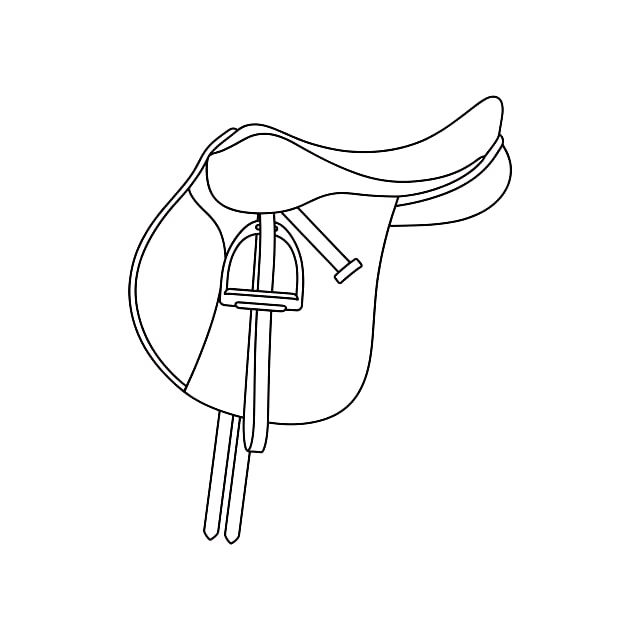 Freeform Classicfrom €1,570English line: trail and hacking with the Trail seat, dressage schooling with the Elite Dressage seat.
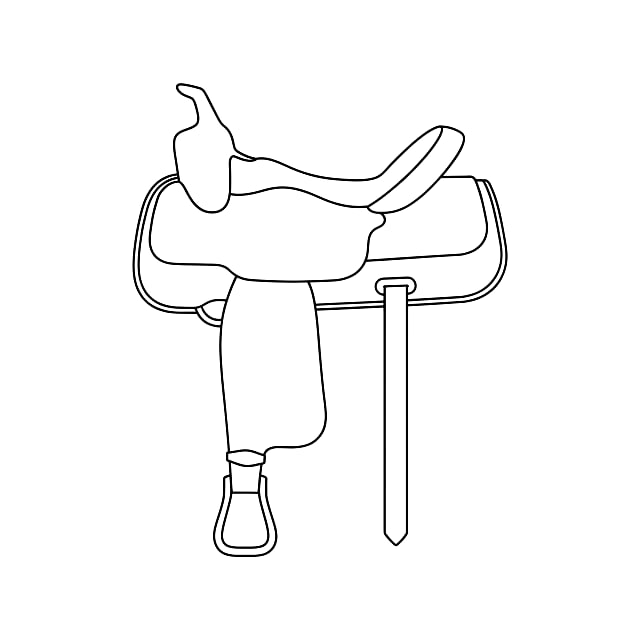 Freeform Scoutfrom €2,270Western line, comfort seat with jockeys, pommel without a horn.
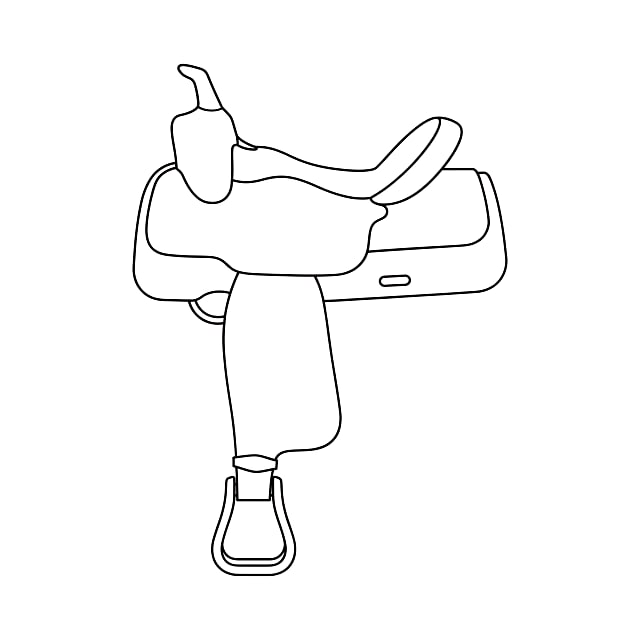 Freeform Pathfinderfrom €2,560Western line with a trail setup and long jockeys.
If you have the seat and a technician has seen the back, you can build a made-to-measure treeless saddle like the Freeform on Equirea: configure your saddle in 3D, choose base, length, seat, leathers and finishes, with the price updated at every choice, and enter your horse's measurements. The saddle is made on the horse's measurements, especially the interior, with a base chosen from three catalog lengths (22", 20", 18.5").
On Equirea's custom saddles delivery is stated as 6-8 weeks, with a statutory guarantee of 24 months plus 5 years on base and aluminum arch, free shipping in Italy (for other countries, ask Equirea for the conditions before ordering) and installments at checkout, depending on the amount and the outcome of the request. The Freeform saddle pad is extra, €146: with the Classic the minimum spend is at least €1,716.
The bases dedicated to dressage, jumping, endurance and pony are not orderable on Equirea today: the Elite Dressage seat fits on the Classic. The Freeform is also sold by Amahorse, Equitime and sattel-baumlos (with a visit to the stable in Germany and Austria), and some retailers also have those bases: the comparison between sellers is in the guide to the custom saddle.
Before payment Equirea asks for a rider verification, free and with no obligation, for example with a free trial lesson (Italy only) or a call. Outside Italy, the call is the option. It is not a technical selection and it does not check the horse. If you compete, on the Freeform the stirrup leather is fixed with a Velcro strap on the base, with no bar: say so in your request to the organizer.
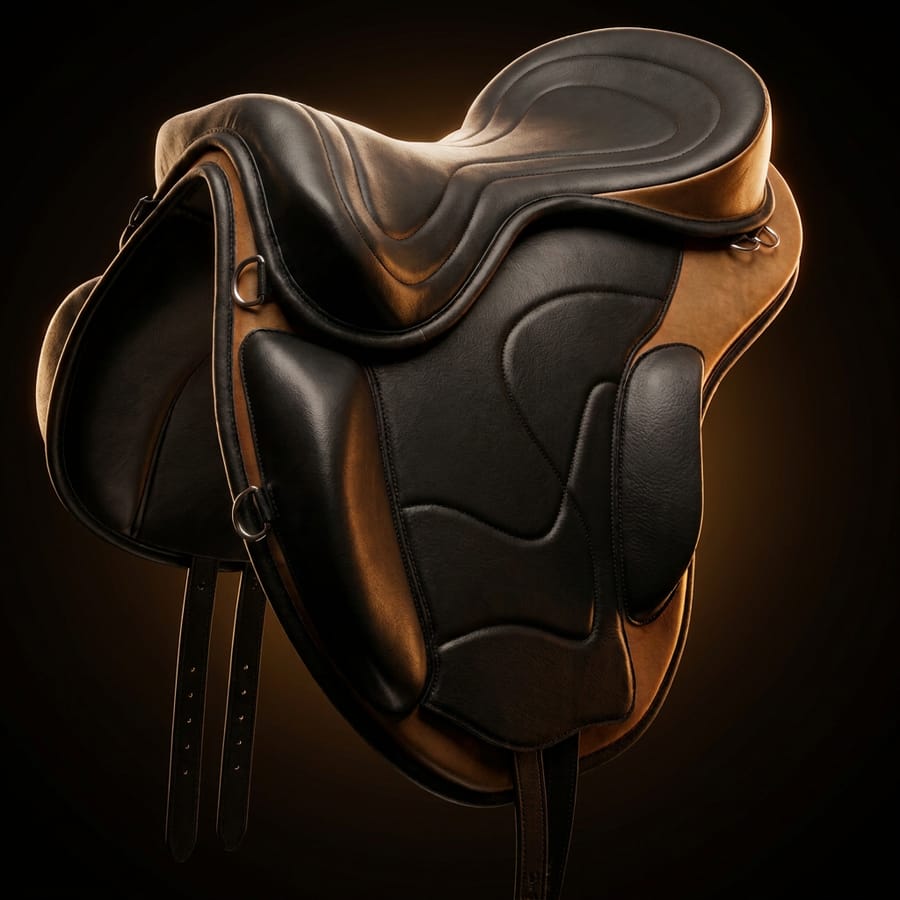
Treeless saddles come in very different price bands. New, in November 2026: Zaldi €270.80 incl. VAT, Barefoot from €499 to €1,369 at La Colombaia, Edix Treeless €550-1,180 and Treeless Cavallin €620-910 at Ilaria Saddle Service. Liz Goldsmith (2008) and Susan Kauffmann (2021), who ride the Freeform, praise its comfort. The first advises against it for riders with balance problems, the second reports that it slips and rotates more than a saddle with a tree. These are customer opinions, and we found no published research on the model: the catalog reports results among the best of the treeless saddles in tests with the Port Lewis Impression Pad, but that is a maker's figure.
In short
- Start from the riding, the horse and the competition rulebook. Budget comes after.
- Dressage and jumping call for almost opposite saddles. The all-purpose is a compromise and becomes a limit if you move up a level.
- Anyone who is learning is better off with a deep seat and a high cantle.
- For the seat, thigh length matters: try it for at least 20 minutes in all gaits.
- Treeless: rules change from country to country, so ask in writing. In our view it makes sense for trail and natural riding with an already independent seat, and it is not recommended for jumping, cross-country, lessons and ponies.
- If you choose one, the Freeform is the one to start from: Classic for the English line, Scout and Pathfinder for the western one, all configurable in 3D on Equirea.
Frequently asked questions
What is the difference between a dressage saddle and a jumping saddle?
The dressage saddle has a deep seat and a long, straight flap, for a lengthened leg. The jumping saddle has a flatter seat and a short, forward flap, for short stirrups and a bent knee.
How do I choose the seat size?
Measure your thigh and use the manufacturer's chart. According to the Krämer guide, the most common adult sizes are 17" and 17.5". Try the saddle for at least 20 minutes, because brands measure differently.
Which saddle for a young horse?
One that is easy to adjust, because the body changes fast: adjustable gullet plate and modifiable panels, according to Krämer. Do not buy it wider in anticipation of growth, because it may rest on the withers. If the horse may outgrow it in a few months, consider a used one.
Which saddle for high or low withers?
With high withers you need plenty of space above the withers and a long gullet plate that steadies the saddle. With low withers, common in ponies, the saddle slips toward the shoulder: you need a wide tree and gullet plate.
What is the best saddle for trail and hacking?
If you are learning, a trail saddle with a tree, padded and with a wide seat. If you already have an independent seat, in our view it is worth looking at a treeless saddle such as the Freeform Classic with the Trail seat or the Freeform Pathfinder, both of which you put together online on Equirea.
Can I compete with a treeless saddle?
It depends on the country and the competition. In Germany the FN catalog 02/2026 prescribes the tree in national dressage, jumping and eventing, while Canada and Australia allow it in dressage. For the FEI, FISE, FFE and RFHE we found no clear rule, and that does not mean allowed: ask the federation or the organizer in writing.