One day your cat chases the feather, the next day ignores it, and there are toys at home that were bought but never touched. To find out what your cat really likes, you don’t need a test: change one thing at a time (type of prey, movement, height, time), keep sessions short and similar, note a few visible signals, and trust only what repeats on different days. One session isn’t enough to draw a conclusion: this is a small at-home observation, not a verdict.
What play preference means
Here, “preference” means what your cat chooses and repeats, not something they do once. To help you get started, you can distinguish three movement styles (practical categories, not a scientific classification):
- Prey that flies: a feather moving through the air.
- Prey that runs on the ground: a small toy that crawls and hides.
- Small, erratic prey: short bursts of movement near the floor.
The toy’s texture and sound, height, speed, location, time of day, and the person playing also matter within each style: there are too many variables to test together.
How to set up fair trials
- Change just one variable: for example, use the same feather, moving it in the air or along the ground.
- Use the same location, the same person playing, and a similar time of day.
- Keep trials short and similar in length: a few minutes is enough.
- If you try several toys, change the order on different days so the first one isn’t always favored.
- Don’t run trials right after a large meal or while your cat is asleep.
- Stop when your cat loses interest and note the actual duration.
What to observe during a trial
Observe your cat and group the signals like this:
- Attention: gaze and ears fixed on the toy, head following it.
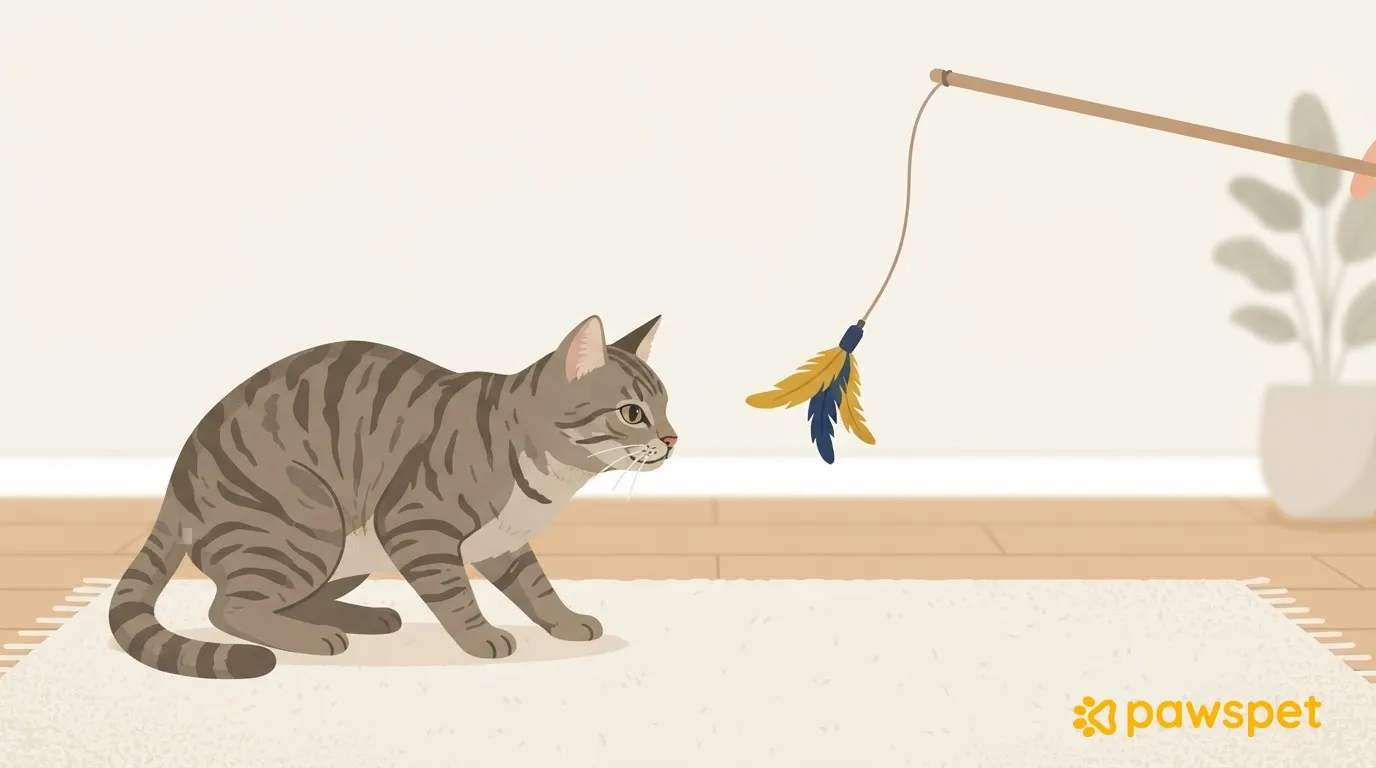
- Getting ready: crouched body, hindquarters swaying.
- Action: chasing, pouncing, grabbing, kicking with the hind legs.
- Persistence: returns to play after a break.
- Disinterest: turns away, grooms, lies down.
Then there are signs of excessive excitement: tail lashing, ears pinned back, increasingly hard bites. If you see them, slow down or stop, and make a note.
To compare sessions, give a score from 0 to 3: this is a home tool for your trials, not a validated scale. Record the highest level reached:
- 0: no interest
- 1: watches the toy
- 2: stalks or chases
- 3: chases, pounces, and grabs several times
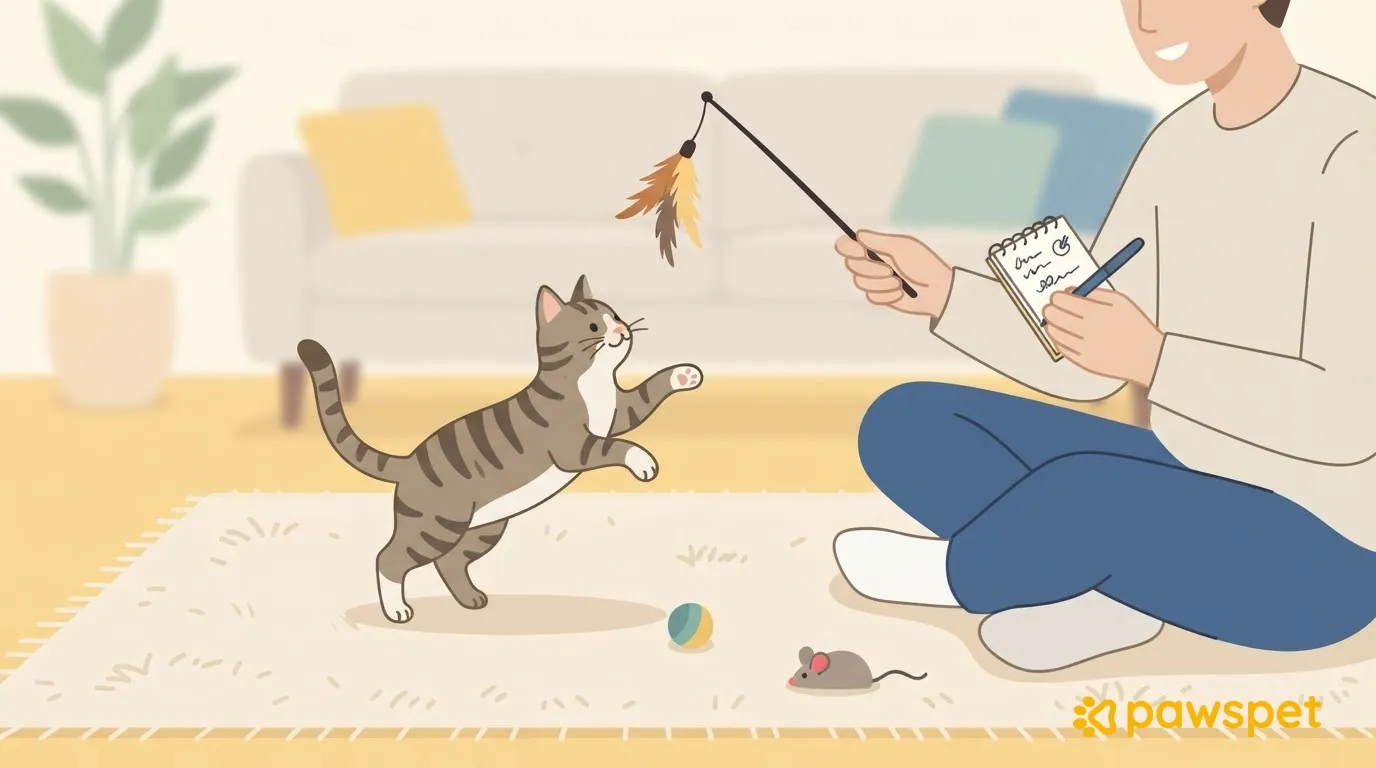
A play diary in five columns
A few words per row are enough, on paper, in your phone’s notes, or in an app. A score of 0 is data too: write it down. The completed row below is just an example of how to fill it in, not a real experience.
| Date and time | Toy and movement | Duration | Score 0-3 | How it ended |
|---|---|---|---|---|
| Example: Monday, evening | Feather, slow movement in the air | 4 min | 2 | Stalked, chased a couple of times, then groomed |
If you want to keep the diary linked to your cat, in PawsPet you can record each trial as an activity: Tab “Activities” » “+”, then choose the type (“Hunting Games” in Sports » Feline sports, or “Free Play and Walks”), the cat in the “Animals” row, and write your observations and score in “Notes.” To find the trials again, open the ☰ menu » “List,” filter by “Category” and “Animal,” and tap a row to read its notes; if you need a routine, create a series with “Repeat” and use the bell to set a reminder before the scheduled time. The app stores and sorts notes but does not analyze or interpret preferences: the conclusions are yours.
Reading and using the results
After a series of trials on different days, look for patterns: which movement gets the quickest reaction, which prey leads to the most catches, and when your cat is most active. Then use them to make three practical choices:
- which lure to attach to the wand for the final catch;
- how to put together sets of toys to rotate on different days;
- whether and what to buy: first check that you don’t already have a toy that uses the movement that works.
There’s no set number of trials: what matters is consistency across different days, and a result that appears only once remains a hypothesis. Preferences can change over time and with age, so repeat a few trials every now and then.
If a cat that used to enjoy playing suddenly loses interest, that’s a reason to contact the veterinarian: without speculating about causes, describe what you’ve noticed.
The first experiment: three days, three movements
- Choose one movement for each style: a feather in the air, a small toy that crawls, and short bursts of movement near the floor.
- Days 1, 2, and 3: try one movement per day, always at the same time and in the same place, for a similar length of time. Fill in one diary row after each trial.
- Days 4, 5, and 6: repeat the three movements in a different order, for example third, first, second.
- Compare the scores: if the same movement wins in both rounds, you have an initial pattern; if they differ, do another round before drawing a conclusion.
Frequently asked questions
Several of us play with our cat: how can we keep one shared diary?
Use the same columns and scale, and add a note about who played. With PawsPet, the cat’s owner can invite family members who already have an account: from the ⋮ menu on the cat’s profile, select “Collaborators” » “Add collaborator,” with “Edit” permission for the Activities area. That way, everyone can record their own trials.
What if my cat always prefers the same toy?
That’s fine. Vary the movement, one thing at a time, and check the toy for wear: if it frays or loses pieces, replace it.