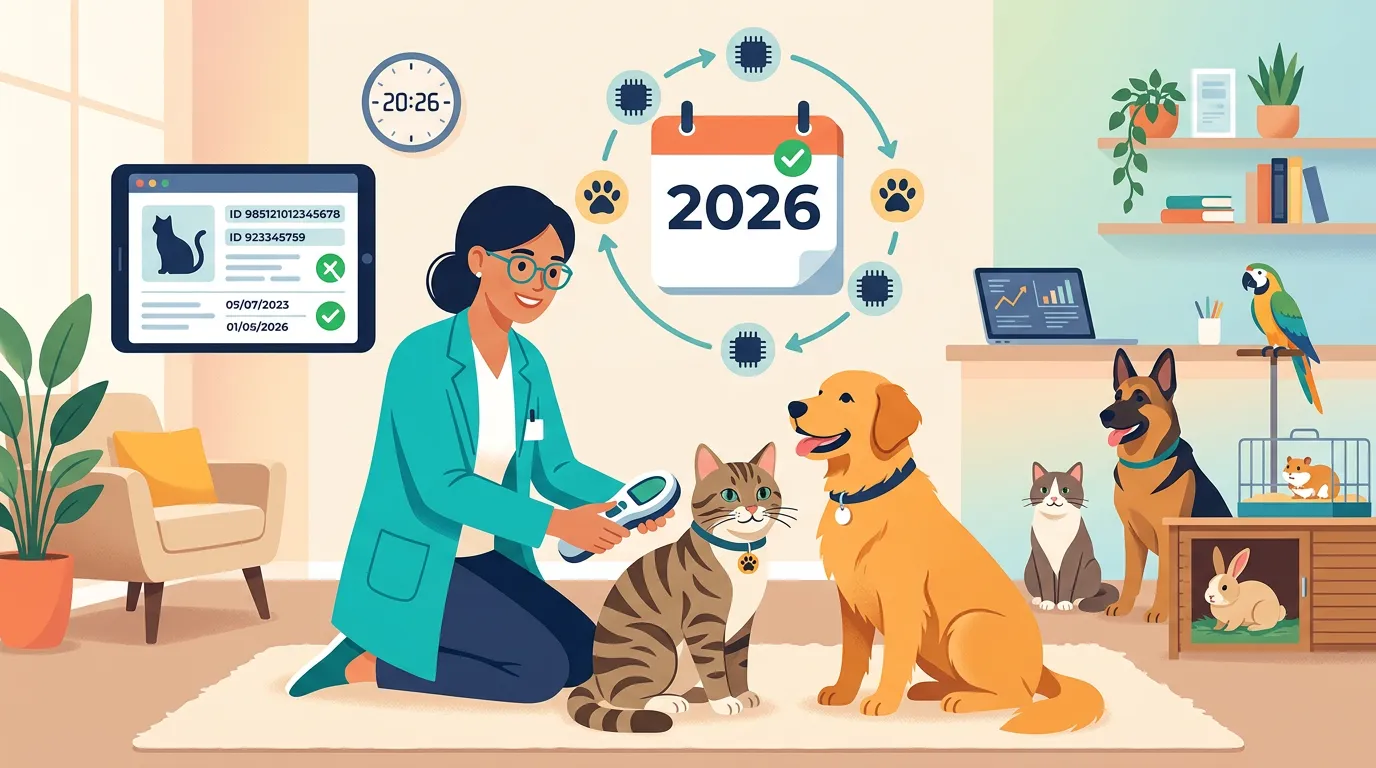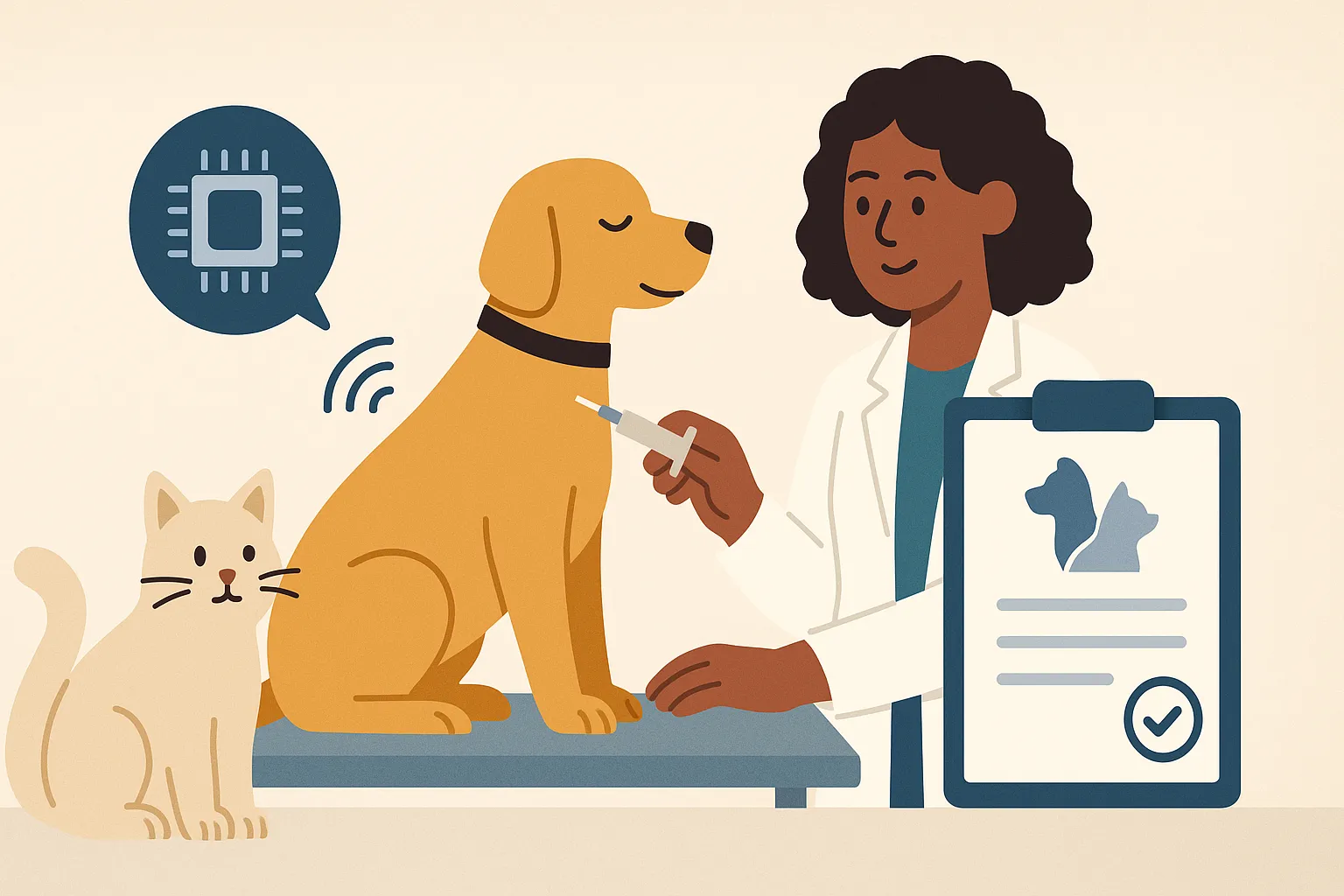
The 2026 regulations on microchips and dog and cat registration introduce a number of important updates regarding obligations, deadlines, penalties for missing microchips, and procedures in the event of a change of owner or loss.
If you own a dog or cat, or run a pet business (grooming, boarding, pet sitting, association), it is essential to know:
- when the microchip is mandatory
- how registration in the pet registry works
- what changes in 2026 for dogs and cats
- what fines you risk if you are not compliant
- how to handle ownership transfers, relocations, and reports of loss
In this guide, updated for 2026, you’ll find a clear and practical overview, with action checklists and tips to help you stay compliant at all times, integrating — where useful — digital tools such as the PawsPet app.
1. Microchip requirement for dogs in 2026
In Italy, the dog microchip requirement is not new in 2026: it has been in place for years, but authorities are stepping up checks and awareness campaigns.
1.1 Is a microchip mandatory for dogs in 2026?
Yes, in 2026 a microchip is mandatory for dogs throughout the country.
In practical terms:
- every dog must have a unique identification microchip
- the microchip must be registered with the Regional Dog Registry
- the owner or keeper is responsible for registration and data updates
Without a microchip, the dog is considered unidentified and you may face administrative penalties.
1.2 By when must a dog be microchipped?
Regions usually set similar deadlines, which in 2026 remain aligned with previous years:
- puppy: within 30/60 days of age (depending on the Region)
- and in any case before being transferred to a third party or before any possible export abroad
If you adopt an adult dog that is already microchipped, you will still need to update the registered owner in the pet registry, as we’ll see later.
1.3 Where is the microchip implanted and who can apply it?
- the microchip is a small capsule (similar to a grain of rice)
- it is inserted under the skin in the neck area, on the left side
- the procedure is carried out by a licensed veterinarian (private practice or local health authority)
The insertion takes just a few seconds and is comparable to a routine injection. The microchip does not contain sensitive data, only a unique numeric code that can be read with a special scanner.
2. Cat microchips: what changes under the 2026 regulations
The hottest topic is often cat microchipping, because for years it was not handled the same way everywhere.
2.1 Cat microchip regulations 2026: is it mandatory?
In 2026, the regulatory trend is clear:
- for owned cats:
- in many Regions, a microchip is already mandatory in cases of transfer, EU passport issuance, or access to controlled feline colonies
- other Regions are introducing or expanding the requirement, with transition periods
- for cats traveling within the EU: a microchip is always required to obtain the EU pet passport
So, even where it is not yet explicitly mandatory for all cats, it is strongly recommended to:
- microchip your cat
- register it in the Feline Registry (regional or national, where available)
This is not only to comply with animal regulations, but also for safety reasons in case the cat goes missing.
2.2 Why microchip a cat even if it is not “mandatory”?
Practical reasons:
- cats can leave the house and wander far away
- a cat without a microchip, if found, may be mistaken for a stray
- with a microchip, if picked up by the local health authority, shelter, or association, it can be traced back to the owner
In many Regions, starting in 2026, campaigns are being strengthened to ensure that even indoor cats are identified just like dogs.
3. Dog registration in the Pet Registry: how it works
Dog registration in the Pet Registry is the step that makes the microchip effective. Without registration, the microchip basically doesn’t connect to any useful database.
3.1 What is the Pet Registry?
The Pet Registry is:
- an electronic register managed at the regional or provincial level
- connected to national information systems
- accessible to health authorities, municipalities, law enforcement, and licensed veterinarians
It contains:
- dog details (species, breed, sex, estimated date of birth, coat color, any distinguishing marks)
- microchip code
- personal and contact details of the owner or keeper
- history of changes (ownership transfers, death, relocation to another Region, loss/found reports)
3.2 Who must register the animal and when
The duty to register in the Pet Registry belongs to:
- whoever keeps the dog on a stable basis (owner, foster caregiver, association)
- within the deadlines set by the Region, typically:
- within 30 days of birth or of entering the household
- and in any case before transfer to a third party
In practice, it is often the veterinarian who enters the data into the system when the microchip is applied or at the first check-up.
4. 2026 penalties for missing dog and cat microchips
Many people search online for things like “penalties for missing dog and cat microchips 2026” because they fear hefty fines. In 2026, the stance remains firm: identification is a legal and moral duty of the owner.
4.1 What kind of fines are предусмотрed?
Penalties for failing to comply with the microchip and registration requirement vary depending on:
- Region (each authority sets its own minimum and maximum)
- severity: simple failure to register, failure to report loss, abandonment, etc.
In general:
- for failure to microchip/register a dog:
- administrative fines can range roughly from tens to several hundred euros
- for more serious conduct (e.g. abandonment):
- possible criminal liability in addition to administrative penalties
For cats, where the microchip is made mandatory by regional regulations, similar penalties apply.
4.2 When can checks take place?
Checks may happen:
- during street or territory inspections (e.g. by the Local Police, animal welfare officers, health authorities)
- following a report (e.g. a roaming dog, neighbors reporting unidentified dogs)
- during veterinary visits or administrative procedures (passport issuance, kennel registration, boarding, etc.)
The check is simple: a microchip scanner is passed over the dog/cat and the data is matched against the registry.
5. Change of owner, relocation, and death: what to do in 2026
Animal regulations are not limited to microchip application. A crucial part concerns how data is managed over time.
5.1 Change of owner for a dog or cat
In case of transfer (sale, adoption, donation):
- the previous owner must report the transfer to the Registry (via health authority forms or an online form, where available)
- the new owner must accept the transfer and provide their full details
- the microchip remains the same, but the registered owner is updated
Deadlines and procedures may vary from Region to Region, but generally:
- the change must be reported within 15–30 days of the transfer
- both parties’ signatures or documentation proving the transfer are required
5.2 Moving to another Region or changing address
If you move to another Region:
- in some areas the update is automatic between connected registries
- in others you must submit a specific request to transfer the animal to the new competent health authority
In case of a simple change of address or contact details (phone, email):
- it is good practice to update the Registry so you can always be reached in case of loss.
5.3 Death of the animal
In the event of the death of a dog or cat:
- the owner must report the death to the Registry
- often the veterinarian can handle the data update directly
This avoids inconsistencies (animals still listed as alive, statistical issues, etc.).
6. Loss, found animals, and the European passport
Microchips and registration become essential precisely when the worst happens: your dog or cat gets lost.
6.1 What to do if your dog or cat goes missing
If your animal disappears:
- Report the loss
- go to the veterinary health authority or municipality (or use online channels, where available)
- fill out the loss report including: animal details, microchip code, date and place of disappearance
- Alert kennels/shelters and local veterinarians
- this is often the first place where a found animal is taken
- Contact local associations and groups
- social media, neighborhood groups, volunteers: very useful channels
- Check reports regularly
- the report remains recorded, but it is best to be proactive
In 2026, many Regions are enhancing online lost/found reporting systems, with direct links to dog and cat registry databases.
6.2 What happens if a dog or cat is found
If a dog or cat is:
- picked up by citizens, law enforcement, health authorities, or associations
- taken to a veterinarian or public facility
the animal’s microchip is scanned and:
- if it is registered, the owner can be identified
- if it is not registered or has no microchip, it will be handled as a stray/roaming animal according to local regulations
This is where the quality of registry data matters too: if your phone number/email are outdated, you may not be contacted.
6.3 European passport and travel
To travel to another EU country in 2026:
- dogs and cats must be microchipped
- an EU pet passport must be issued
- a valid rabies vaccination is mandatory, and there is often a minimum waiting period before departure
The veterinarian:
- checks the microchip
- verifies or administers the required vaccinations
- fills out the passport with details consistent with the Registry
7. 2026 regulations: regional differences and references
In Italy, the management of animal registries is highly regionalized. This means:
- the general principles (dog microchip requirement, promotion of cat identification, registrations, penalties) are consistent
- the operational details (forms, deadlines, fine amounts) may change
7.1 What to check in your Region
To make sure you comply with animal regulations in 2026:
- check the website of your Region or veterinary health authority
- verify:
- dog microchip requirement (always present, but check the deadlines)
- any cat microchip requirement and relevant cases (all cats? only those that go outdoors? only in case of transfer?)
- deadlines for:
- registry registration
- change of owner
- loss report
- transfer to another Region
- forms and responsible offices
- updated penalty amounts for 2026
7.2 Why the regulations are becoming stricter
The reasons are:
- to combat stray animal populations
- to protect public health (zoonoses, bites, management of feline colonies)
- to ensure the animal can always be traced back to a responsible person
- to reduce costs for municipalities and health authorities in managing kennels and shelters
8. How to stay fully compliant: practical checklist
A short operational checklist for 2026, useful for both pet owners and pet professionals.
8.1 For anyone who has or adopts a dog
- check whether the dog already has a microchip
- if not, book a veterinarian visit for implantation and registration
- make sure the registry details are correct (address, phone, email)
- in case of a change of owner, follow the transfer procedure in the Registry
- in case of relocation to another Region, contact the new health authority for updates
- in case of loss, immediately file the report with the municipality/health authority
8.2 For anyone who has or adopts a cat
- ask your veterinarian whether, in your Region, a microchip is mandatory in 2026 for your specific case
- in any case, seriously consider microchipping your cat (even if it is strictly indoor)
- register the cat in the Feline Registry, where available
- update the data if you change address or transfer ownership
- for EU travel, request the European passport well in advance
8.3 For pet professionals and businesses
If you run:
-
boarding facilities, day care, grooming salons, dog walkers/pet sitters, associations, shelters
you should: -
always request proof of microchip and the animal’s details
-
keep an updated internal log of the dogs and cats in your care
-
inform clients about the responsibilities linked to the 2026 regulations (lack of identification, penalties, etc.)
9. How technology can help: the PawsPet example
Managing microchips, registries, documents, and deadlines can become complicated if you have several animals or work in the pet sector. That’s exactly why pet apps were created: to simplify things.
With an app like PawsPet, for example, you can:
- save each dog/cat’s microchip code in its dedicated profile
- record:
- microchip implantation date
- assigned veterinarian
- notes about ownership transfers
- keep a digital dossier for the animal:
- vaccinations
- medications
- documents (e.g. photo of the EU passport)
- receive reminders for:
- veterinary check-ups
- vaccine renewals
- deadlines related to travel or documents
If you are a professional:
- you can keep track of your clients’ animals in an organized way, always respecting privacy
- have an immediate overview of hosted animals with the essential information (microchip, any health notes, owner contacts)
This helps you to:
- respond more quickly in case of emergencies (e.g. a pet goes missing during a walk: you have codes and contacts at hand)
- demonstrate professional, documented management of the animals you host or care for.
10. Practical tips for navigating the 2026 regulations with peace of mind
A short “box” of practical tips to make the 2026 regulations on microchips and dog/cat registration work for you, not against you.
Good practices to adopt:
- microchip puppies and kittens as soon as possible
- if you adopt an adult animal, check the code and registry ownership immediately
- always keep an up-to-date photo of your dog/cat (useful if it goes missing)
- keep these handy:
- microchip code
- veterinarian’s contact details
- any documents (passport, health certificates)
- update registry data whenever there is:
- a move
- a change of phone number or email
- a change of ownership
The final goal is not only to avoid a fine, but to truly protect your animal and ensure a quick return home if something goes wrong.
Conclusions: 2026 regulations, responsibility, and useful tools
In 2026, the dog microchip requirement, the growing regulation of cat microchipping, and the central role of registry registration confirm a clear direction:
- every dog and, increasingly, every cat must be identifiable and traceable to a responsible person
- those who fail to comply may face administrative penalties, and in more serious cases even criminal liability
- proper identification simplifies procedures in case of loss, ownership changes, travel, and checks
To manage everything with less stress, you can also rely on digital tools: PawsPet helps you collect and organize in one place the essential information related to your animals’ health and identification.
If you want to handle the 2026 regulations with peace of mind:
- make sure your dog and cat are compliant with microchip and registration rules
- keep data updated promptly
- use tools that make daily life easier with your four-legged companions.
Try the PawsPet app to always have important information about your animal’s microchip, documents, and health with you, and to manage everything related to its well-being in a simple and secure way.
FAQ on microchips and 2026 regulations for dogs and cats
Does the 2026 dog microchip requirement also apply to dogs that live only in the yard or indoors?
Yes. The regulations do not distinguish between “apartment dogs,” “yard dogs,” or “working dogs”: all dogs must be identified with a microchip and registered in the Pet Registry, regardless of where they live or how often they go out.
Do I need to microchip my cat if it lives indoors only?
In 2026, this depends largely on the Region. In some Regions, cat microchipping is already mandatory in several cases (transfer, colony access, etc.), while in others it is strongly recommended. Even for an indoor-only cat, a microchip is advisable, because it can always happen that it escapes (open door or window, moving house, fright).
What do I risk if my dog has no microchip in 2026?
You risk an administrative penalty (fine), the amount of which varies depending on the Region and the specific situation. Also, in case of loss or an accident, it will be much harder to prove ownership and the animal may be treated as wandering or stray. In cases of abandonment, criminal liability may also apply.
How can I tell whether my dog or cat is correctly registered in the registry?
You can:
- ask your veterinarian to scan the microchip and check the registry data
- contact the relevant veterinary health authority with the microchip code
- check any online portals provided by your Region
If you notice incorrect or missing data (address, contact details, owner), request an update immediately following the required procedure.