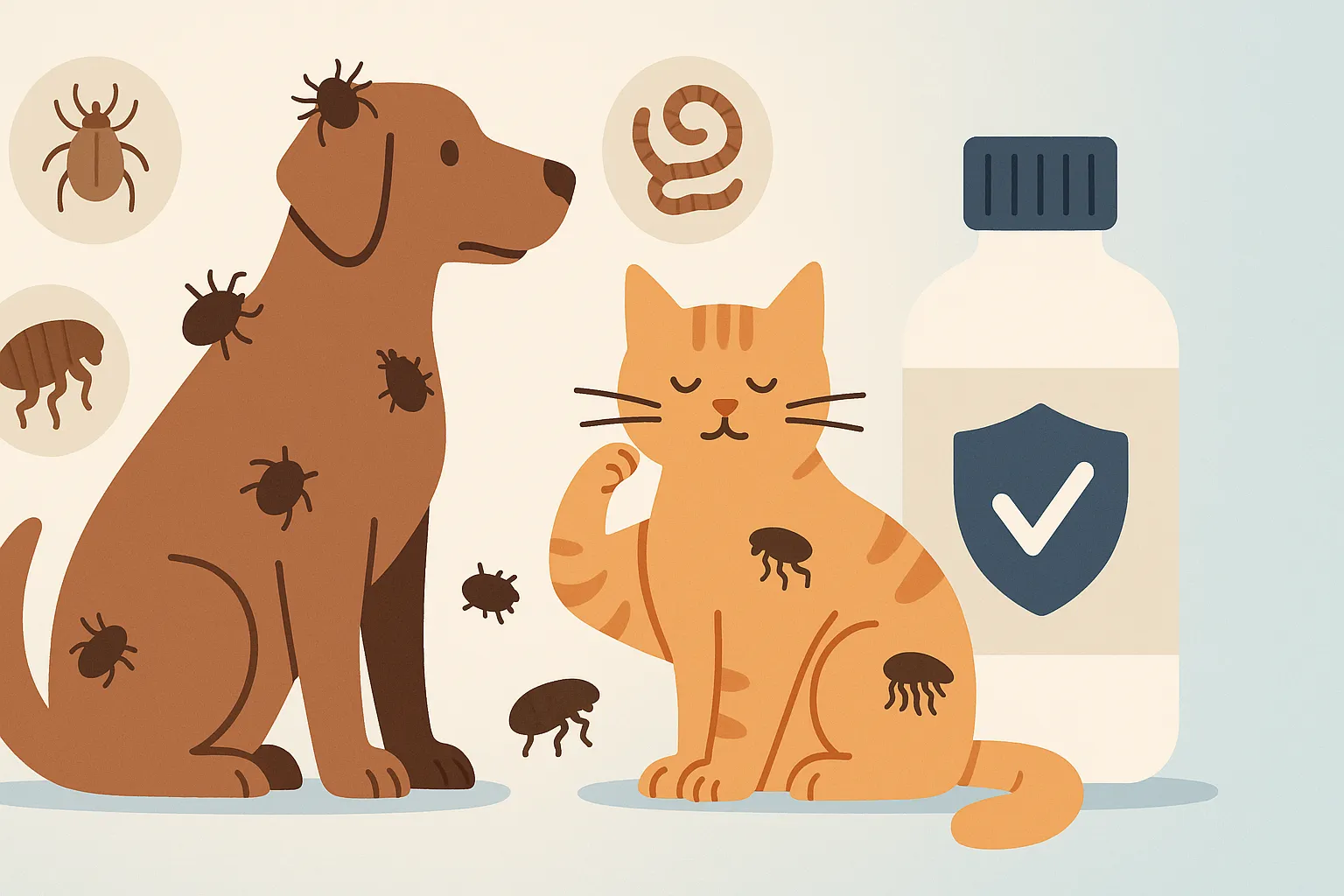
Protecting dogs and cats from fleas, ticks, sand flies, and other parasites is not just a matter of “being bothered”: it is a matter of real health prevention, for them and for the family. Choosing the right antiparasitic, understanding when to apply it and for how long can, however, become a puzzle among collars, spot-ons, tablets, and sprays.
In this clear and practical guide we’ll look at:
- the main parasites affecting dogs and cats;
- the risks they bring with them (including for humans);
- how to navigate the different types of antiparasitics;
- how to set up a truly effective antiparasitic plan, based on your lifestyle and the area where you live;
- practical tips so you never forget a treatment, also taking advantage of digital tools like PawsPet.
1. Parasites in dogs and cats: not just fleas and ticks
1.1 The main external parasites
The best-known external parasites (ectoparasites) of dogs and cats are:
-
Fleas
- They jump from one animal to another.
- They cause intense itching, allergic dermatitis, anemia in puppies/kittens.
- They can transmit tapeworms (intestinal worms).
-
Ticks
- They attach to the skin and feed on blood for days.
- They are found in the countryside, but also in cities (parks, apartment complex gardens).
- They can transmit serious diseases such as ehrlichiosis, babesiosis, and anaplasmosis.
-
Sand flies
- Small insects similar to tiny mosquitoes.
- Active mainly at dusk and at night during the warm season.
- They can transmit leishmaniasis to dogs (very widespread in various Italian regions).
-
Mosquitoes
- In addition to the nuisance of bites, they can transmit heartworm disease in dogs and cats.
-
Lice and mange mites
- Less common but very irritating.
- Some mites (e.g. Sarcoptes scabiei) can cause mange forms that may also be transmitted to humans.
1.2 Why parasites are dangerous
Parasites are not just an aesthetic nuisance or an itching problem:
- they can carry serious or chronic diseases;
- they cause severe itching, skin lesions, and secondary infections;
- they compromise the animal’s overall well-being (loss of appetite, weight loss, lethargy);
- some are zoonotic, meaning they can also affect humans (e.g. some tick-borne diseases, some mites).
For this reason, antiparasitic prevention is a key part of any health plan for dogs and cats, not only in the summer months.
2. Understanding the risk: lifestyle, location, season
Before asking “dog antiparasitic: which one should I choose?” or “cat antiparasitic: any advice?”, it is essential to understand what we need to protect them from.
2.1 Factors that increase the risk
Consider:
-
Geographic area
- Areas endemic for leishmaniasis (Central-Southern Italy, coastal areas, some Northern areas): specific protection against sand flies.
- Areas with a high presence of ticks: countryside, woods, pastures, but also urban parks.
- Areas with many mosquitoes: risk of heartworm increases.
-
Dog’s lifestyle
- Does it only go out for short walks in the city, or does it take long walks in the countryside/woods?
- Does it frequent dog parks, boarding facilities, daycare centers, training grounds?
- Does it travel with you to different areas (sea, mountains, abroad)?
-
Cat’s lifestyle
- Indoor-only cat: reduced risk, but not zero (fleas can come in on shoes, other animals).
- Cat that goes into the garden or onto the street: higher risk of fleas, ticks, intestinal parasites.
- Cats living in groups: greater chance of shared infestations.
-
Presence of other animals in the home
- Dogs + cats together: all of them must be protected, with species-appropriate products.
- Other animals (rabbits, small rodents): they require specific plans decided with the vet.
2.2 Seasonality: antiparasitic only in summer?
A very common mistake is using antiparasitics only “in the warm season”. In reality:
- in many areas of Italy, fleas and ticks are present almost all year round;
- in cities, with milder winters, the risk does not completely disappear;
- continuous protection makes environmental control easier (flea eggs and larvae in the house, in the car, in the bed).
For this reason, many veterinarians now recommend continuous antiparasitic coverage, possibly adjusting the product type and frequency according to the season and the area.
3. Types of antiparasitics: collars, spot-ons, tablets, and more
There are several formulations, each with pros and cons. There is no absolute “best” one, only the one most suitable for your dog or cat, their lifestyle, and the diseases present in your area.
3.1 Antiparasitic collars
How they work
They gradually release active ingredients (repellents and/or insecticides) onto the skin and coat, protecting the animal for weeks or months.
Advantages
- Often long-lasting coverage (up to 6–8 months in some products).
- Some collars also have a repellent effect against sand flies and ticks.
- Convenient for owners who fear forgetting frequent applications.
Limitations
- They must be worn continuously to be effective.
- They may not be ideal for:
- cats that climb or fight with other cats (risk of getting caught if the collar is not breakaway);
- dogs/cats that bathe frequently (sea, lakes, grooming).
- Some animals do not tolerate a collar (itching, irritation).
3.2 Spot-on pipettes (topical antiparasitics)
How they work
They are applied to the skin, usually at the nape or along the back. The active ingredient spreads over the body surface and, in some cases, is partially absorbed.
Advantages
- Usually monthly coverage.
- Wide choice of products specific for:
- fleas,
- ticks,
- sand flies,
- some internal parasites.
- Easy to apply (if the dog/cat is cooperative).
Limitations
- You must carefully follow the timing and application instructions.
- It is important not to bathe the animal within a certain interval before/after application (varies by product).
- Some cats may lick the area if it is not applied correctly.
3.3 Tablets and oral antiparasitics
How they work
They are given by mouth (chewable tablets or capsules). The animal ingests the antiparasitic, which acts systemically.
Advantages
- Very convenient if the dog accepts tablets willingly (they are often palatable).
- They are not affected by baths, shampoos, or swimming.
- No oily residue on the coat, no risk of contact with children immediately after application.
Limitations
- They are usually not repellents: the parasite must bite the animal in order to die.
- They require a vet’s prescription and precise instructions.
- Oral alternatives are not always available for cats; the range is broader for dogs.
3.4 Sprays and antiparasitic shampoos
These are more often used:
- for very young puppies/kittens, when other products are not suitable;
- as an emergency treatment (heavy infestations, many visible fleas);
- on veterinary advice, in combination with other antiparasitics.
They generally have a shorter duration of action and require care when used, especially to protect mucous membranes (eyes, mouth, nose).
4. Dog antiparasitic: which one should you choose?
The question “dog antiparasitic: which one should I choose” has the correct answer: it depends on the individual dog and the veterinarian’s opinion. You can, however, narrow it down using a few practical criteria.
4.1 Parameters to consider
When discussing it with your veterinarian, clarify:
- Weight and size of the dog
- Dosages are always based on weight.
- Age
- Puppies have limitations with some molecules and formulations.
- Pregnancy/lactation
- Specific products are needed, safe for mother and puppies.
- Previous conditions
- Heart disease, kidney or liver failure, known allergies.
- Lifestyle
- Apartment dog vs working/hunting dog, dog that swims often, dog that stays in boarding.
4.2 Practical examples
-
Dog living in an apartment in the city, going out 3–4 times a day on a leash
- Priority: protection against fleas, ticks and, if in a risk area, sand flies/mosquitoes.
- Possible choices (always evaluated with the vet):
- long-lasting collar +, if needed, dedicated heartworm prevention;
- monthly spot-on with multiple actions;
- oral tablet + external repellent product if leishmaniasis coverage is needed.
-
Sporty dog or dog that swims often
- Collars and some spot-ons may lose part of their effectiveness with frequent bathing.
- Oral tablets are often suitable + possibly an additional repellent for sand flies during the season.
-
Dog that goes frequently into the countryside/woods
- High risk of ticks and transmitted diseases.
- The veterinarian may suggest products with rapid acaricidal effect and strong repellent action, used continuously.
5. Cat antiparasitic: specific advice
Cats have characteristics and sensitivities different from dogs. For this reason, dog antiparasitics should never be used on cats, especially those containing certain pyrethrins or permethrins that are highly toxic to felines.
5.1 Indoor cat vs cat that goes outside
-
Indoor-only cat
- Lower risk of fleas, but not zero.
- A lighter but continuous prevention program may be enough, as decided with the vet.
- Pay attention to:
- new animals entering the home;
- travel, boarding, cat sitters who have other animals.
-
Cat that goes outside (garden, terrace, street)
- High risk of fleas, ticks and internal parasites.
- In this case, regular coverage throughout the risk period is important (often all year round).
5.2 Which formulations are most used in cats
-
Spot-ons specifically for cats
- They are the most common choice.
- They protect against fleas, ticks, and sometimes also against some internal parasites.
- It is essential to apply them in a place the cat cannot lick, usually at the base of the skull.
-
Antiparasitic collars for cats
- They must be breakaway safety collars to avoid strangulation risks.
- A good choice for cats that also live outdoors and tolerate a collar.
-
Tablets
- Oral antiparasitics also exist for cats, but they are less common or less practical to administer.
- Their use should always be decided with the vet.
5.3 Watch out in dog–cat households
If dogs and cats live together in the same home:
- check with the vet that the products used on the dog are not toxic for the cat in case of contact;
- avoid letting the cat lick the dog immediately after a spot-on application;
- keep products and packages out of reach of all animals.
6. Sand flies, leishmaniasis, and targeted protection
The PostMeta contains the keyword “sand flies dog leishmaniasis” because this is one of the most delicate topics, especially in many Italian regions.
6.1 What are sand flies
- They are small blood-feeding insects (phlebotomines) active mainly:
- from spring to autumn;
- in the evening and at night.
- They can enter the home through imperfect window screens, balconies, and gardens.
6.2 Leishmaniasis: why it is so feared
Leishmaniasis:
- is a serious, chronic disease, difficult to completely eradicate;
- can cause:
- progressive weight loss;
- skin lesions;
- kidney problems;
- anemia and other systemic changes;
- requires specialized veterinary diagnosis and management;
- is endemic in many areas of Central-Southern Italy, but is now also present farther north.
6.3 How to protect your dog from sand flies
Prevention is based on several pillars:
- Antiparasitics with a repellent effect against sand flies
- Specific collars or spot-ons, used throughout the risk period.
- Environmental management
- Reduce sources of moisture and resting areas for insects.
- If possible, keep the dog indoors during the highest-risk hours (evening and night).
- Periodic veterinary screening
- Blood tests in dogs living in or traveling to endemic areas.
- Vaccines and other preventive measures
- Vaccines and immunomodulatory products exist: their use should be discussed with the veterinarian, weighing risks and benefits for the specific dog.
7. How to set up an effective antiparasitic plan
To turn general advice into a concrete plan, you can proceed as follows.
7.1 Checklist for the veterinary visit
Bring with you:
- Updated data for your dog/cat:
- current weight,
- age,
- any medications currently being given.
- History:
- previous flea/tick infestations;
- stays in high-risk areas (sea, hills, abroad).
- Daily habits:
- how much time they spend outside;
- whether they sleep in bed, on the sofa, or in the garden.
Ask your vet to help you define:
- Which parasites to protect against as a priority (fleas, ticks, sand flies, mosquitoes, mites…).
- Which combination of products is most suitable (e.g. collar + heartworm prevention, spot-on + tablets, etc.).
- Application schedule: how often, in which months, for how long.
7.2 Example of an annual plan (indicative)
This is just a general example, not a prescription:
- All year round
- Continuous protection against fleas and ticks with a collar, spot-on, or tablets.
- From spring to autumn (or all year in warm areas)
- Additional protection against sand flies and mosquitoes (repellent product).
- In endemic areas: heartworm prevention according to veterinary instructions.
- 1–2 times a year
- Check-up visit + possible blood tests (especially for dogs at risk of leishmaniasis or heartworm).
8. Safe use of antiparasitics: mistakes to avoid
8.1 General rules
- Always read the package leaflet before use.
- Use only veterinary products, bought from a pharmacy, pet pharmacy, or veterinarian.
- Follow:
- species (dog or cat);
- weight;
- minimum age indicated;
- administration frequency.
8.2 Common mistakes
- Using a dog antiparasitic on a cat → it can be very dangerous.
- Splitting a pipette “for two smaller animals” → dosages are not linear, and the risk of inefficacy or overdose is real.
- Applying the product too often, thinking that “more often = more protected” → side effects may increase.
- Bathing immediately before or right after applying spot-ons without following the instructions.
- Forgetting to treat all the animals in the home: one infested animal can reinfest the others and the environment.
8.3 Warning signs
After applying an antiparasitic, contact your vet if you notice:
- severe lethargy, tremors, or seizures;
- persistent vomiting, significant diarrhea;
- widespread skin reactions (redness, blisters, intense itching).
Do not stop or switch products on your own: the veterinarian is the one who should assess more suitable alternatives.
9. Practical tips so you don’t forget the antiparasitic
Managing a continuous antiparasitic program can become demanding, especially with multiple pets.
9.1 Small organizational tricks
- Mark application dates directly on the calendar (paper or digital).
- Keep the blisters or empty packages until the next application, with a note of the date.
- Link the antiparasitic application to a fixed monthly routine (e.g. the first Monday of the month).
9.2 How PawsPet can help you
An app like PawsPet can greatly simplify prevention:
- You create a profile for each animal (dog or cat) with weight, age, health notes.
- You enter the antiparasitic products you use and the frequency recommended by the vet.
- You set smart reminders:
- they remind you when to apply the pipette or give the tablet;
- you can differentiate reminders for each pet.
- You keep track over time of:
- application dates;
- any reactions;
- trips to risk areas (thanks to GPS/walk diary features, if you use them).
In this way, you always have your flea and tick prevention plan (and for the other parasites too) under control, without the risk of forgetting.
10. Conclusions: continuous prevention, tailored to your pet
Fleas, ticks, sand flies, and mosquitoes are a reality that anyone living with a dog or cat must deal with all year round. The good news is that today we have many effective tools available: collars, spot-ons, tablets, sprays, which can be combined safely with the help of the veterinarian.
The secret is not to find “the best antiparasitic in absolute terms”, but to:
- assess your animal’s lifestyle, area, and health;
- build a personalized antiparasitic plan with your veterinarian;
- maintain it over time with consistency, using reminders and digital tools.
If you want to simplify the management of vaccines, antiparasitics, and visits:
- try registering your dog and cat on PawsPet,
- set up antiparasitic reminders,
- keep all their health information in one place.
Good organization is the foundation of effective prevention and peace of mind for the whole family, both two-legged and four-legged.
FAQ on antiparasitics for dogs and cats
Which antiparasitic is best for dogs?
There is no “best” antiparasitic for all dogs. The choice between collar, spot-on, or tablets depends on:
- weight, age, and health conditions;
- the area where you live (presence of leishmaniasis, heartworm, ticks);
- lifestyle (frequent baths, outdoor activity).
The veterinarian is the reference professional for building a personalized plan. You can come to the appointment already prepared by writing down this information and saving it in PawsPet too.
How often should I apply the antiparasitic to dogs and cats?
It depends on the product:
- many spot-ons last about 4 weeks;
- some collars last several months;
- some tablets provide coverage for 1–3 months.
For effective flea and tick prevention in dogs and cats, it is important to follow the timing indicated on the package and by the veterinarian. App reminders help you avoid missing a dose.
Can I use the dog’s antiparasitic on the cat?
No, never. Some dog antiparasitics contain substances (such as certain permethrins) that are toxic to cats, even through contact or licking. Always use cat-specific products and ask your vet for advice in case of dog–cat cohabitation.
Is an antiparasitic enough to protect a dog from leishmaniasis?
Antiparasitics with a repellent effect against sand flies are an important pillar of prevention, but not the only one. In areas endemic for leishmaniasis, the veterinarian may suggest:
- periodic blood tests;
- additional strategies (vaccine, immunomodulatory products, managing walking times).
Talk to your veterinarian to build a complete plan, suited to the specific risk in your area and your dog’s health profile.