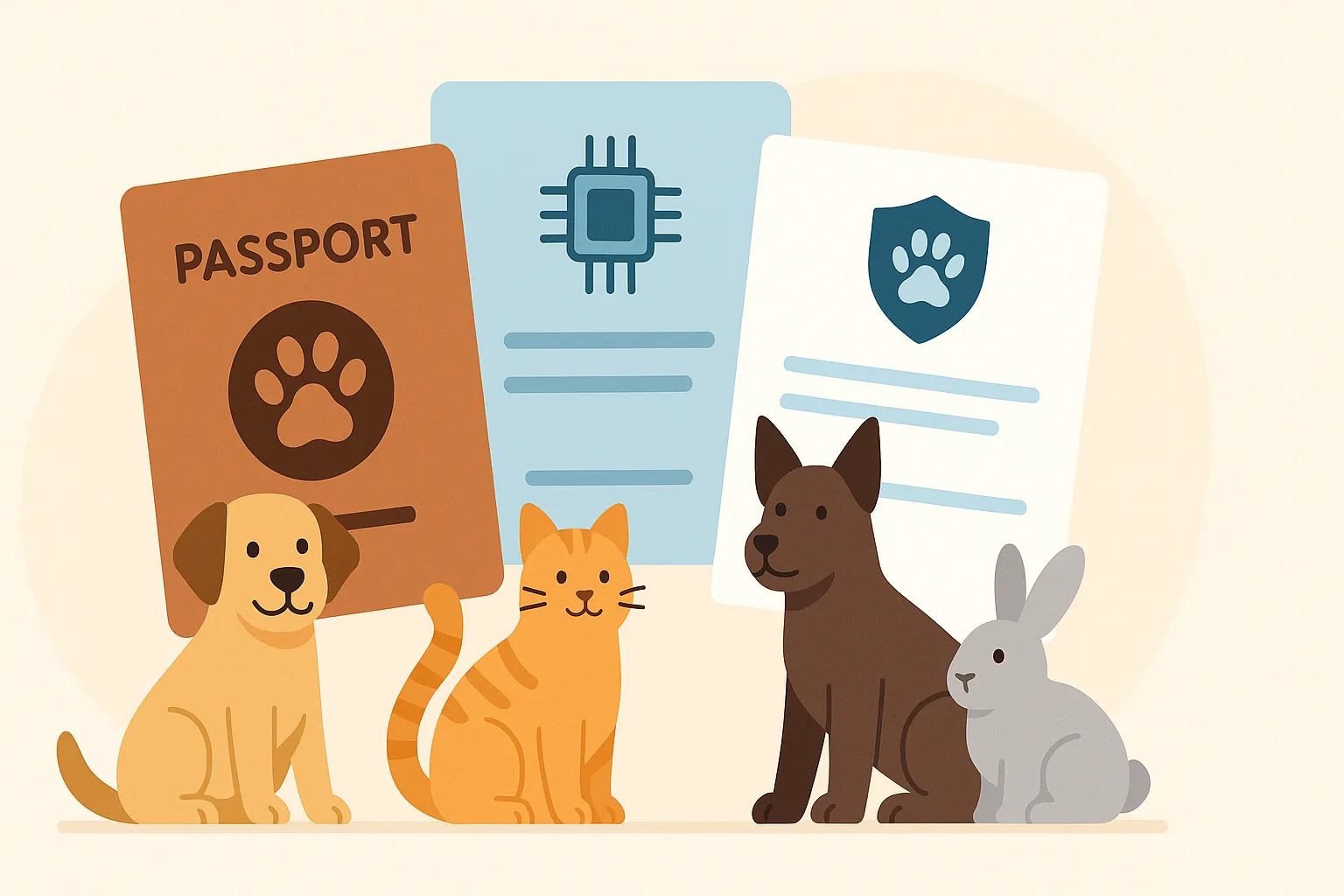
Organizing your pet’s documents (whether dog or cat) is one of those things we all know we should do… but often put off. Passport, microchip, insurance, vaccinations, medical reports, vet invoices: everything ends up in a generic folder or, worse, scattered across drawers and emails.
The problem usually shows up at the worst possible moment:
- you’re about to leave and can’t find the European pet passport;
- the vet asks for the microchip number and you don’t remember it;
- you need your dog’s insurance policy after an accident or damage claim;
- you’re asked which vaccinations they’ve had and you don’t have the health booklet with you.
In this practical guide, we’ll look at how to:
- understand which documents are truly required for dogs and cats;
- set up a simple, reliable system so nothing gets lost;
- prepare a “ready-to-go” travel kit with pet passport and insurance;
- use digital tools (like the PawsPet app) to keep everything always on your smartphone.
1. Which documents are required for dogs and cats?
Let’s start with the basics: before thinking about organization, you need to be sure you have all the documents required by law or strongly recommended for your pet’s safety.
1.1 Required dog documents
For dogs in Italy, the essential documents are:
-
Regional Canine Registry enrollment
- Required by law.
- Usually done by the veterinarian when the microchip is implanted.
- It establishes the legal link between you (owner/keeper) and the dog.
-
Microchip
- A small subcutaneous electronic device with a unique number.
- Mandatory in Italy for all dogs.
- It connects the dog to the Canine Registry and helps identify you if the dog goes missing.
- The microchip number appears:
- on the registry enrollment certificate;
- in the health booklet;
- often on vet invoices.
-
Health booklet / medical record
- Not required “by law” like registry enrollment, but essential in practice.
- It contains:
- the dog’s and owner’s personal details;
- vaccinations (including rabies, if applicable);
- parasite prevention treatments;
- checkups and therapies.
For some breeds or dogs considered potentially more demanding, a:
- Dog liability insurance
- Covers possible damage to people or property caused by the dog, within policy limits.
- Some policies also include legal protection and veterinary reimbursement.
1.2 Required cat documents
For cats, the rules vary by region, but in general:
-
Cat microchip
- Not mandatory everywhere as it is for dogs, but highly recommended, especially:
- for cats that go outdoors or live in a garden;
- for cats that travel with you;
- in case of adoption through reputable associations (they often require it).
- When implanted, the microchip is registered in the registry (often the same or integrated with the canine registry, depending on the region).
- Not mandatory everywhere as it is for dogs, but highly recommended, especially:
-
Health booklet / medical chart
- Managed by the veterinarian.
- It contains vaccinations (e.g., trivalent, FeLV), treatments, tests, and procedures.
Cats can also be covered by:
- Pet insurance (dog/cat)
- Not mandatory, but useful for people living in apartment buildings, traveling, or worried about unexpected expenses.
1.3 When do you need a European pet passport?
The European pet passport is required when you travel with a dog or cat:
- within the European Union;
- to some non-EU countries that accept it as a reference document.
The European pet passport includes:
- owner details;
- dog/cat details;
- microchip number and implantation date;
- vaccinations, especially:
- rabies vaccination (required for international travel);
- parasite treatments required by some countries (e.g., tapeworm treatment for the UK, Northern Ireland, Malta, etc. — always check the latest rules).
2. The most common mistake: documents everywhere (and nowhere when you need them)
Many pet owners end up in this situation:
- a folder at home with health booklets, certificates, and reports;
- photos and PDFs of exams and insurance documents scattered across WhatsApp, email, and phone folders;
- paper documents in the car (maybe a printed policy or a photocopy of the passport);
- nothing truly centralized.
The result:
- stress every time you need to find information;
- risk of not having the documents exactly when you need them (travel checks, veterinary emergency, missing pet report);
- wasted time calling around or requesting copies from the vet or insurer.
The goal of this guide is to take you from this scattered chaos to a system that is simple, repeatable, and long-lasting.
3. Step 1: gather and list all your pet’s documents
First, make a full inventory of your dog’s or cat’s documents. Set aside 30 minutes and collect everything you can find.
3.1 Basic document checklist
For each pet in the house, look for:
- Health booklet (or veterinary folder)
- Registry enrollment certificate (dog, or cat if applicable)
- Microchip number (in the booklet or on a dedicated certificate)
- European pet passport (if you’ve requested one)
- Insurance policy:
- policy number;
- insurance company;
- expiry date;
- main terms (coverage limits, deductibles).
You can also add, if available:
- Important reports (blood work, interpreted X-rays, ultrasounds, cardiology exams)
- Specialist certificates (e.g., hip dysplasia exemption certification, genetic conditions, FIV/FeLV tests for cats)
- Adoption documents:
- adoption contract from an association;
- pedigree (if purebred dog/cat);
- transfer documents (if from a breeder).
- Important contacts:
- primary veterinarian;
- 24/7 emergency clinic;
- insurance company (claims line);
- optionally trainer, pet sitter, boarding facility.
3.2 If something is missing: how to recover it
-
Lost health booklet:
- Contact your veterinarian: they can reconstruct much of the medical history through the clinic’s records and issue a new booklet or a summary file.
-
Registry certificate / microchip number unknown:
- Contact the local veterinary health authority or the veterinarian who implanted the microchip: they can retrieve the number using your tax ID and the pet’s details.
-
Lost pet passport:
- Notify the veterinarian authorized to issue passports and the local health authority; a new document will be issued following the required procedure, which may vary by region.
-
Insurance policy can’t be found:
- Search your emails using the insurer’s name or keywords like “dog policy” or “pet insurance.”
- Alternatively, call the insurance company directly with your tax ID.
4. Step 2: how to organize paper documents
Once everything is collected, move on to physical organization.
4.1 Create a folder for each pet
The simplest and most effective method is to prepare:
- 1 folder (or binder) for each pet, clearly labeled with:
- pet name;
- species (dog/cat);
- optionally a photo on the cover (helpful for anyone opening the drawer).
Inside, organize by section:
-
Identification & registry
- copy of registry certificate;
- microchip details;
- adoption contract, if applicable.
-
Vaccinations and treatments
- health booklet;
- cards with major vaccines and dates;
- important parasite prevention treatments (you can note month/type).
-
Reports and specialist visits
- blood tests;
- imaging (ultrasounds, reported X-rays);
- specialist reports.
-
Insurance & legal documents
- copy of dog/cat liability insurance;
- any documents related to claims already opened;
- other special documents (e.g., certificates for working dogs, pet therapy, etc.).
-
Travel
- European pet passport;
- any health certificates required for non-EU travel.
4.2 Where to keep your pet’s documents
A few practical tips:
- Keep the folders in a fixed, easy-to-find place (e.g., the family document drawer).
- Avoid spreading things around:
- some in the entryway;
- some in the bedroom;
- some in the kitchen.
Choose one spot and keep it consistent, including for other family members.
5. Step 3: digitize everything (and why it pays off)
Paper documents alone are not enough. In case of:
- travel;
- your dog/cat going missing;
- a veterinary emergency;
- theft or loss of physical documents,
having digital copies can make all the difference.
5.1 What you should digitize
For each pet, take a photo or scan of:
- front/back of the health booklet;
- registry enrollment certificate with the microchip number clearly legible;
- European pet passport (all important pages: details, microchip, vaccinations, rabies);
- complete insurance policy (not just the first page);
- important reports, especially those that may be needed urgently:
- cardiology exams;
- exams related to epilepsy, allergies, chronic conditions;
- reports listing medications to avoid.
5.2 How to save everything neatly
Common mistakes:
- countless photos in the camera roll with no names;
- PDFs scattered across different folders;
- no backup.
Try following a simple structure:
- Create one folder per pet, for example:
DOG_LUNACAT_MILO
Inside, create subfolders:
01_Identification02_Vaccinations03_Reports04_Insurance05_Travel
And rename files with a consistent format, for example:
Luna_microchip_registry_2023.pdfLuna_EU_passport_2024.jpgLuna_rabies_vaccine_2024.jpgLuna_RC_policy_2025.pdf
6. Step 4: keep everything in your pocket with a dedicated app
A physical folder and a digital folder are a great start, but when you’re:
- at the park;
- traveling;
- at the vet;
- in an emergency clinic,
you don’t always have a computer and you don’t always have time to dig through dozens of files.
That’s where a pet care app like PawsPet comes in.
6.1 How PawsPet can help with documents
With one app, you can:
- create an individual profile for each pet:
- name, species, breed, date of birth;
- microchip number;
- owner contact details;
- upload photos or PDFs of:
- health booklet;
- European pet passport;
- important reports;
- insurance policy;
- keep track of:
- vaccinations;
- parasite prevention treatments;
- visits and procedures.
That way:
- if the vet asks for the latest rabies vaccine or the last ultrasound, you have it at your fingertips;
- if you need to show your dog’s insurance coverage, you can open the policy directly in the app;
- in case of loss, you can immediately show the microchip number and your contact details.
6.2 Reminders and deadlines you’ll never forget again
Many document problems come from forgotten deadlines:
- rabies vaccine expired just before a trip;
- dog insurance not renewed;
- booster shots delayed.
An app like PawsPet lets you:
- set automatic reminders for:
- vaccine due dates;
- insurance renewal;
- periodic checkups;
- receive notifications early enough to:
- book the vet appointment;
- renew the policy on time;
- update the pet passport.
7. Documents and travel: how to prepare your “mobility kit”
If you travel often with your dog or cat — by car, train, plane, or abroad — it’s worth preparing a proper travel document kit.
7.1 What you need for travel within Italy
Within the country, checks are less frequent, but it’s still wise to have:
- health booklet (original or copy);
- microchip number and identification details;
- any insurance document (liability insurance) if you stay in pet-friendly accommodations or campsites;
- documentation for any chronic conditions (e.g., heart disease), useful at a 24/7 clinic.
You can:
- keep a small folder in the car;
- store digital copies in PawsPet or in your cloud, easy to access.
7.2 What you need to travel in Europe (European pet passport)
To travel within the EU with a dog or cat, you generally need:
-
European pet passport:
- issued by authorized veterinarians;
- with complete identification details;
- showing a valid rabies vaccination.
-
Proper microchip:
- compliant with ISO standards;
- implanted before the rabies vaccine or, if after, respecting the required waiting period (your vet will explain the details).
-
Valid rabies vaccination:
- the first vaccination is only valid after a certain number of days (usually 21, but this must be verified);
- boosters given on time maintain continuity.
Some countries require:
- certified parasite treatments within a certain period before travel;
- additional health certificates.
7.3 Travel checklist with a pet
A quick reminder:
- European pet passport (if traveling abroad)
- Valid rabies vaccine (check dates and boosters)
- Microchip number and registry certificate
- Active dog/cat liability insurance (check travel coverage limits)
- Vet/emergency clinic contacts in the destination area
- Digital copies of all documents uploaded to an app (e.g., PawsPet)
8. Dog/cat insurance: why it should be linked to health documents
Many owners take out dog insurance or a dog/cat policy but then:
- forget where they saved it;
- don’t remember the expiry date;
- don’t know which veterinary expenses are actually covered.
Integrating the policy into your document system helps you:
- know right away what to do in case of an accident or claim;
- avoid wasting time when you need to open a claim.
8.1 What to always keep handy for the policy
For each dog/cat insurance policy:
- policy number;
- insurer and claims contact (phone/email);
- annual expiry date;
- main coverages:
- third-party liability;
- legal protection;
- veterinary expense reimbursement (if included);
- deductibles and main exclusions.
You can note a short summary in:
- a paper sheet inside the physical folder;
- a note in PawsPet linked to your pet’s profile;
- the “notes” field in the digital folder.
8.2 Linking reports and insurance
If your policy includes veterinary expense reimbursement:
- keep and digitize:
- vet invoices;
- treatment reports;
- any quotes and insurer authorizations.
Organizing them by date and type of procedure will make it easier to:
- send them when requesting reimbursement;
- prove the treatments carried out, if needed.
9. How to maintain the system over time (without losing your mind)
Organizing your dog’s/cat’s documents is a one-time investment, but it must be maintained over time with a bit of discipline.
9.1 A simple routine after every visit
After every vet visit or exam, create a small ritual:
- You get home.
- Immediately place the health booklet and any reports in the correct physical folder.
- Take a clear photo of the reports and upload it:
- to the digital folder;
- or directly into PawsPet (your pet’s profile).
Total: 5 minutes. But it saves you hours of chaos later.
9.2 Updating critical information
Whenever one of these happens:
- changing vets;
- changing address or phone number;
- renewing or changing insurance;
- taking a new trip abroad;
remember to:
- update the identification details:
- with the registry (if required);
- in your digital system (folders + app);
- note the new dates and references (e.g., new policy expiry, new phone number).
With PawsPet, for example, you can update your pet’s profile and keep the essential details always in one place.
10. Practical example: a “zero panic” system in 7 steps
To sum up, here’s a mini action plan you can follow even if you have multiple pets.
- Gather
- Collect all the scattered documents for your dog(s) and cat(s).
- Sort
- Discard unnecessary duplicates and keep only:
- official documents;
- meaningful reports and certificates.
- Discard unnecessary duplicates and keep only:
- Dedicated folders
- Create one folder for each pet with clear sections.
- Digitize
- Scan or photograph:
- booklet;
- passport;
- policy;
- important reports.
- Scan or photograph:
- Digital folder structure
- Organize by pet + subfolders (Identification, Vaccinations, Reports, Insurance, Travel).
- Set up the app (e.g., PawsPet)
- Create the pet profile;
- enter microchip and identification details;
- upload key documents;
- set reminders for vaccinations and insurance.
- Post-visit routine
- update physical folder + digital copy + app.
After this initial setup, day-to-day management becomes much easier.
11. Conclusion: less paper, less stress, more safety for your pet
Keeping order among pet documents, passport, microchip, insurance, and reports is not just about being precise: it’s a concrete form of care and responsibility toward your dog or cat.
With a clear system:
- you avoid fines or missed trips due to missing documents;
- you can answer quickly when vets, clinics, or accommodations ask for information;
- you’re better prepared in case of an emergency or a missing pet.
By combining:
- physical folders at home;
- organized digital folders;
- and smart support like the PawsPet app to always keep:
- microchip;
- passport;
- vaccinations;
- insurance;
in your pocket, you turn possible chaos into a simple, controlled workflow.
If you want to take the next step:
- try creating your pet’s profile on PawsPet right away;
- upload the main documents;
- set your first reminders (vaccinations, parasite prevention, insurance).
Before long, keeping your pet’s documents in order will become the new normal, and you can focus on what really matters: living well with your dog or cat.
FAQ on dog and cat documents
What are the required dog documents in Italy?
In Italy, the mandatory documents for dogs are:
- microchip;
- registration in the regional Canine Registry;
- registration of ownership change or loss, if it happens.
The health booklet is not formally “required by law,” but it is essential in practice, especially to prove vaccinations and treatments. The European pet passport is only mandatory for travel abroad.
What documents are needed for a cat?
For cats, the health booklet is essential. The microchip and registry enrollment are not mandatory everywhere, but they are strongly recommended, especially for cats that go outdoors or travel. For travel to other countries, you often need a microchip, rabies vaccine, and, if required, a passport or specific health certificates: always check with your veterinarian and the destination country’s updated rules.
How do I find my dog’s or cat’s microchip number?
You can usually find the microchip number:
- in the health booklet;
- on the registry enrollment certificate;
- on the European pet passport, if you have one.
If you can’t find it, you can:
- ask your veterinarian to read it with a microchip scanner;
- contact the local veterinary authority or regional registry with your details.
Then save it securely (folder, digital folder, app like PawsPet).
Is the European pet passport mandatory in Italy too?
No. The European pet passport is not required for moving around within Italy. It becomes necessary when you travel with your dog or cat within the European Union (and in some other countries that accept it), together with a microchip and a valid rabies vaccination. For everyday use in Italy, microchip, registry enrollment, and the health booklet are enough.