
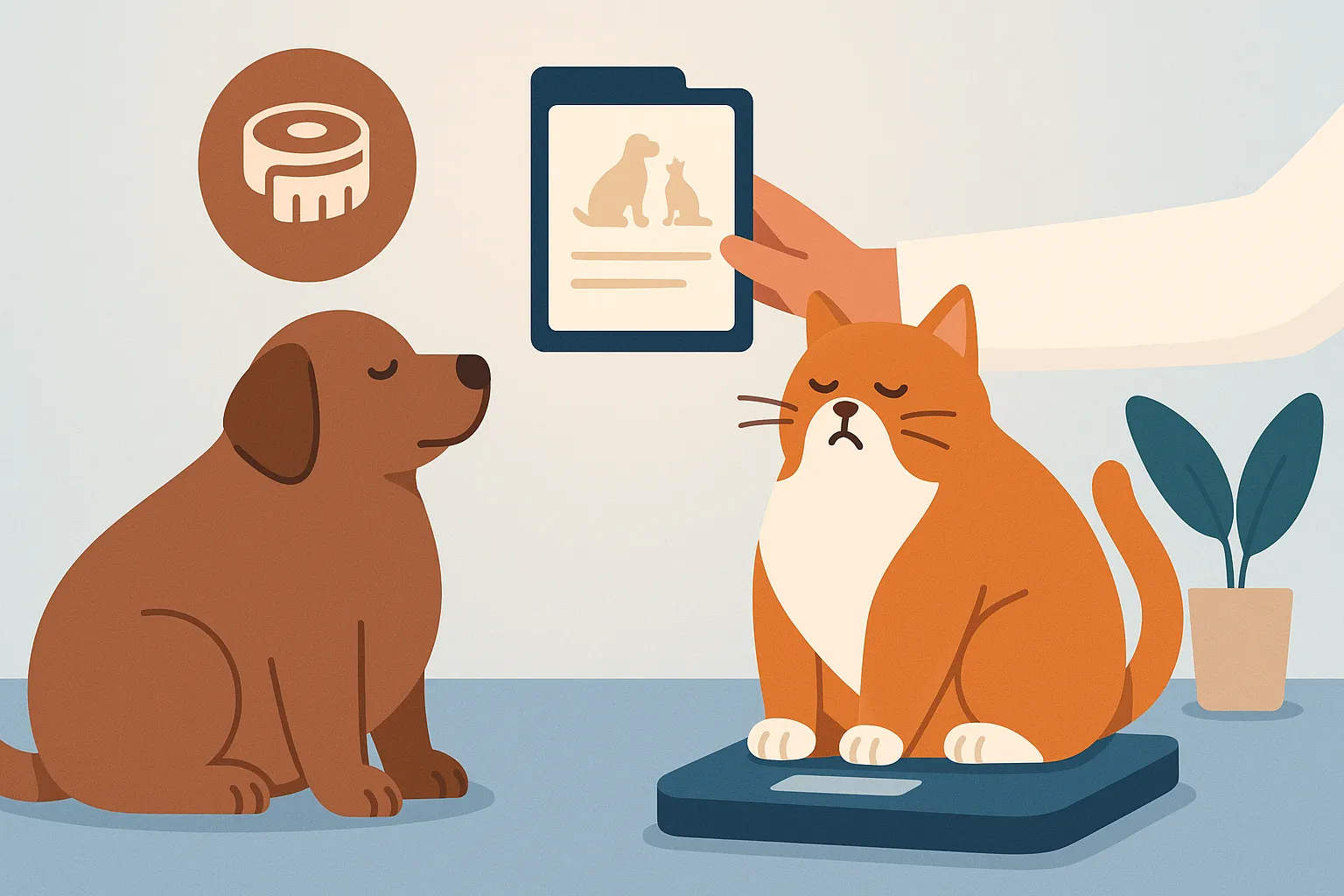
Obesity in dogs and cats is much more common than we think: in some cities, more than 1 in 3 pets is estimated to be overweight. Maybe you’re wondering too:
- “Is my dog just a bit sturdy, or truly overweight: what should I do?”
- “My cat is lazy, sleeps a lot, and keeps gaining weight: how can I help them lose weight without stressing them out?”
- “What is the ideal weight for dogs and cats, and how can I maintain it over time?”
In this article, we’ll look at:
- how to tell, in practical terms, whether a dog or cat is overweight;
- what health risks obesity brings;
- how to set up a safe weight-loss plan (diet, exercise, monitoring);
- how to use digital tools like the PawsPet app to keep everything under control.
1. Obesity in dogs and cats: why it’s not just “a few extra pounds”
In dogs and cats, obesity is not just a cosmetic issue: it is a real medical condition that increases the risk of many other diseases.
1.1 When do we talk about overweight, and when about obesity?
In simple terms:
- Overweight: body weight about 10–20% above ideal weight.
- Obesity: body weight more than 20% above ideal weight.
We don’t always know our pet’s exact “ideal weight” (it depends on breed, body structure, age). That’s why, in addition to the scale, veterinarians use the BCS – Body Condition Score, a visual/tactile scale from 1 to 9.
- 1–3: too thin
- 4–5: ideal
- 6–9: overweight/obese
Later on, we’ll see how to use a practical version of BCS at home too.
1.2 Why do dogs and cats tend to gain weight?
The most common causes are:
- Too many calories compared with what they burn.
- Too many treats, table scraps, and between-meal snacks.
- Too little physical activity (especially in apartment dogs or indoor cats).
- Spaying/neutering: it changes metabolism, so the diet needs adjusting.
- Age: with aging, metabolism slows down.
- Some medications or hormonal conditions (hypothyroidism, Cushing’s syndrome, etc.).
If your dog or cat gains weight without any obvious change in diet or habits, a vet visit with basic tests is essential.
2. How to tell if a dog is overweight: a practical guide
Many owners notice the problem too late, because weight gain is a slow, everyday process. Here’s a checklist to help answer the question: “My dog is overweight, what should I do to know for sure?”
2.1 Rib and waist test
Try this simple test:
- Stand your dog up, relaxed.
- With your fingertips, place your hands on the sides of the chest (behind the front legs).
- Apply light pressure, as if you were gently petting them.
-
In a dog at a healthy weight:
- the ribs are easy to feel but not too visible;
- the waist is slightly tucked in when viewed from above;
- from the side, there is a slight abdominal tuck rising toward the back legs.
-
In an overweight dog:
- the ribs are hard to feel because of fat;
- the waist is barely visible or absent from above;
- the side profile is almost straight or even pot-bellied.
-
In an obese dog:
- you can hardly feel the ribs at all;
- there is a pendulous belly;
- fat deposits are often visible on the neck and at the base of the tail.
2.2 Other signs of an overweight dog
Watch for whether your dog:
- gets tired quickly during walks;
- pants a lot after minimal effort;
- avoids stairs or jumping onto the sofa;
- snores often;
- has trouble grooming themselves (for long-haired dogs).
If you notice more than 2–3 of these signs, booking a veterinary checkup is the first step.
3. How to tell if a cat is overweight: often “hidden” signs
An overweight cat is even harder to spot: fur hides a lot, and many cats are not handled much, especially if they don’t like being picked up.
3.1 Tactile and visual assessment of the cat
Use the same principle as for dogs, with a few adjustments:
- Gently run your fingers along the sides of the chest.
- Healthy-weight cat: you can feel the ribs, covered by a thin layer of fat.
- Overweight/obese cat: the ribs are “hidden,” and you have to press to feel them.
- Look at the cat from above:
- Ideal weight: you see a slight waist after the ribs.
- Overweight: the side profile looks more rectangular.
- Look at the cat from the side:
- If the belly forms a clear hanging pouch (a “belly apron”), it’s very likely they are overweight.
Note: a small abdominal pouch can be normal in some adult cats; the issue is when it is very pronounced and accompanied by an overall increase in size.
3.2 Habits that suggest an overweight cat
Ask yourself:
- Does the cat play little, move little, and sleep almost all day?
- Do they struggle to jump onto counters, tall cat trees, or windowsills?
- Do they have trouble grooming the back end or under the belly?
- Do you hear breathing noises during sleep or after a short play session?
If you’re wondering “my cat is overweight, how do I help them lose weight without stressing them?”, the first step is recognizing these early signs.
4. Health risks of obesity in dogs and cats
Understanding the ideal weight for dogs and cats is not just about looks, but about protecting their long-term health.
Here are some documented consequences of obesity:
- Arthritis and orthopedic problems
- Extra strain on joints, hips, knees, and spine.
- Cardiovascular and respiratory disease
- Greater effort for the heart and lungs, breathing difficulties.
- Diabetes mellitus
- Especially in obese cats.
- Liver and metabolic diseases
- Fatty liver (hepatic lipidosis), lipid disorders.
- Reduced life expectancy
- Studies indicate that an obese dog may live up to 2 years less than a dog at a healthy weight.
- Lower quality of life
- Less movement, less desire to play, more chronic pain.
That’s why acting early, when your companion is only “a little rounder,” is the best strategy.
5. Ideal weight for dogs and cats: how to estimate it properly
There is no one-size-fits-all number: two dogs of the same breed can have different builds. Still, you can get a good idea with a few practical steps.
5.1 How to estimate a dog’s ideal weight
- Ask your veterinarian:
- The medical record often includes the estimated “optimal weight” from the visit.
- If you have a purebred dog:
- Check breed weight charts by breed/sex/age (use only as a reference).
- If you have a weight history:
- Look back to the stable adult phase (between 2 and 6 years old) and see what the “average” weight was when the dog was fit.
- Match the number of kilos to the BCS:
- Example: a dog weighed 20 kg with a perfect BCS; today they weigh 24 kg with a BCS of 7/9 → ideal weight is around 20 kg.
5.2 How to estimate a cat’s ideal weight
For cats, the focus is often more on BCS than on kilos:
- Average adult domestic cat:
- indicative ideal weight between 3.5 and 5 kg, but it can vary a lot.
- To determine ideal weight:
- with the vet’s help, define a range based on bone structure and muscle mass (e.g. 4–4.5 kg).
6. Overweight dog: what to do in practice (weight-loss plan)
Let’s get practical: how do you help a dog lose weight safely?
6.1 Step 1 – Veterinary visit and personalized plan
Before starting:
- General checkup + any necessary blood tests:
- to rule out hormonal issues or other conditions that cause weight gain.
- BCS evaluation and target weight estimate.
- Discussion about:
- current diet type (kibble, wet food, homemade);
- habits, meal times, physical activity.
The vet may suggest:
- a light or weight-loss-specific diet food;
- or a balanced homemade plan (with nutritionist support only).
6.2 Step 2 – Weight-loss diet for dogs
Some general rules (always to be adjusted with your vet):
- Portion calculation: based on ideal weight, not current weight.
- Gradual calorie reduction:
- usually between 15% and 30% fewer calories than maintenance.
- Split meals:
- 2–3 meals a day help control hunger.
- No table scraps:
- no leftovers, bread, cheese, or cured meats.
And what about treats?
- Use:
- part of the daily kibble ration as training rewards;
- specific low-calorie treats;
- small pieces of allowed vegetables (e.g. carrot, boiled zucchini — always ask your vet first).
6.3 Step 3 – Physical activity for an overweight dog
Exercise is part of the “therapy,” but it should be increased sensibly.
- At first:
- more frequent but shorter walks (e.g. 3 x 15–20 minutes a day);
- flat ground, no intense running;
- avoid high-impact activities (jumps, long stair climbs) if the dog is very heavy.
- After a few weeks:
- extend some walks by 5–10 minutes;
- add controlled play sessions (ball games, scent work, problem-solving toys).
If the dog has joint issues, ask the veterinarian whether these are appropriate:
- controlled swimming;
- underwater treadmill (hydrotherapy).
7. Overweight cat: how to help them lose weight without stress
“My cat is overweight: how do I make them lose weight without making them hungry or stressed?”
The strategy here is different from a dog’s, because:
- cats hate drastic and sudden food reductions;
- prolonged fasting in an obese cat can cause serious problems (e.g. hepatic lipidosis).
7.1 Weight-loss diet for cats: guidelines
With the help of your vet:
- Choose an appropriate food:
- often weight management kibble or wet food formulated for obese cats.
- Calculate portions based on ideal weight:
- slow, gradual calorie reduction to avoid fasting.
- Split meals:
- 3–4 small meals are better than one or two large ones.
- No free feeding:
- especially for cats that don’t self-regulate.
For cats that ask for food often:
- use interactive bowls or puzzle feeders;
- divide the ration into micro-meals throughout the day.
7.2 Increasing activity for indoor cats
Movement is essential, but it should feel like play:
- Recommended toys:
- feather wands or string toys;
- light balls, stuffed mice;
- hunting games (hide diet treats in different spots).
- Environment:
- create vertical routes (shelves, multi-level cat trees);
- rotate toys to keep interest high.
Goal: at least 15–20 minutes of active play a day, split into sessions (e.g. 3 sessions of 5–7 minutes).
8. Tracking weight loss: weigh-ins, timing, and realistic goals
An effective weight-loss diet for dogs and cats is not a crash diet, but a process.
8.1 How fast should they lose weight?
General guidance (always to be adjusted with your vet):
- Dog:
- weight loss around 1–2% of body weight per week.
- Cat:
- more cautious loss: 0.5–1% of body weight per week.
Examples:
- 30 kg dog:
- 1% = 0.3 kg per week → about 1.2 kg per month.
- 6 kg cat:
- 0.5% = 30 g per week → about 120 g per month.
If weight loss is too fast or too slow, the ration should be adjusted with the vet.
8.2 How to weigh dogs and cats reliably
- Small/medium dog:
- pick up the dog and step on the scale, then subtract your own weight.
- Large dog:
- use the clinic or pet store scale (many allow this for free).
- Cat:
- you can use the same method as for a small dog;
- or use a baby scale or kitchen scale for kittens and very small cats.
Recommended frequency:
- every 2 weeks during the active weight-loss phase;
- once a month during maintenance.
9. Tools and routines to maintain ideal weight long term
Losing weight is only half the journey: the real challenge is not gaining it back.
9.1 Daily habits that help maintain weight
- Always weigh meals, never estimate by eye.
- Exercise routine:
- dog: daily walks and structured play;
- cat: scheduled active play sessions.
- Snack control:
- keep a dedicated container; when it’s empty, no more snacks that day.
- Watch the “helpers” in the house:
- everyone in the family should know that no leftovers or double portions are allowed.
9.2 How PawsPet can help you manage weight
Adding a simple app can make everything easier and more consistent. With PawsPet you can:
- create your dog or cat’s profile with ideal weight, age, and any health conditions;
- record food type and note diet changes;
- set reminders for:
- periodic weigh-ins;
- buying diet food;
- follow-up veterinary visits;
- keep a complete history of weight, activity, and health, so you can quickly spot any trend toward gaining again.
10. Practical checklist: what can I do starting tomorrow?
10.1 If you suspect your dog is overweight
- Check ribs, waist, and belly by sight and touch.
- Weigh your dog today and write the number down.
- Book a veterinary checkup.
- Bring the food bag and note exactly how much they eat.
- Ask the vet:
- Estimated ideal weight.
- Suggested daily amount.
- Best food type.
- Start cutting back on extra treats and slightly increase walks.
10.2 If you suspect your cat is overweight
- Assess the ribs and abdomen by touch.
- Weigh your cat if possible.
- Talk to your vet about possible weight-management food.
- Set up 2–3 play sessions a day.
- Remove high-calorie snacks or reduce them drastically.
- Split meals into several small portions.
Conclusion: helping dogs and cats stay at their ideal weight
Knowing whether your dog or cat is overweight is the first step to protecting them from many diseases and giving them more active, peaceful years of life. It’s not about forcing them to give things up, but about:
- learning how to assess your pet’s body condition;
- defining the ideal weight with your veterinarian;
- setting up a balanced weight-loss diet without drastic changes;
- always pairing it with exercise and play suited to age and health.
If you think your pet has a few extra pounds, acting today is the best gift you can give them.
To make the process easier and more organized, you can try the PawsPet app: you’ll always have weight, diet, activity, and vet visits in one place, helping your dog or cat reach their healthy weight and maintain it over time.
FAQ on obesity in dogs and cats
How can I tell if my dog is overweight?
Feel the ribs: they should be easy to feel under your fingers but not overly visible. Look at your dog from above: they should have a defined waist and, from the side, a slight abdominal tuck. If the ribs are hard to find, the waist isn’t visible, and the belly is round, the dog is probably overweight. Always confirm with a veterinary checkup.
My dog is overweight: what should I do to help them lose weight safely?
You need a plan agreed with your vet that includes:
- a specific diet (light or diet food, with portions calculated from ideal weight);
- gradual calorie reduction;
- a progressive increase in walks and physical activity;
- regular weigh-ins every 2 weeks.
Avoid cutting food “at random” or too quickly.
My cat is overweight: how can I help them lose weight safely?
Cats should lose weight slowly. Your vet may recommend a “weight management” food and a moderate calorie reduction. It is important to:
- never let the cat fast;
- divide food into several small meals;
- encourage movement with hunting games and environmental enrichment;
- monitor weight once a month.
What is the best weight-loss diet for dogs and cats?
There is no single diet that works for everyone: it depends on age, health status, any medical conditions, and food preferences. In general, people use:
- commercial foods specifically for weight loss/weight management;
- or balanced homemade diets formulated by a veterinary nutritionist.
The most important thing is that the plan is personalized and followed over time with veterinary checkups and weight monitoring, for example with the help of an app like PawsPet.


