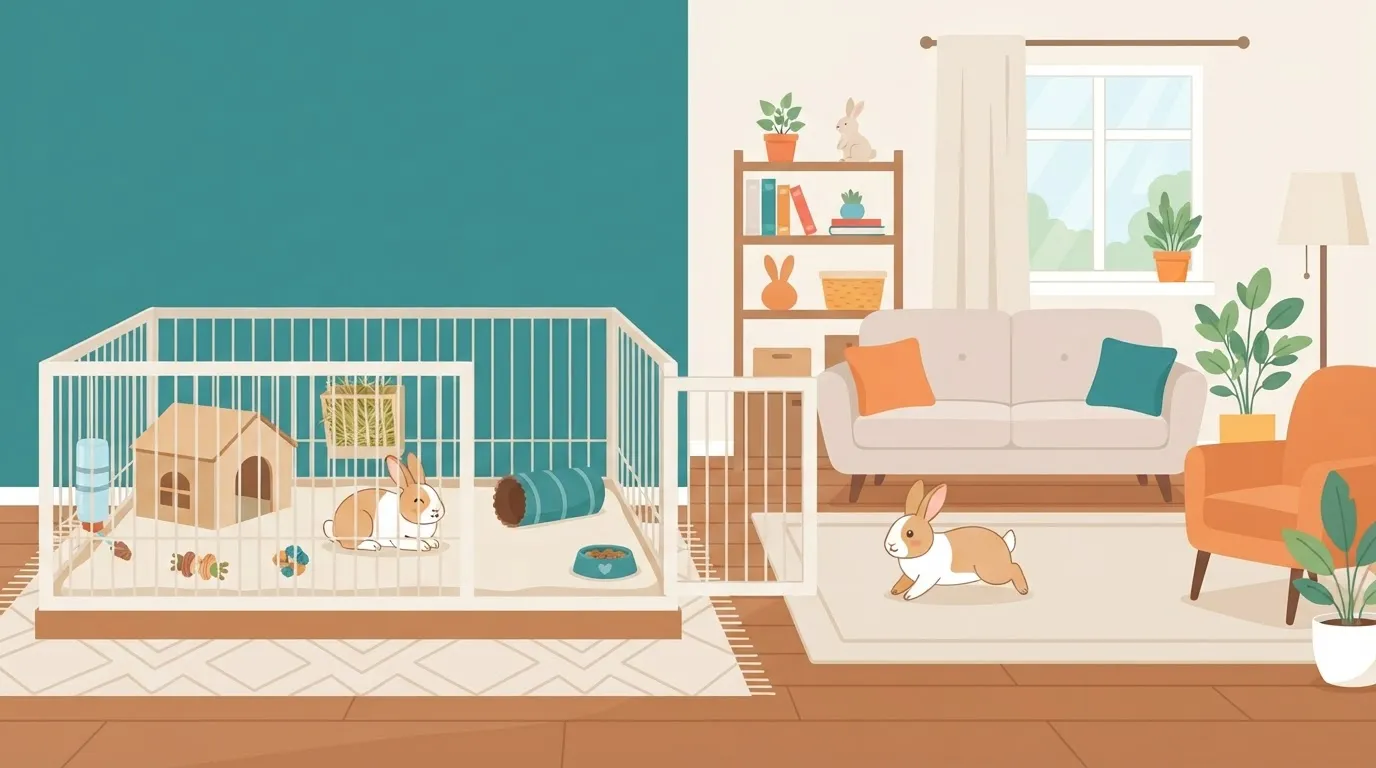
A rabbit allowed to roam freely indoors can experience the home in a richer, more natural way, but clear boundaries and suitable protections are essential. Choosing between an indoor rabbit exercise pen and a dedicated room depends on your home, your family’s routines, and your rabbit’s temperament.
The best solution is not necessarily the largest one: it is the one that is safe, easy to clean, and able to provide movement, rest, and daily activities without unnecessary risks.
Indoor rabbit exercise pen: when it is the most practical choice
An exercise pen is often a good starting point, especially during the first stages of living together, while your rabbit is settling in, or whenever you cannot supervise them. It should not be treated as a space where the rabbit remains confined for most of the day: rabbits need regular opportunities to explore, run, and move around.
An exercise pen can be useful if:
- your rabbit has just arrived and needs to become familiar with household noises, people, and routines;
- other animals live in the home and introductions need to happen gradually;
- you need to limit access to cables, delicate furniture, or stairs;
- you want to make it easier to organize hay, litter, and bowls.
Choose stable panels that are high enough to prevent jumping or climbing, and check that there are no openings where the rabbit’s head or paws could become trapped. The floor should not be slippery: washable rugs, suitable mats, or nonslip surfaces can help your rabbit move more safely.
Leave open floor space inside the pen rather than filling it with accessories. A hiding house, hay available at all times, water, a litter box, and a few suitable items to chew are more useful than an overcrowded environment.
Dedicated rabbit room: more freedom, more preparation
A dedicated rabbit room can be ideal if you have a quiet space and can make it safe for exploration. It offers greater freedom of movement and allows you to create separate areas for eating, resting, using the litter box, and activities.
Before giving your rabbit access, look at the room from their perspective: anything low, protruding, or suitable for chewing could attract them. Rabbit-proofing your home requires particular attention to electrical cables, plants, fabrics, and furniture.
Secure the following:
- Cables and outlets: gather wires in sturdy cable covers and limit access to power strips, chargers, and extension cords.
- Plants and household products: move ornamental plants, cleaning products, medicines, and air fresheners somewhere inaccessible.
- Furniture and baseboards: protect chair legs, corners, baseboards, and surfaces your rabbit might chew.
- Windows, balconies, and doors: use reliable latches and check for gaps through which your rabbit could escape or fall.
- Textiles: avoid rugs with long threads, exposed stuffing, or objects that could be swallowed.
A dedicated room does not remove the need for supervision. Even in a prepared environment, observe your rabbit during the first few weeks to understand which objects they seek out and which behaviors require adjustments.
How to organize rabbit spaces at home
Whether your rabbit lives in an exercise pen or a dedicated room, they benefit from a predictable routine and clearly defined areas. Arranging the different elements also helps you maintain cleanliness and order.
You can organize the space as follows:
- Litter and hay area: place the hay next to or above the litter box, as many rabbits eat while using it.
- Resting area: add a shelter with at least two entrances, so your rabbit does not feel trapped.
- Activity area: leave a clear stretch for short bursts of running and add tunnels, clean cardboard boxes, and suitable chew toys.
- Feeding area: keep water and food away from the litter box, in heavy containers that are difficult to tip over.
Avoid changing the layout frequently, especially during the first few days. If you need to move the pen or modify the room, do so gradually and keep at least the shelter and litter box in familiar positions.
Mistakes to avoid for a rabbit-proof home
Freedom without preparation can expose your rabbit to avoidable risks. Some common mistakes come from assuming that closing a door or placing a small cage in a corner is enough.
Pay attention to these points:
- leaving your rabbit on very smooth floors without nonslip areas;
- using an exercise pen that is too small as a permanent setup;
- underestimating your rabbit’s ability to jump, squeeze through gaps, or chew;
- allowing unsupervised access to rooms that have not been prepared;
- assuming that “natural” objects are safe without checking their materials, paints, or treatments.
If your rabbit stops eating, seems very lethargic, shows signs of pain, or displays unusual behavior, contact a veterinarian experienced with exotic pets promptly. Setting up the space is important, but it does not replace daily monitoring of your rabbit’s health.
FAQ
Is it better to let a rabbit roam freely indoors or use an exercise pen?
It depends on how safe the environment is and how much supervision is available. A large exercise pen can provide an organized, protected base, while free roaming in the home or a dedicated room should begin only after the main risks have been removed.
How large should an indoor rabbit exercise pen be?
It should allow your rabbit to move around, stretch out, and reach the litter box, hay, and shelter without obstacles. The more space available, the better: avoid setups that resemble a small cage.
Can a rabbit live with other household pets?
Living together requires caution, gradual introductions, and supervision. Even animals that seem calm can frighten or injure a rabbit; if you have concerns about their behavior, discuss the situation with a qualified professional.
Organizing your rabbit’s space means preventing risks and making everyday care easier. With PawsPet, you can keep reminders, health information, and veterinary appointments organized, helping environmental care fit more smoothly into your rabbit’s routine.